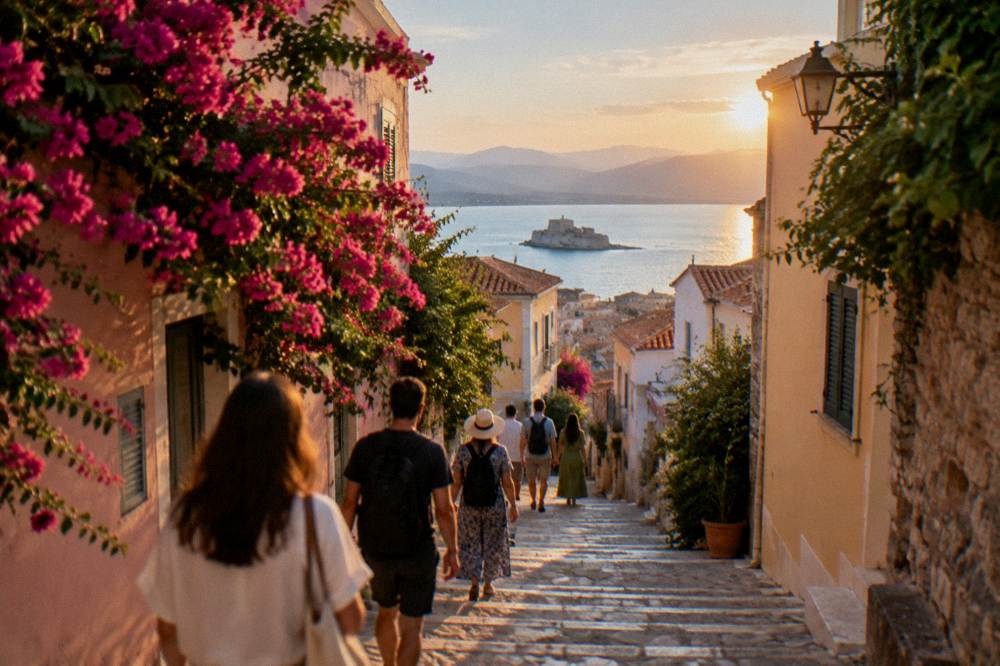
Palamidi Fortress: The Famous Steps Above The Old Town
Palamidi Fortress is the Baroque-era citadel that defines the skyline of Nafplio, a coastal town of about 14,500 residents in the Argolid, on the Peloponnese in southern Greece. This guide sets out what the Ministry of Culture's own listings say about tickets, hours and the famous stairway, and how to fit the climb into a visit.
Short answer
Palamidi Fortress stands 216 m above Nafplio's Old Town and costs 20 euro full, 10 euro reduced in 2026. The stairway from the town is usually counted at about 850 steps, not the legendary 999.
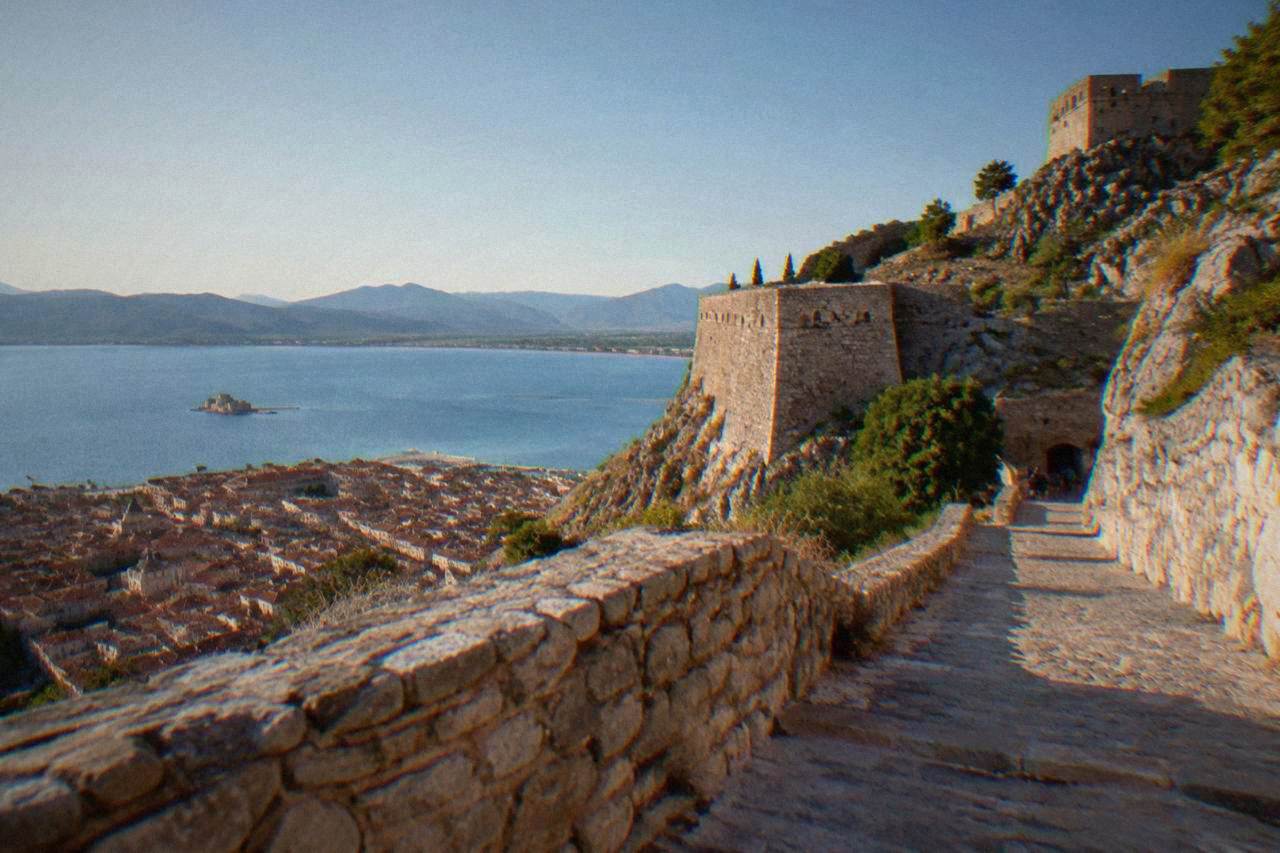
Palamidi Fortress is the great stone citadel that crowns the hill directly above Nafplio, the small coastal town on the Argolic Gulf that served as the capital of modern Greece from 1827 to 1834. The fortress stands 216 m above sea level, looking down on the Old Town, the harbour islet of Bourtzi and, on clear days, the whole sweep of the Argolic Gulf toward the day-trip destinations of Tolo and Asini. The Ministry of Culture's visiting page for the monument lists its 2026 admission at 20 euro full and 10 euro reduced, and its summer hours running to 20:00 from early May. The stairway that connects the town to the fortress is the thing everyone asks about first, and the honest answer is that it has about 850 steps, not the legendary 999 that older guides still repeat.
This page gathers what the primary sources actually say: the Ministry of Culture's own pages for tickets and hours, and the town's own guide pages for the stairway count. Around the fortress facts sits the practical planning detail, how the site fits a two-day stay, what the free-admission days are, and which paid experiences in town make a natural pairing with the climb. For the wider picture of the town itself, the Nafplio Travel Guide homepage collects the main sightseeing routes.
What Is Palamidi Fortress In Nafplio?
Palamidi Fortress is a Venetian-era fortress of linked bastions built on a 216 m hill directly above Nafplio's Old Town, fortified by the Venetians between 1686 and 1715 to plans by the engineers Giaxich and Lasalle, taken by the Ottomans in 1715 and liberated by the Greeks in 1822. It is the single most prominent monument in a town that was the first capital of modern Greece, and it is open to visitors year round under Ministry of Culture hours.
The fortress is a work of the second Venetian period, the decades between 1686 and 1715 when the Republic of Venice held the Peloponnese as the "Kingdom of Morea". The design is a chain of separate bastions joined by walls, laid out by the military engineers Giaxich and Lasalle, and built in the years before the Ottoman army swept back in 1715. Greek forces under Staikos Staikopoulos took the fortress in 1822, during the War of Independence, and the town below became the seat of the new Greek state five years later.
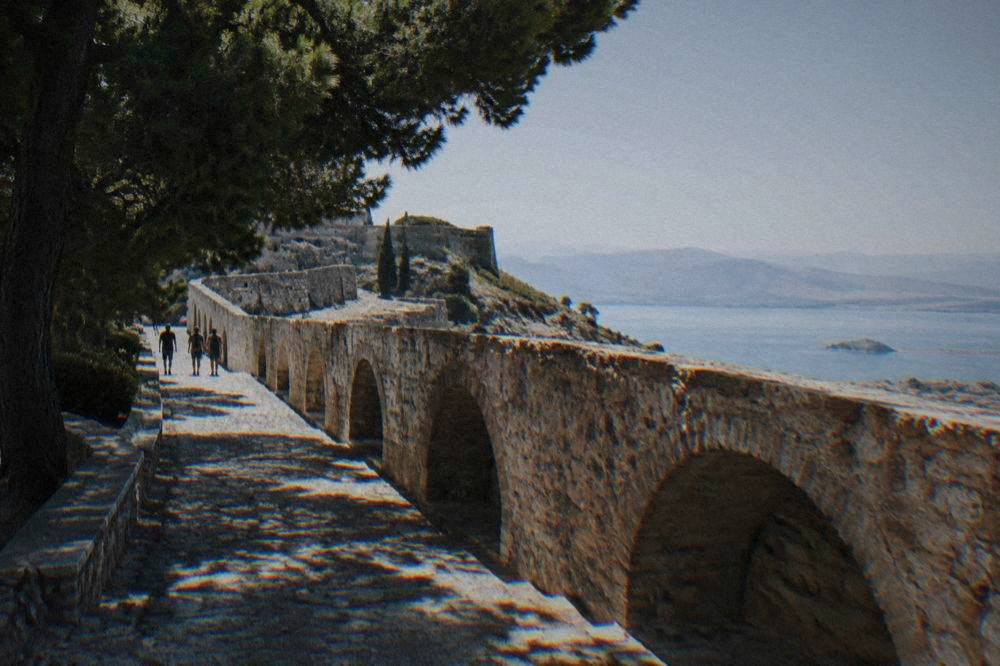
What makes the fortress unusual among Greek citadels is how close it sits to a living town. The stairway drops from the eastern bastions straight into the streets below, so a visitor can walk out of the Old Town and be inside the walls within the hour, without a car or a bus. That proximity is a large part of why Palamidi anchors almost every Nafplio itinerary, from the one-day whistle stop to the relaxed two-day plan. The fortress, the Old Town and Bourtzi together form the postcard view of Nafplio that appears in nearly every photograph of the town.
How Many Steps Does Palamidi Fortress Really Have?
The stairway from Nafplio up to Palamidi is usually counted at 857 carved stone steps, so the honest figure is "about 850 steps (not the legendary 999)". The 999 number is folklore that local guide pages explicitly debunk, and it circulates mainly because older travel articles repeated it. The stairway climbs from the town side to the eastern bastions, and there is also a road to the top for anyone who prefers to drive.
The town's own sightseeing pages state the count plainly, "the 857 steps (not 999)", and treat the larger figure as a legend rather than a measurement. The legend is persistent enough that the correction is worth making once, here, and then forgetting: the climb is about 850 steps, and the view from the top is the same whether or not anyone counts them.
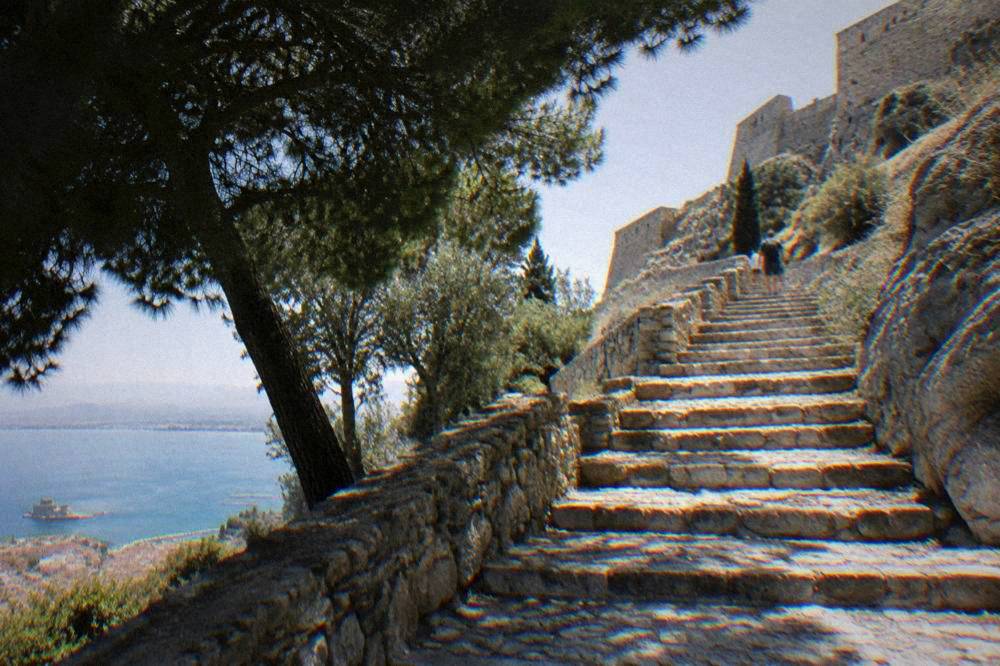
A few practical notes on the stairway itself. The steps are carved stone, uneven in places, and exposed to the sun for much of their length, so the time of day matters more than the count. Water and sun protection are the standard advice for any exposed Greek hillside in summer. The alternative is the road: a vehicle can reach the upper entrance, which is how several guided experiences approach the site, and the city walking tour pairs the Old Town sights with the fortress approach on foot.
The climb pairs naturally with the rest of the town's walking sights. The Kolokotronis statue below commemorates a hero of the same war in which Palamidi was taken, and the fortress story continues at the first parliament building and the Church of Agios Spyridon, outside which the first governor of Greece, Ioannis Kapodistrias, was assassinated in September 1831.
For visitors who want the fortress story told rather than read off a plaque, the guided options divide cleanly. A private walk with a local guide covers the lanes and the legends of the town below the walls.
And for those who would rather see the fortress from the sea than from its own ramparts, the kayak route along the coast below gives the citadel and Akronafplia from the water.
What Does A Visit To Palamidi Fortress Cost?
A full ticket to Palamidi costs 20 euro and a reduced ticket 10 euro in 2026, according to the Ministry of Culture's own visiting page, and the reduced ticket is sold only from 1 October to 31 May. The fortress is closed on 1 January, 25 March, 1 May, Easter Sunday and 25 and 26 December. Greek state sites also run free-admission days that apply here.
The 20 euro figure is worth stating firmly because older prices still circulate. Guides written a few years ago quote 8 or 10 euro for the full ticket, and those numbers are out of date. The Ministry's page for the monument is the authority on the current price, and it also carries the seasonal rule on the reduced ticket: from 1 June to 30 September only the full ticket is sold.
| Ticket | Price | Availability |
|---|---|---|
| Palamidi full | 20 euro | All year |
| Palamidi reduced | 10 euro | 1 October to 31 May only |
| Bourtzi full | 7 euro | All year |
| Bourtzi reduced | 5 euro | Per the Ministry's listing |
| Archaeological Museum of Nafplio full | 10 euro | Closed Tuesdays |
| Archaeological Museum of Nafplio reduced | 5 euro | Closed Tuesdays |
The free-admission days are the budget traveller's friend, and they apply across the Greek state sites, not just here. The Ministry's pages list them for every monument in its care.
| Free-admission day | Applies to |
|---|---|
| 6 March | All Greek state sites, including Palamidi |
| 18 April | All Greek state sites |
| 18 May | All Greek state sites and museums |
| Last weekend of September | European Heritage Days |
| 28 October | All Greek state sites |
| First and third Sundays, November to March | All Greek state sites |
Beyond the gate, the rest of a Palamidi day costs what you choose to spend. The stairway itself is free to look at from the town, the walk back down ends in the Old Town lanes around Syntagma Square, and the harbour waterfront is a short stroll from the stairway's foot. Visitors assembling a fuller plan will find the town's main sightseeing roundup covers the free and paid mix.
What Are The Opening Hours Of Palamidi Fortress?
Palamidi Fortress opens at 08:30 and closes at 15:30 in winter, extends to 08:00 to 19:00 in April, and runs 08:00 to 20:00 from 2 May 2026, with the closing time stepping down through September and October to 18:00 by late October. The fortress closes entirely on 1 January, 25 March, 1 May, Easter Sunday and 25 and 26 December.
The Ministry of Culture publishes the full seasonal ladder, and it rewards a close read because the closing time moves month by month through the shoulder season. Arrive in late September expecting summer hours and the gate may already be shut.
| Period (2026) | Hours |
|---|---|
| Winter season | 08:30 to 15:30 |
| April | 08:00 to 19:00 |
| From 2 May | 08:00 to 20:00 |
| 1 to 15 September | 08:00 to 19:30 |
| 16 to 30 September | 08:00 to 19:00 |
| 1 to 15 October | 08:00 to 18:30 |
| 16 to 31 October | 08:00 to 18:00 |
| Good Friday | 12:00 to 17:00 |
Two planning consequences follow. First, a winter visit is a morning visit: the 15:30 closing leaves no afternoon slot, so Palamidi belongs at the start of a winter day, with the indoor sights, the archaeological museum, the war museum or the folklore museum, saved for the colder hours. Second, the long summer evenings mean the fortress can be the late-afternoon stop on a hot day, climbed after the midday heat has passed, with the Old Town and dinner afterwards. The climate record supports that instinct: the HNMS Argos station, 1980 to 2010, shows a July mean daily high of 34.0 C, with June at 31.4 C and August at 33.7 C.
Who Built Palamidi Fortress?
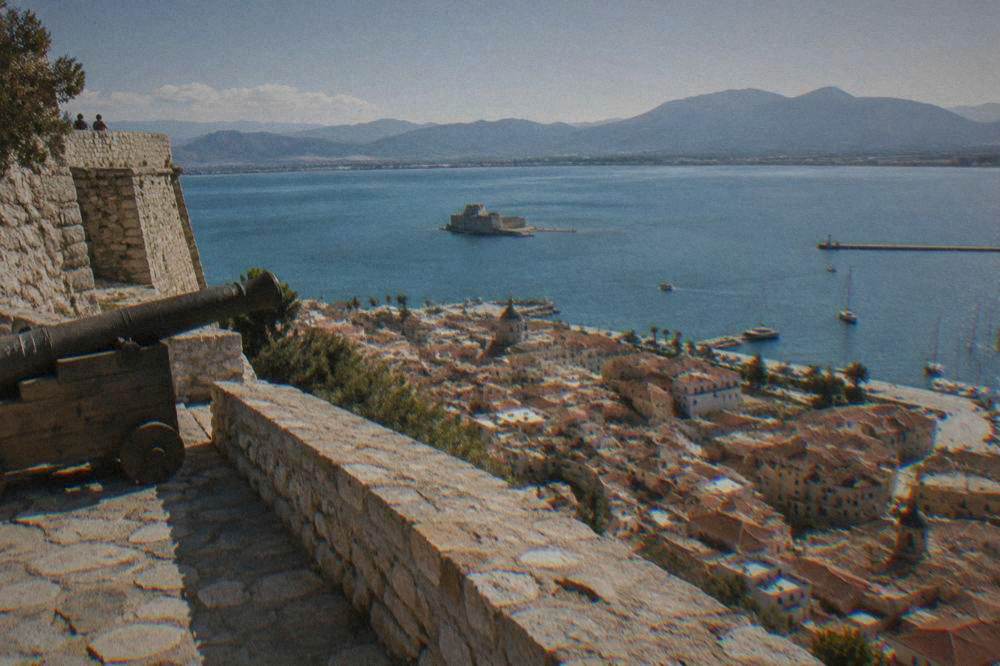
The Venetians fortified Palamidi during their second rule over the region, from 1686 to 1715, to plans by the engineers Giaxich and Lasalle, and the fortress fell to the Ottomans in 1715 before Greek forces under Staikos Staikopoulos took it in 1822. The construction window of 1686 to 1715 and the names of both engineers belong to the standard record of the monument.
The story is shorter than the stones suggest. Venice held the Argolid twice, first from 1389 to 1540 and again from 1686 to 1715, and Palamidi belongs entirely to that second period. The fortress was the Republic's great project for the region, a chain of mutually supporting bastions designed for the artillery age. It held for barely a generation: the Ottoman campaign of 1715 took it, and it stayed Ottoman until the Greek War of Independence.
The Greek capture is the event the town remembers. In 1822, Staikos Staikopoulos led the night assault that took the fortress, and the Ottoman garrison's surrender handed the revolutionaries both the citadel and, with it, the town that would become their capital five years later. Nafplio served as the capital of Greece from 1827 to 1834, the seat from which Kapodistrias governed after his arrival in 1828, until the capital moved to Athens in 1834. Walking the walls, the history reads in layers: Venetian masonry, Ottoman repairs, and the Greek state's first decades, all within a single circuit.
What Will You See From The Top Of Palamidi?
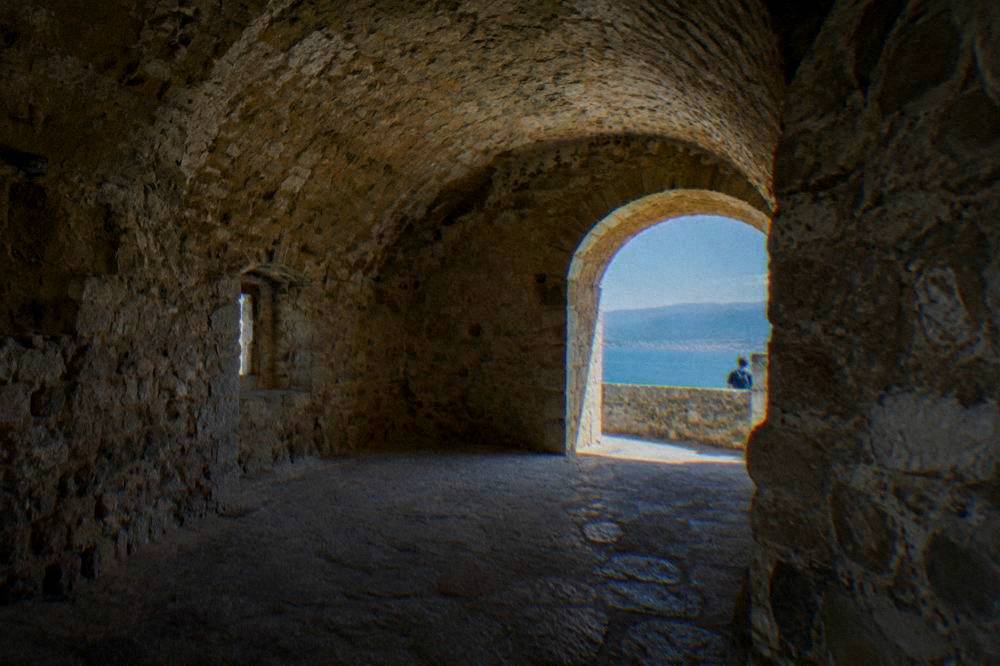
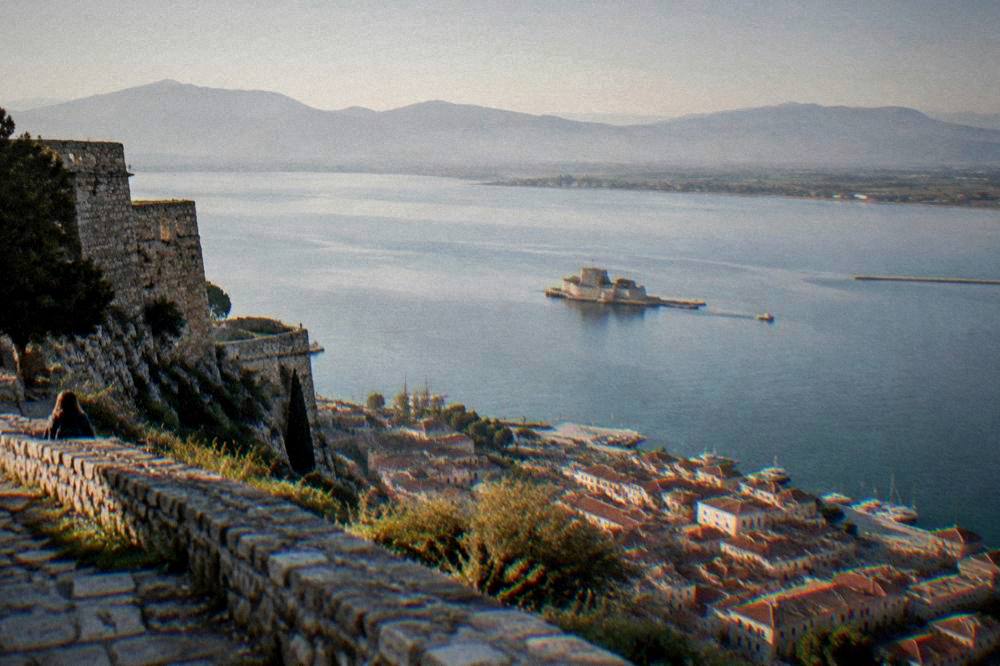
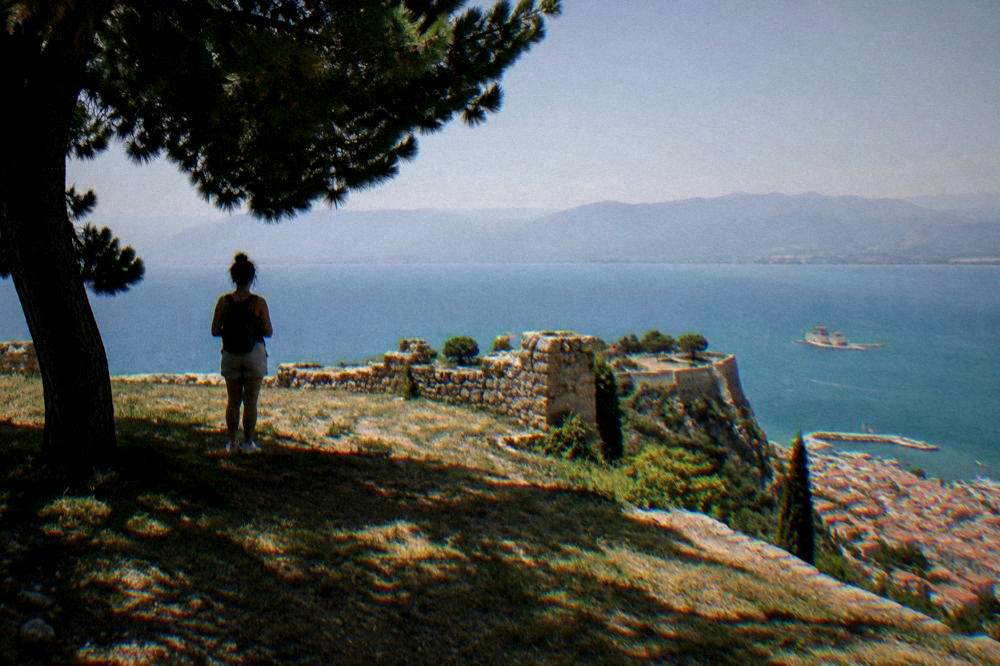
From the ramparts of Palamidi, 216 m above sea level, the view takes in the whole of Nafplio below: the red roofs of the Old Town, the harbour with the fortified islet of Bourtzi, the arc of the Argolic Gulf, and inland the mountains of the Argolid. The fortress itself is a chain of bastions, vaulted chambers and cisterns spread along the hilltop, more a walled hill than a single keep.
The panorama is the payoff, and it is genuinely three panoramas in one. To the north and west, the town: the Old Town grid, Syntagma Square, and the harbour arm with the lighthouse at its tip. To the south, the coast curving toward Arvanitia and the beaches, with Tolo and Asini a short drive beyond. To the east, the gulf itself, and on a clear afternoon the water fills the frame from rampart to horizon.
| View direction | What you see |
|---|---|
| Below, north | The Old Town rooftops and Syntagma Square |
| Below, west | The harbour, Bourtzi and the lighthouse |
| South | Arvanitia, the coast and the hills of Pronoia |
| East | The Argolic Gulf open water |
| On the hilltop itself | Linked bastions, vaulted chambers and cisterns |
Inside the walls, the fortress rewards slow walking. The bastions are connected along the ridge, the vaulted rooms are mostly open to explore, and the scale becomes clear only on foot. Allow more time than the climb itself suggests, and carry water in the warm months. The descent by the stairway drops you at the edge of the Old Town, a short walk from where to eat and the evening promenade.
How Do You Get To Palamidi Fortress?
Palamidi is reached from Nafplio either on foot up the stairway of about 850 steps from the town side, or by road to an upper entrance suitable for vehicles and guided tours. The Old Town below is largely closed to visitor parking, with free lots reported on the Akti Miaouli waterfront, and the town itself is served by KTEL buses with reported local fares of 2.20 euro to Argos and Tolo.
On foot, the stairway is the classic route, and its foot lies within the town, so no transport is needed to start the climb. By car, the road spirals up to the top; the parking situation in the Old Town is the constraint, since the old streets are resident-priority, and the waterfront lots are the reported free option, though drivers should confirm arrangements locally on arrival. The full parking picture, including the blue-zone edges, is covered in the parking guide.
For anyone without a car, the day trips still work. The KTEL local fares are reported at 2.20 euro to Tolo and to Argos and Tiryns, and 3.50 euro to Mycenae and to Epidaurus, with the Mycenae and Epidaurus services sparse, so timetables need checking before committing to a bus-based day. Computed drive times from Syntagma Square put Tiryns about 9 minutes and 5 km away, Argos about 18 minutes and 15 km, Mycenae about 32 minutes, and the Epidaurus theatre about 41 minutes.
| Destination from Syntagma Square | Drive time (about) | Distance by road |
|---|---|---|
| Tiryns | 9 minutes | 5 km |
| Tolo | 17 minutes | 11 km |
| Argos | 18 minutes | 15 km |
| Mycenae | 32 minutes | 25 km |
| Epidaurus theatre | 41 minutes | 28 km |
| Nemea town | 49 minutes | 46 km |
Guided transport removes the planning entirely. A day trip that bundles the Argolid's ancient sites with Nafplio is the standard formula from Athens, and the fortress town is usually the lunch stop.
When Is The Best Time To Climb Palamidi?
The best time to climb Palamidi is early morning or late afternoon: the HNMS Argos station, 1980 to 2010, records a July mean daily high of 34.0 C, and the stairway is exposed stone with no shade, so midday in July and August is the hardest hour on the path. In winter the 08:30 to 15:30 hours make the climb a morning affair by necessity rather than choice.
The climate table tells the story plainly. Mean daily highs run 31.4 C in June, 34.0 C in July and 33.7 C in August, easing to 29.7 C in September and 24.7 C in October. Rain is the winter variable: November averages 82.5 mm over 9.4 rain days and December 69.7 mm over 12.2 rain days, against 8.9 mm in June over just 3.0 rain days, all per the HNMS Argos station, 1980 to 2010. Stone steps are slick in rain, which argues for a dry-weather window in the wetter months.
| Month | Mean daily high (C) | Mean daily low (C) | Rain (mm) | Rain days |
|---|---|---|---|---|
| May | 26.5 | 10.5 | 18.7 | 6.2 |
| June | 31.4 | 14.0 | 8.9 | 3.0 |
| July | 34.0 | 16.7 | 9.1 | 2.1 |
| August | 33.7 | 16.8 | 13.0 | 2.5 |
| September | 29.7 | 14.2 | 20.3 | 5.0 |
| October | 24.7 | 11.5 | 44.3 | 6.9 |
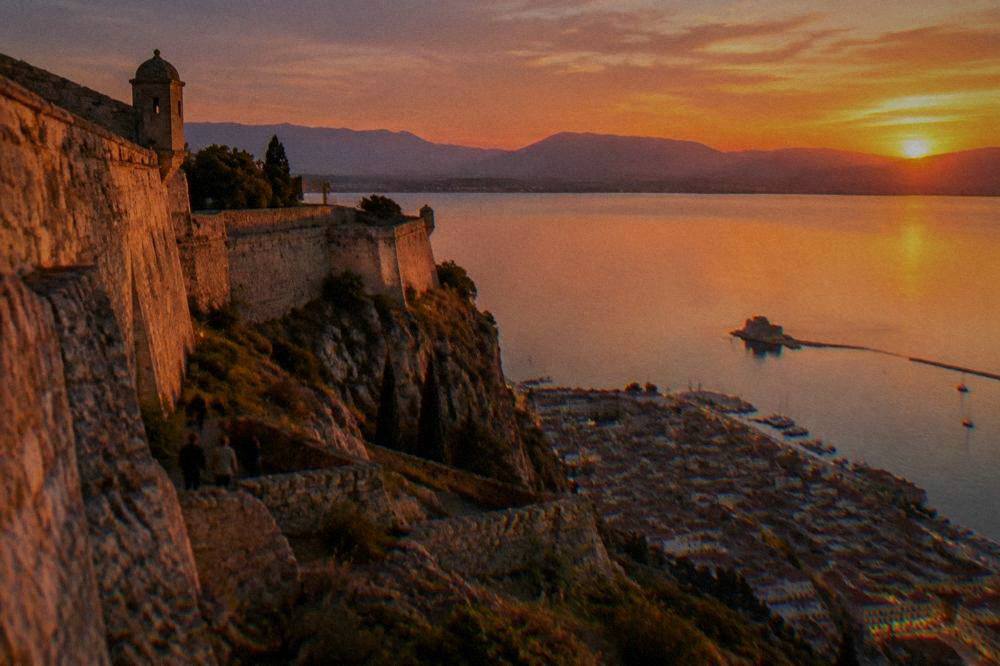
Late afternoon has a second advantage in the long season: from 2 May the site stays open to 20:00, so a 17:00 start finishes the ramparts in the golden hour with the town lighting up below. That timing also leaves the morning free for the museums or a boat trip on the gulf, and the two fit together neatly as a one-day rhythm. The seasonal question, spring versus autumn, is covered in detail in the town's best time to visit and weather guides.
Is Palamidi Fortress Worth The Climb?
On the evidence, yes: Palamidi offers a 216 m Venetian fortress complex, a genuine piece of Greek state history and the defining panorama of the Argolic Gulf, for a 20 euro ticket and a stairway of about 850 steps, and no other sight in Nafplio combines all three. The honest caveat is the exposure, the climb is unshaded and steep, and anyone for whom that is a barrier can reach the upper entrance by road instead.
That is an editorial judgement with reasons, not a ranking. The case for the fortress rests on facts: the monument's scale and state of preservation, its place in the story of the Greek state's first capital, and a viewpoint that takes in the harbour, Bourtzi, the Old Town and the gulf in one turn of the head. The case against is practical: heat, steps and the seasonal closing times. Families weighing the decision may find the town's visiting with kids guide useful, and the wider "is it worth it" question about the town itself is answered, with the same reasoning style, in what Nafplio is famous for.
Pairing the fortress with something slower balances the day. A late-afternoon catamaran or sailing trip on the gulf turns the fortress into the backdrop instead of the workout, and the cooking classes and food walks give the evening a focus once the steps are done.
Common Questions About Palamidi Fortress
How many steps does Palamidi Fortress in Nafplio have?
The stairway is usually counted at 857 carved stone steps, so the honest figure is about 850 steps, not the legendary 999 that folklore and older guides repeat. A road also reaches the upper entrance for anyone who prefers not to climb.
How much does Palamidi Fortress cost in 2026?
Admission is 20 euro full and 10 euro reduced, per the Ministry of Culture's visiting page. The reduced ticket is sold only from 1 October to 31 May; from June to September only the full ticket is available.
What are the opening hours of Palamidi Fortress?
Winter hours are 08:30 to 15:30, April runs 08:00 to 19:00, and from 2 May the site is open 08:00 to 20:00. Closing steps down through September and October, reaching 08:00 to 18:00 from 16 to 31 October. The fortress is closed on 1 January, 25 March, 1 May, Easter Sunday and 25 and 26 December.
Are there free-admission days at Palamidi Fortress?
Yes. Greek state sites, including Palamidi, are free on 6 March, 18 April, 18 May, 28 October, the last weekend of September, and the first and third Sunday of each month from November to March.
Who built Palamidi Fortress?
The Venetians, during their second period of rule from 1686 to 1715, to plans by the engineers Giaxich and Lasalle. The Ottomans took it in 1715, and Greek forces under Staikos Staikopoulos captured it in 1822, five years before Nafplio became the capital of Greece.
Can you drive to Palamidi Fortress instead of climbing the steps?
Yes, a road reaches the upper entrance. Note that the Old Town below is largely closed to visitor parking; free lots are reported along the Akti Miaouli waterfront, and drivers should confirm arrangements locally on arrival.