Nafplio Old Town: Streets, Squares And Balconies
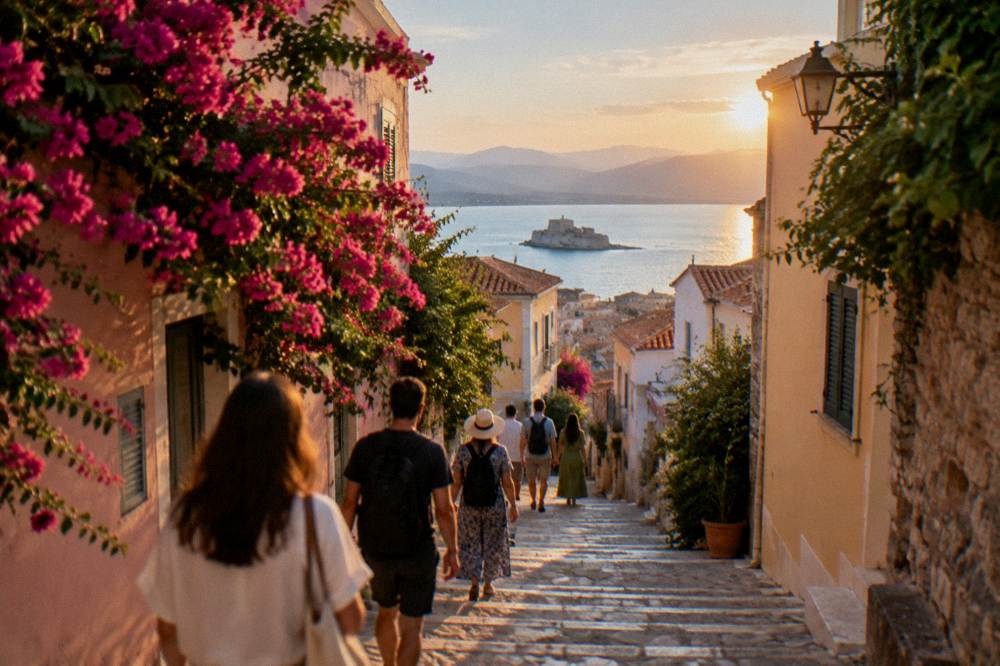
The Old Town of Nafplio, the first capital of modern Greece from 1827 to 1834, is a compact web of Venetian, Ottoman and neoclassical streets under Palamidi Fortress on the Argolic Gulf. Here is what the official sources say about its squares, walls, stairways and tickets.
Short answer
The Old Town of Nafplio is walkable end to end in under an hour, sits under Palamidi Fortress 216 m above, and holds Syntagma Square, the Archaeological Museum at 10 euro full entry, Bourtzi in the harbour at 7 euro, and the Land Gate. Palamidi costs 20 euro full and 10 euro reduced in 2026, with about 850 steps, not the legendary 999.
Nafplio's Old Town is the historic core of a small coastal town of about 14,500 residents in the Argolid, on the Argolic Gulf in the north-east Peloponnese of mainland Greece, and it packs three fortifications, a first-parliament building and a museum-lined square into a footprint you can cross on foot in well under an hour. The town was the capital of Greece from 1827 to 1834, before the capital moved to Athens, and nearly every street of the Old Town carries a layer of that story: Venetian rule from 1389 and again from 1686 to 1715, Ottoman periods in between, and the young Greek state that governed from the buildings around Syntagma Square. This page from the Nafplio Travel Guide editorial desk walks the area street by street, using the Ministry of Culture's own site pages for every ticket price and opening hour, so what you read here matches what the ticket office will tell you.
What Exactly Is The Old Town Of Nafplio?
The Old Town of Nafplio is the historic peninsula core below Palamidi Fortress and Akronafplia, bounded by the harbour to the north and the Arvanitia side to the south, with Syntagma Square at its centre and the Land Gate as its old western entrance. It is not a museum quarter or a ticketed zone: it is the living centre of a town of about 14,500 residents, and the streets carry Venetian, Ottoman and neoclassical building layers side by side. The name covers several named sub-areas, including Syntagma Square, the harbour front, the Psaromachalas fishermen's quarter on the Akronafplia slope and the approaches to Palamidi Fortress.
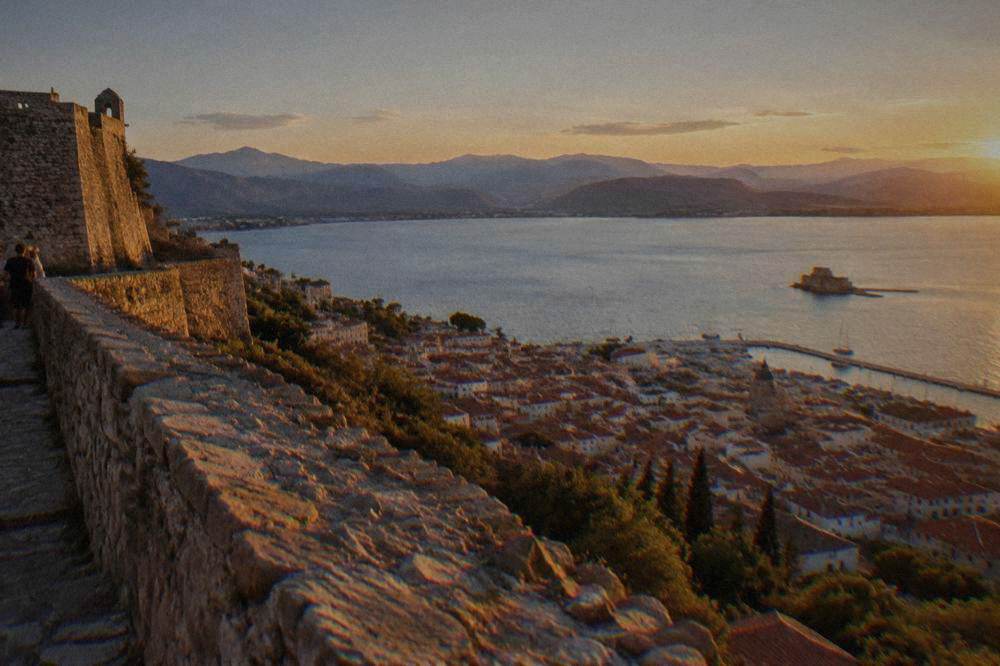
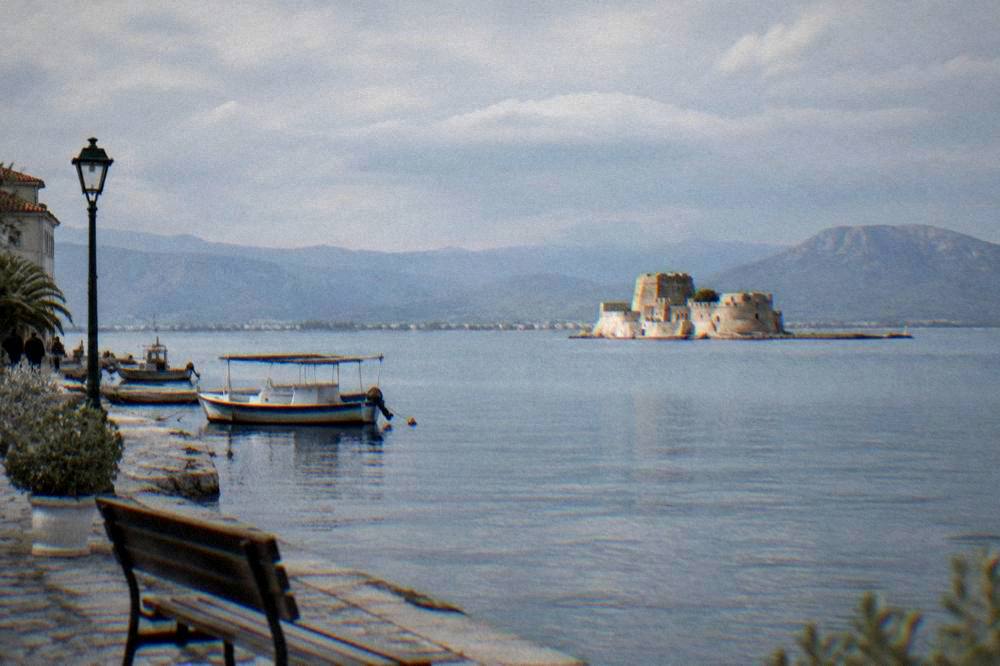
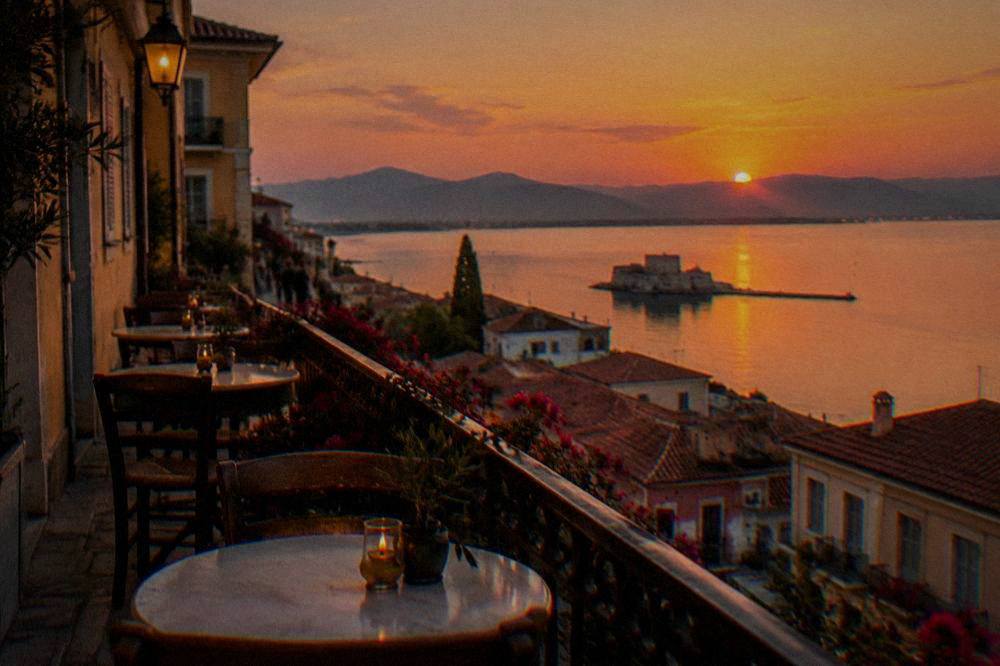
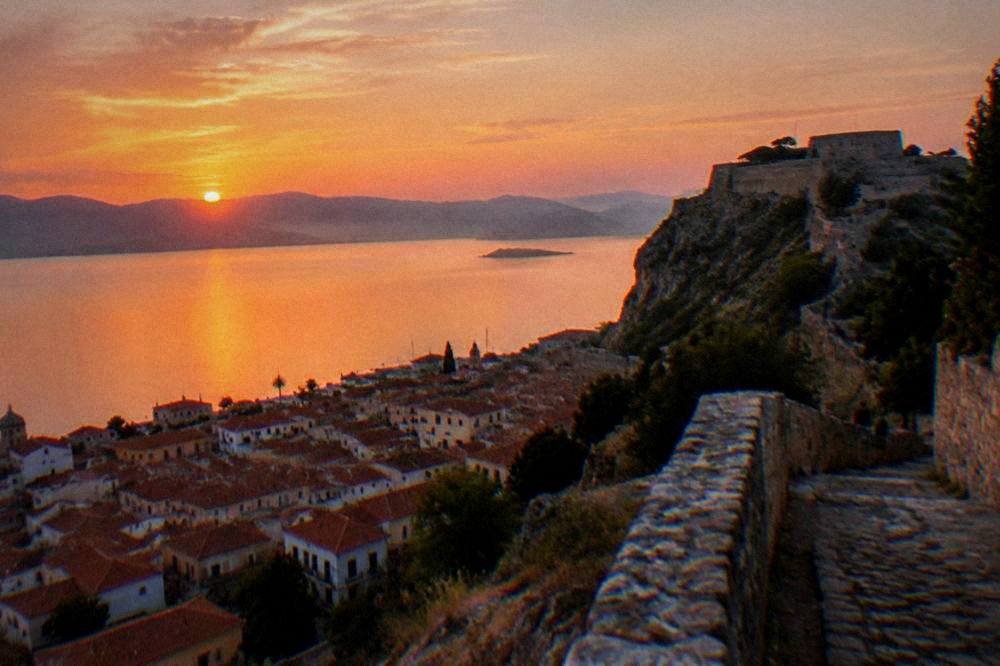
The layout is simple once you see it from above, and the view from Palamidi, 216 m above the Old Town, is the fastest way to understand it. The rocky spine of Akronafplia, the old acropolis, forms the western tip of the peninsula. Below and east of it spreads the grid of streets the Venetians and Ottomans built, and the harbour curve wraps the north side, with the fortified islet of Bourtzi standing in the water offshore. The Ministry of Culture's visiting page lists Bourtzi as open by boat, with a full ticket at 7 euro and a reduced ticket at 5 euro in 2026.
Two practical notes shape any visit. First, the Old Town is largely closed to visitor parking, and the free public lots sit on the Akti Miaouli waterfront, a short walk from the centre, so arriving on foot or by bus is simpler than driving in. The parking guide covers the details. Second, everything here is close together: the distances that matter are the vertical ones, above all the stairway up to Palamidi.
| Area | Character | Anchor sight |
|---|---|---|
| Syntagma Square | Central square, cafes, museums | Archaeological Museum, Vouleftiko |
| Harbour front | Waterfront promenade, port lots | Bourtzi views, lighthouse |
| Psaromachalas | Old fishermen's quarter on the slope | Akronafplia walls |
| Land Gate side | Western entrance, old fortification | Land Gate, Five Brothers Bastion |
| Arvanitia edge | Southern shore path and pebble beach | Arvanitia Promenade, about 1 km |
How Do You Walk The Old Town In One Loop?
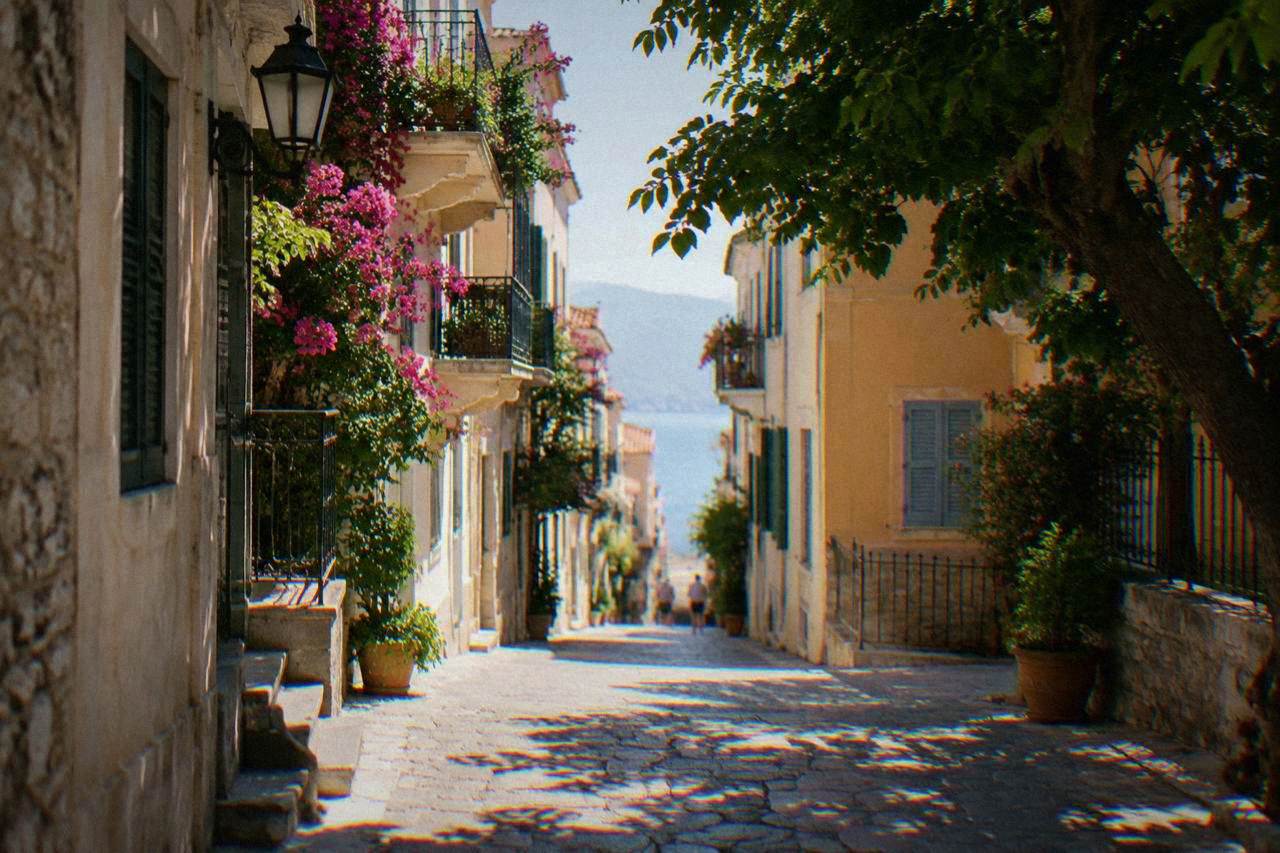
A single walking loop covers the whole Old Town: start at Syntagma Square, walk down the harbour front to the lighthouse, climb into Psaromachalas under the Akronafplia walls, descend to the Land Gate, and return through the shopping streets to the square. The Arvanitia Promenade, a paved coastal path of about 1 km from the harbour lighthouse around to Arvanitia square, extends the loop along the water on the southern side. The terrain is uneven in places, with slopes and stepped lanes, so ordinary walking shoes serve better than smooth soles.
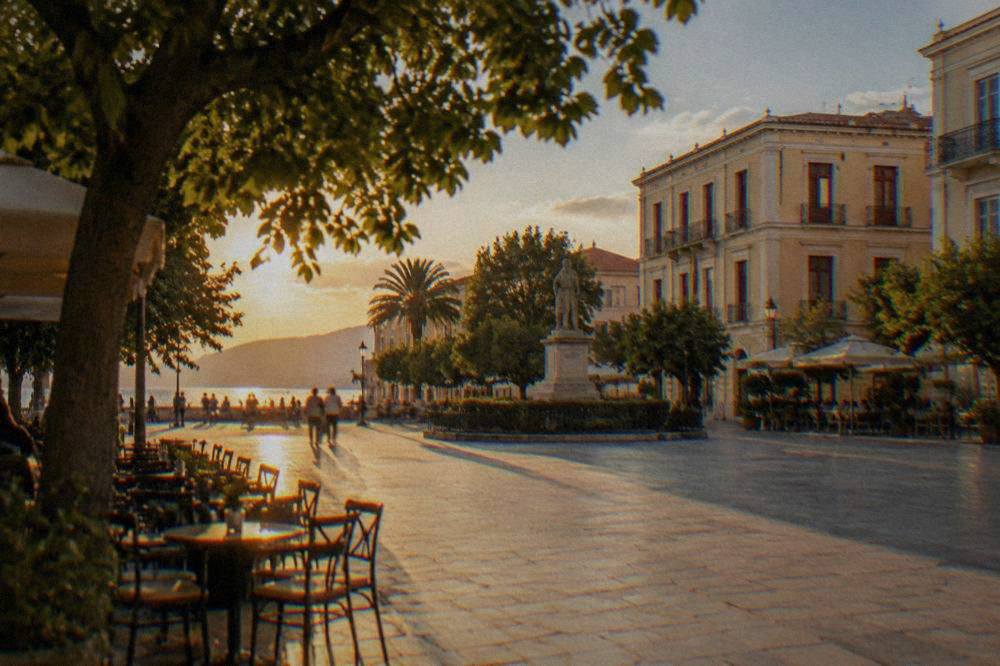
Syntagma Square is the natural starting point because it holds three of the town's key buildings: the Archaeological Museum in the old Venetian arsenal, the Vouleftiko, the mosque building that hosted the first Greek parliament sessions from 1825, and the Trianon, the old mosque of the same era. The Archaeological Museum of Nafplio charges 10 euro full and 5 euro reduced, opens 08:30 to 15:30 all year and closes every Tuesday, per the Ministry of Culture's page. That Tuesday closure is worth building the week around, since the rest of the square is always open.
From the square, the harbour front runs northwest past the boat departure point for Bourtzi toward the lighthouse at the tip. The Arvanitia Promenade starts there and wraps the foot of Akronafplia. Psaromachalas, the fishermen's quarter, climbs the slope between the promenade and the fortress walls, a district of small houses and lanes that preserves the town's working-sea character. The Land Gate, the monumental Venetian-era entrance to the town, stands at the inland edge, with the Five Brothers Bastion in the walls beside it.
A guided walk adds the stories the stones do not carry. The Nafplio city walking tour pairs the Old Town circuit with a boat trip out to Bourtzi, and a shorter city walking tour option covers the core lanes; both are described on their own listing pages. For travellers who prefer two wheels, the cycling tour below covers the Old Town, the waterfront and the approaches beyond it.
What Do Tickets And Hours Look Like Around The Old Town?
The paid sights around the Old Town in 2026 are Palamidi at 20 euro full and 10 euro reduced, the Archaeological Museum at 10 and 5, Bourtzi at 7 and 5, Argos agora and theatre at 10 and 5, and Asini at 5 and 3, with the reduced Palamidi ticket sold only from 1 October to 31 May. The Mycenae and Epidaurus tickets, 20 euro full and 10 euro reduced each, matter for day trips rather than the town itself. All these figures come from the Ministry of Culture's own site pages for each monument.
Hours follow the state-site calendar. Palamidi runs winter hours of 08:30 to 15:30, April 08:00 to 19:00, from 2 May 08:00 to 20:00, with a stepped reduction through September and October down to 08:00 to 18:00 from 16 to 31 October. Bourtzi keeps harbour hours: 09:00 to 17:00 in November and December, 09:00 to 18:00 in April and May, to 21:00 in July and August, with weekend extensions in some months. The state sites close on 1 January, 25 March, 1 May, Easter Sunday and 25 and 26 December.
| Sight | Full ticket | Reduced ticket | 2026 hours (main season) |
|---|---|---|---|
| Palamidi Fortress | 20 EUR | 10 EUR (1 Oct to 31 May only) | from 2 May, 08:00 to 20:00 |
| Archaeological Museum of Nafplio | 10 EUR | 5 EUR | 08:30 to 15:30, closed Tuesday |
| Bourtzi | 7 EUR | 5 EUR | Jul to Aug, 09:00 to 21:00 |
| Argos agora and theatre | 10 EUR | 5 EUR | 08:30 to 15:30 |
| Asini | 5 EUR | 3 EUR | state winter hours apply |
Free-admission days apply across the Greek state sites, and they are the single easiest saving in town. The Ministry's pages list 6 March, 18 April, 18 May, the last weekend of September, 28 October, and the first and third Sunday of each month from November to March as free entry days. A late-autumn or winter trip therefore lands free Sundays fairly often.
| Free-admission day | Applies to |
|---|---|
| 6 March | All state sites, including Palamidi and the museum |
| 18 April | All state sites |
| 18 May | All state sites |
| Last weekend of September | All state sites |
| 28 October | All state sites |
| 1st and 3rd Sundays, November to March | All state sites |
The Old Town's food side deserves a slot in the loop as well. The where to eat guide covers the taverna and cafe streets, and a cooking class turns the local table into part of the visit rather than a stop between sights.
How Many Steps Lead Up To Palamidi From The Old Town?
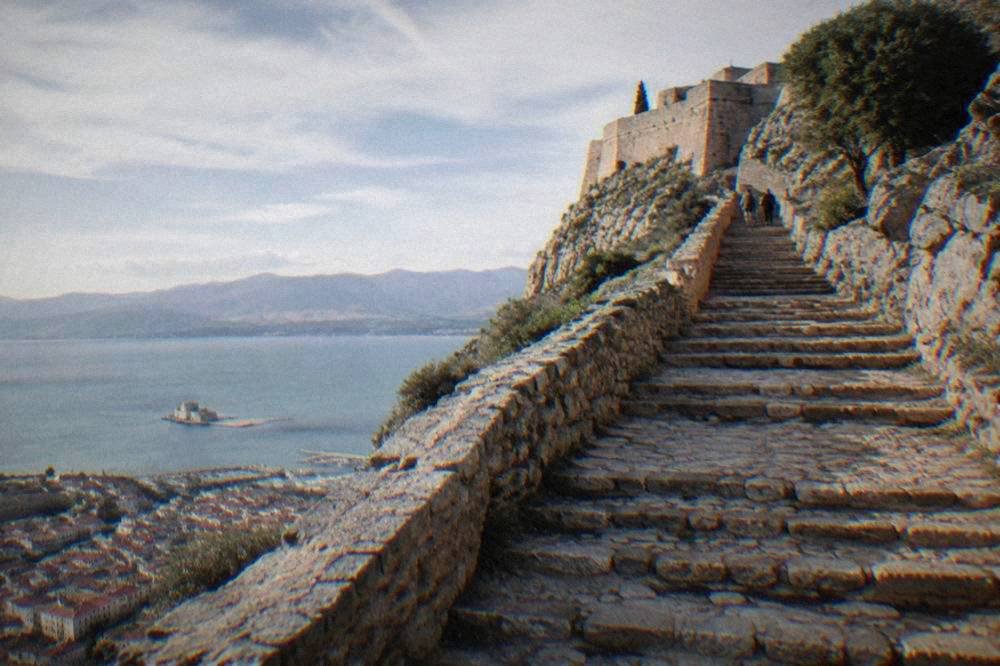
The famous stairway from the Old Town up to Palamidi is usually counted at about 850 steps, 857 by the common count, and not the legendary 999 that folklore and older guides repeat, and the fortress ticket is 20 euro full and 10 euro reduced in 2026. The stairway climbs the east side of the rock from the town to the fortress gate, and there is also a road approach for anyone who prefers to drive up and walk down. The Ministry of Culture's visiting page for Palamidi lists the prices, the hours and the closure days.
The 999 figure is a legend, and the correction matters because the climb is real either way: the fortress stands 216 m above the Old Town, and the stairway goes up that height in carved stone flights with rest landings. Older guides still say 999 steps, which is out of date as a count even though the stairway itself is centuries old. The fortress was fortified by the Venetians in the second Venetian period, from 1686 to 1715, to plans by the engineers Giaxich and Lasalle, taken by the Ottomans in 1715, and liberated by the Greeks in 1822, per the Argolis culture authority's monument page.
Once at the top, the bastions frame the whole reason the Old Town looks the way it does: the harbour with Bourtzi, the Akronafplia spine, and the Argolic Gulf beyond. The full Palamidi Fortress guide covers the bastions in detail, and the one day in Nafplio itinerary sequences the climb with the rest of the town.
Which Streets And Squares Should You Not Miss?
The five named places that define the Old Town are Syntagma Square, the harbour front with its Bourtzi views, the Psaromachalas quarter, the Land Gate with the Five Brothers Bastion, and the Church of Agios Spyridon, outside which Governor Kapodistrias was assassinated in September 1831. Each is free to see from the street, and each carries a distinct layer of the town's history, from the Venetian gate to the first-capital years.
The Church of Agios Spyridon stands near the square, and its plain front marks the spot where Ioannis Kapodistrias, the first governor of Greece, who arrived in Nafplio in January 1828, was assassinated in September 1831. The Church of Agios Georgios, the large church in the Old Town, and the Vouleftiko, which hosted the first Greek parliament sessions from 1825, complete the first-capital group. The Kolokotronis statue commemorates the hero of the 1822 Palamidi capture, Staikos Staikopoulos.
Psaromachalas deserves more than a pass-through. The quarter's lanes climb from the harbour side toward the Akronafplia walls, and its houses are the closest thing the town has to a preserved fishermen's village, layering Ottoman-era planning under Greek-era rebuilding. The Arvanitia side, covered in the Arvanitia area guide, starts where the promenade ends, with the Blue Flag pebble beach and summer facilities below the cliffs.
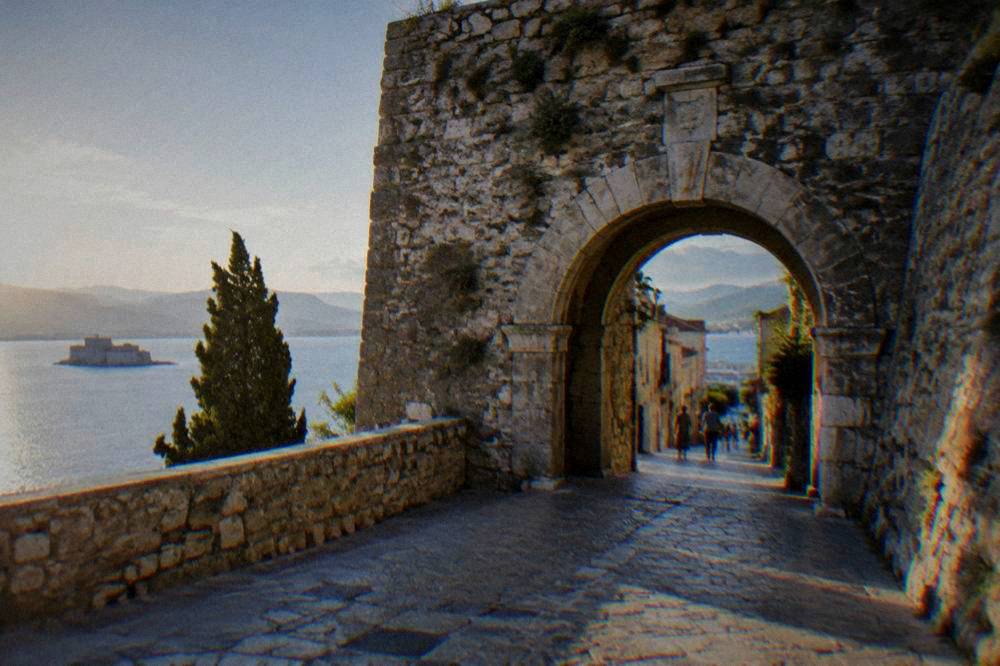
The Land Gate, at the inland edge of the Old Town, was the fortified entrance when the town was a walled settlement, and the Five Brothers Bastion in the wall beside it survives from the Venetian defences. Pronoia, the district just beyond the gate, holds the Lion of Bavaria, carved from 1840 to 1841 by Christian Heinrich Siegel as a copy of Thorvaldsen's Lion of Lucerne, donated by Ludwig I of Bavaria for Bavarian soldiers who died in Nafplio. The Pronia area guide covers that side of town.
When Is The Best Time Of Day To Photograph The Old Town?
Morning light between roughly 08:00 and 10:00 lights the harbour front and Bourtzi from the east, late afternoon light warms the west-facing facades around Syntagma Square, and the HNMS Argos station, 1980 to 2010, shows July and August mean daily highs of 34.0 and 33.7 C, which makes the stairway climb an early-morning or late-afternoon task in summer. The station is inland, about 10 km north-west of the town, so the waterfront often runs a little milder than those figures.
The photography logic follows the geography. Bourtzi and the harbour face north and east, so the morning sun crosses the gulf and catches the islet and the waterfront facades first. The Palamidi stairway and the east side of the fortress take strong side light in the late afternoon, and the rooftops view from the top reads best when the sun is low enough to model the terrain. The Arvanitia Promenade, on the south side, carries good light through the middle of the day in winter.
Rain matters less than heat here. The HNMS Argos station, 1980 to 2010, records June at 8.9 mm of rain and 3.0 rain days against November at 82.5 mm and 9.4 rain days, so the dry window is wide and stable through the summer, while the November-to-February period averages 9 to 12 rain days a month. None of that closes the Old Town, which is an all-year street district; the winter visiting pattern is covered in the wider things to do in Nafplio page.
| Month | Mean daily high C | Mean daily low C | Rain mm | Rain days |
|---|---|---|---|---|
| January | 14.6 | 3.0 | 66.5 | 10.3 |
| April | 21.3 | 6.7 | 33.7 | 8.6 |
| July | 34.0 | 16.7 | 9.1 | 2.1 |
| October | 24.7 | 11.5 | 44.3 | 6.9 |
| November | 19.2 | 7.7 | 82.5 | 9.4 |
Where Should You Stay Relative To The Old Town?
The lodging areas of Nafplio group into Old Town and Syntagma Square, Akronafplia and the harbour, and Arvanitia and the Palamidi side, with no listed property in Tolo or Karathona, so the practical choice is between being inside the historic core or a short walk from it. Editorial judgement, not a ranking: staying inside the Old Town puts every street of this guide at the door but means carrying luggage over cobbles and slopes, while the harbour side trades a few minutes of walking for flat access and the port parking lots.
Akronafplia and the harbour side suits travellers who want the waterfront and the Bourtzi boat within a flat stroll, and it keeps the evening promenade close. The Arvanitia and Palamidi side puts the stairway, the promenade and the quieter southern shore nearest, at the cost of a slope between the room and the square. Pronoia, just beyond the Land Gate, is a residential alternative with the Lion of Bavaria and the walk in through the gate.
One fee applies wherever you sleep: the Greek climate resilience fee is collected by the accommodation and is higher from April to October. Confirm the amount with the property when booking. The wider where to stay in Nafplio discussion belongs to the lodging pages; here the point is only that the Old Town is small enough that any of these areas serves it well.
How Does The Old Town Fit Into A Day Trip Or A Longer Stay?
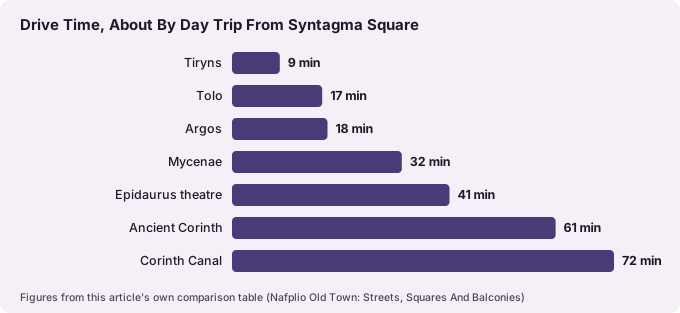
The Old Town is the fixed centre of every Nafplio plan: one day covers the square, the museum, the harbour and either Palamidi or Bourtzi, two days add the second fortress and the Arvanitia side, and three days add Mycenae at about 32 minutes' drive and the Epidaurus theatre at about 41 minutes, per computed free-flow drive times from Syntagma Square. The itineraries for two days and three days sequence exactly that escalation.
Day trips radiate from the Old Town because the Argolid's ancient sites sit in a tight ring around it. Tiryns is the nearest at about 9 minutes by road, Argos about 18, Tolo about 17, Mycenae about 32, the Epidaurus theatre about 41 and Ancient Corinth about 61, all computed free-flow times from Syntagma Square. Mycenae with Tiryns, and Epidaurus, are UNESCO World Heritage sites, inscribed in 1999 and 1988 respectively. There is no train to Nafplio in 2026 and no scheduled ferry from Nafplio or Tolo to Hydra or Spetses, so the day trips run by road, or by seasonal day cruise for the islands.
| Day trip from Syntagma Square | Drive time, about |
|---|---|
| Tiryns | 9 minutes |
| Tolo | 17 minutes |
| Argos | 18 minutes |
| Mycenae | 32 minutes |
| Epidaurus theatre | 41 minutes |
| Ancient Corinth | 61 minutes |
| Corinth Canal | 72 minutes |
Visitors arriving from Athens usually reach the Old Town by KTEL coach from the Kifissos terminal, a reported fare of about 15.70 euro one way over about 2 hours 10 minutes, or by car over about 141 km. The Nafplio day trip from Athens tour listings handle the connection as a package, and the Mycenae and Epidaurus tours page covers the ancient-site pairing. For the sites themselves, the Mycenae day trip guide is the companion page.
Common Questions About The Old Town Of Nafplio
Is the Old Town of Nafplio walkable?
Yes. The whole Old Town is a pedestrian-friendly web of lanes around Syntagma Square, crossable on foot in well under an hour, with slopes in Psaromachalas and stepped lanes in places. The vertical exceptions are the Palamidi stairway, about 850 steps, and the paths on the Akronafplia slope.
How much does it cost to visit Palamidi from the Old Town?
The 2026 ticket is 20 euro full and 10 euro reduced, per the Ministry of Culture's visiting page, and the reduced ticket is sold only from 1 October to 31 May. Free-admission days include 6 March, 18 April, 18 May, the last weekend of September, 28 October and the first and third Sundays from November to March.
Does Palamidi really have 999 steps?
No, that is folklore. The stairway from the Old Town is usually counted at 857 steps, so write it as about 850, and older guides that repeat 999 are out of date on the count. The fortress stands 216 m above the Old Town.
Can you visit Bourtzi from the Old Town harbour?
Yes. Bourtzi is open to visitors, reached by boat from the harbour for a separate boat fee, and the entry ticket is 7 euro full and 5 euro reduced in 2026, per the Ministry of Culture's page. July and August hours run to 21:00.
Where is the centre of the Old Town?
Syntagma Square. It holds the Archaeological Museum in the old Venetian arsenal, 10 euro full entry, open 08:30 to 15:30 and closed Tuesdays, plus the Vouleftiko, the mosque building that hosted the first Greek parliament sessions from 1825.
How old is the Old Town of Nafplio?
The layers run deep: Akronafplia carries ancient walls from the Mycenaean era, Venetian rule ran from 1389 and again from 1686 to 1715, with Ottoman periods between, and the town served as the capital of Greece from 1827 to 1834. Many of the neoclassical facades and balconies belong to the years after Greek independence, once the town became the seat of government in 1827.
Nafplio's Old Town rewards exactly the pace its geography imposes: everything close, one steep climb, and a museum, a mosque-turned-parliament and a fortress islet all inside a single walk. Plan the Palamidi stairs for the cool hours, keep Tuesday clear of the Archaeological Museum, and the rest of the streets arrange themselves.