Ancient Corinth: The Temple Of Apollo And Acrocorinth From Nafplio
Ancient Corinth sits about an hour north of Nafplio by road, close enough to pair with the Corinth Canal and still be back for dinner on Syntagma Square. This guide lays out the drive, the two-tier site of the ancient city below and the fortress of Acrocorinth above, and what the official sources actually say about tickets and hours.
Short answer
Ancient Corinth is about 57 km and a 61-minute drive from Syntagma Square in Nafplio, and the fortress of Acrocorinth adds about four more kilometres. Confirm the site's admission price and hours locally before you go.
Ancient Corinth is the farthest of the classic day trips that sit inside a single morning's drive of Nafplio, the small coastal town on the Argolic Gulf that was the first capital of modern Greece from 1827 to 1834. The ancient city sits on the flat plain below the rock of Acrocorinth, roughly 57 km north-east of Syntagma Square, and the Corinth Canal, the sea-level cut that separates the Peloponnese from the mainland, lies another 12 km beyond it. For a traveller based in the Old Town, that geography is the whole argument: three very different sights, a Roman city, a mountain fortress and an engineering canal, all reachable on one road out of the Argolid.
What this page does is practical. It sets out the drive times the route-planning data gives, describes what the archaeological site and Acrocorinth actually contain, explains what the Ministry of Culture's own listings say (and what they do not, so you know to confirm tickets and hours locally), and lays out realistic ways to combine the trip with Mycenae, Epidaurus or the canal. Guided options exist for travellers who would rather not drive, and this site's guide to everything the area offers covers the rest of the Argolid and beyond.
How Far Is Ancient Corinth From Nafplio?
Ancient Corinth lies about 57 km from Syntagma Square in Nafplio, a drive of about 61 minutes in free-flow traffic, and Acrocorinth, the fortress rock above it, about 59 km and 65 minutes. The Corinth Canal is a further 12 km on, about 72 minutes and 69 km in total from the square. These are route-planning figures for the road, not timetables, so allow more in summer traffic.
The route leaves Nafplio northwards through the Argolid plain, passing the turn-offs for Tiryns and Argos before the road climbs toward the Corinthia. Mycenae sits conveniently off the same corridor at about 32 minutes out, which is why so many guided itineraries chain the two together. The canal crossing at Isthmos comes at the top of the drive, and the ancient site sits just below the modern village of Archaia Korinthos on the plain.
Two practical notes from the published sources. There is no passenger train to Nafplio or to the Corinthia of use on this trip, so the choice is your own car, a booked tour, or the KTEL bus network with a change at Corinth, and the local bus timings to the ancient site itself are sparse enough that driving or a tour is the sensible reading. Second, the Old Town of Nafplio is largely closed to visitor parking, with free public lots on the Akti Miaouli waterfront reported as the main option, so plan the car's start and end there rather than in the lanes.
| Destination from Syntagma Square | Distance by road | Drive time (free-flow) |
|---|---|---|
| Mycenae | 25.4 km | about 32 min |
| Ancient Corinth | 57.1 km | about 61 min |
| Acrocorinth | about 59 km | about 65 min |
| Corinth Canal | 68.9 km | about 72 min |
| Ancient Nemea | 38.3 km | about 46 min |
| Epidaurus theatre | 27.7 km | about 41 min |
What Is There To See At Ancient Corinth Itself?
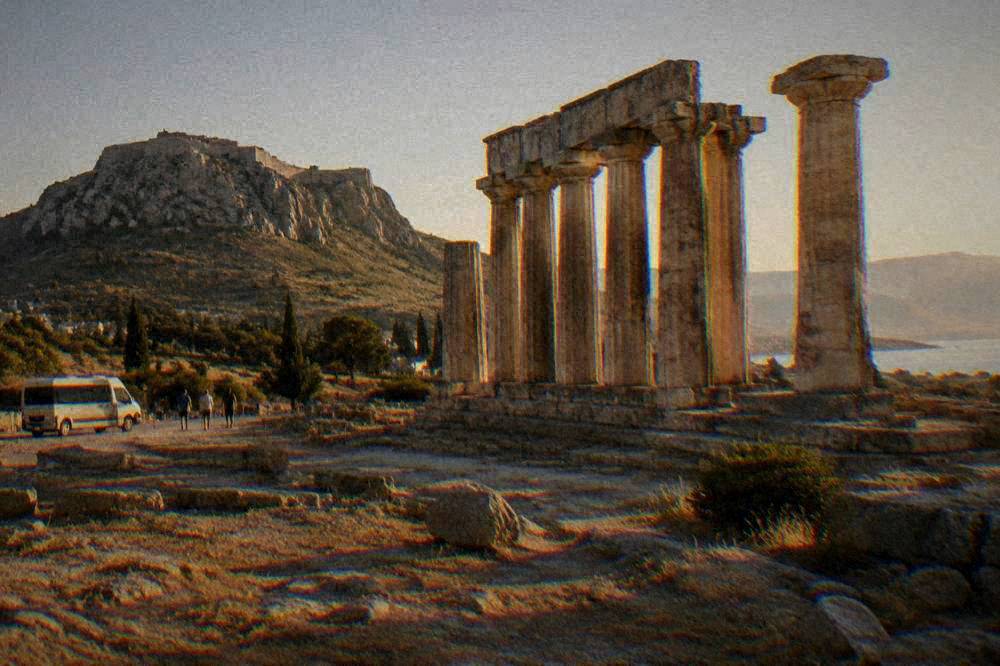
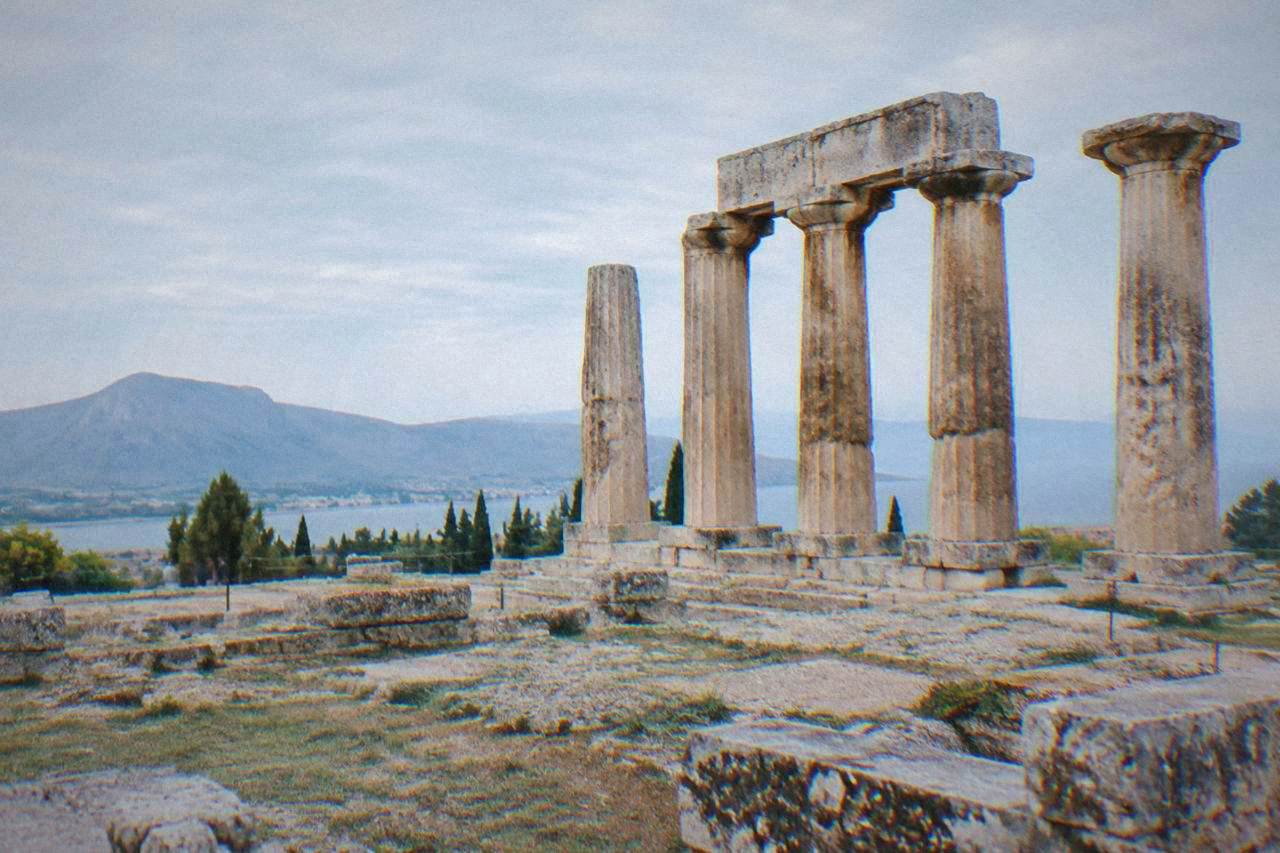
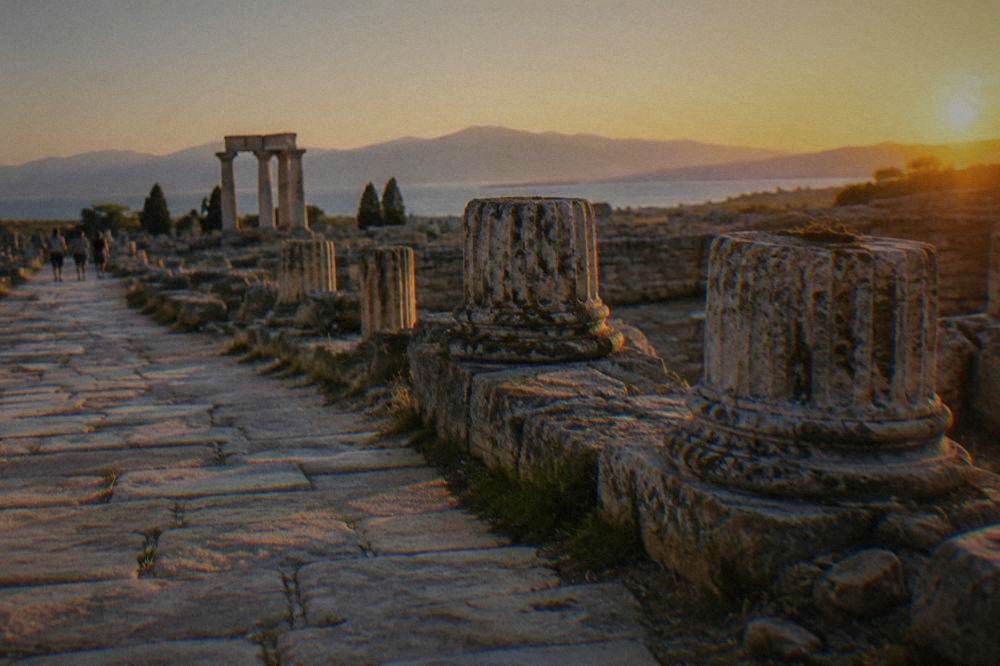
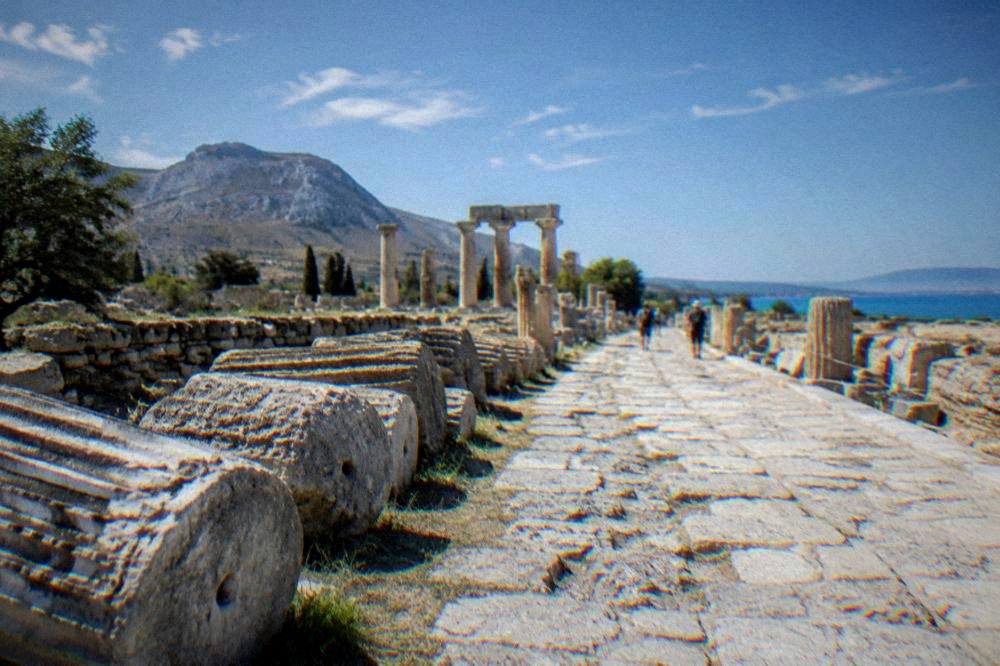
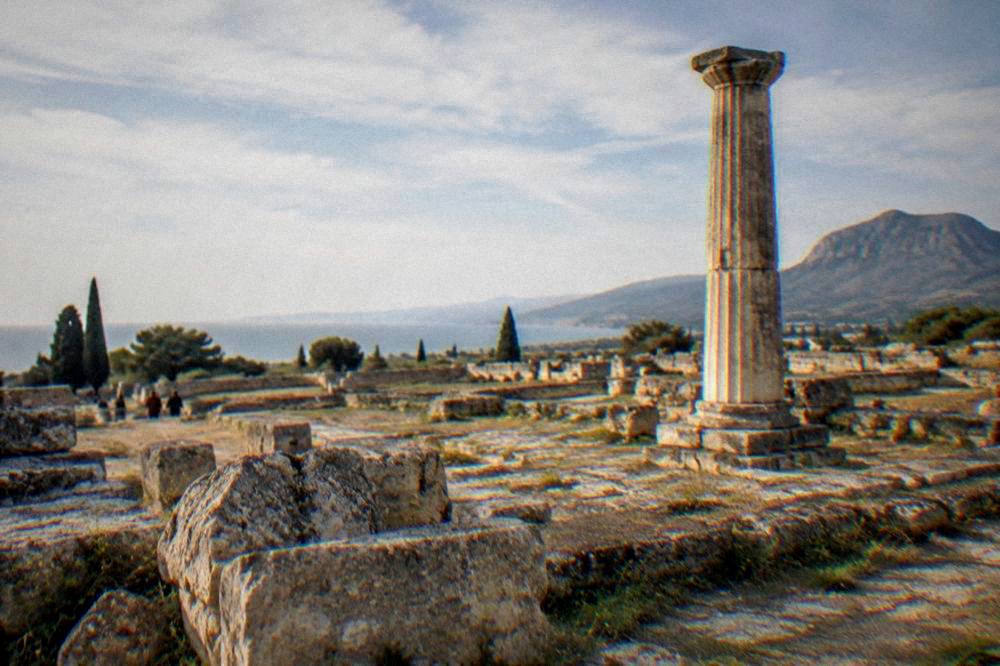
The core of Ancient Corinth is the Roman-era forum with the Temple of Apollo, whose monolithic limestone columns still stand on their terrace, together with the remains of shops, stoas, the bema where public business was conducted, the Peirene fountain and the site museum. Above it all rises Acrocorinth, the walled rock that dominates the plain. The Ministry of Culture's Odysseus portal lists the site among the monuments of the Corinthia.
The city that these ruins represent was a Roman provincial capital rebuilt on the bones of the Greek city that Rome destroyed, and the excavation you walk through today is chiefly that second, imperial city. The Temple of Apollo is the one structure that survived from the earlier Greek period in standing form, and its seven or so columns are the image every visitor takes away. Around the forum, the archaeological work has exposed the paved Lechaion road, the rostra, and the fountain of Peirene, which in antiquity was famous enough to be written about by travellers.
The on-site museum holds the finds from more than a century of excavation, sculpture, mosaics, inscriptions and the product of the city's workshops. Corinth in its Roman heyday was a commercial hub, and the museum's collection reflects that breadth rather than a single temple's worth of material.
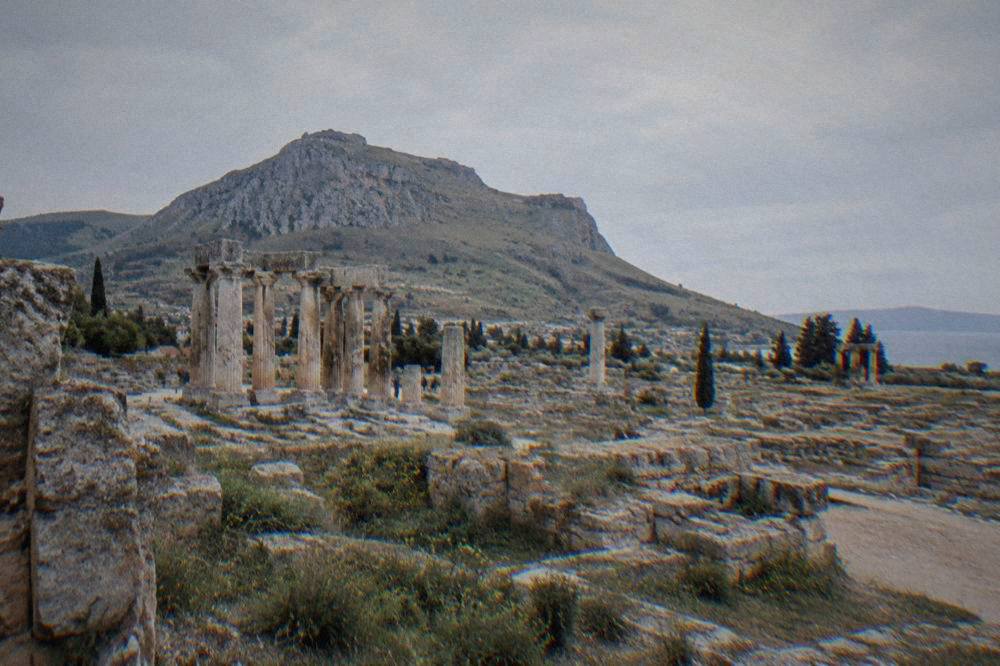
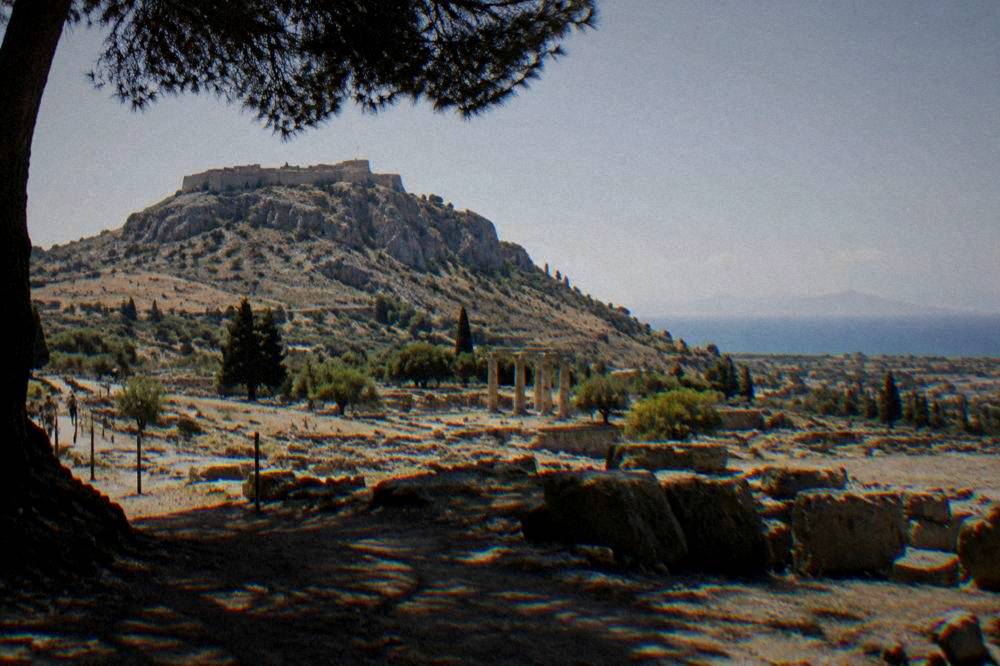
Acrocorinth deserves its own block of time rather than a glance upward. The rock carries fortification walls layered by successive powers, with the surviving circuit largely Frankish, Venetian and Ottoman in date. The climb is on foot up a winding path, and inside the walls the summit spreads into a surprisingly large landscape of cisterns, foundations and, on clear days, a view that takes in both the Saronic and Corinthian gulfs. The fortress is free of the city noise below, and it is the kind of place where the wall-walking, not any single monument, is the point.
What the official listings do not give, and what a traveller therefore has to confirm locally, is the current admission price and opening hours for both the ancient site and Acrocorinth. The Ministry's pages do not publish them for these monuments, and this site will not guess. Ask at the ticket office on arrival or check the ticket page before booking any tour that includes entrance.
For travellers who would rather not drive the corridor themselves, guided options cover the pairing well. A Corinth-and-Nafplion day trip from Athens, such as From Athens: Explore Ancient Corinth & Charming Nafplion, runs the route in the other direction and fits the ancient site and the town into one booked day. Multi-stop options out of Nafplio itself are compared further down this page.
Can You Combine Ancient Corinth With The Corinth Canal?
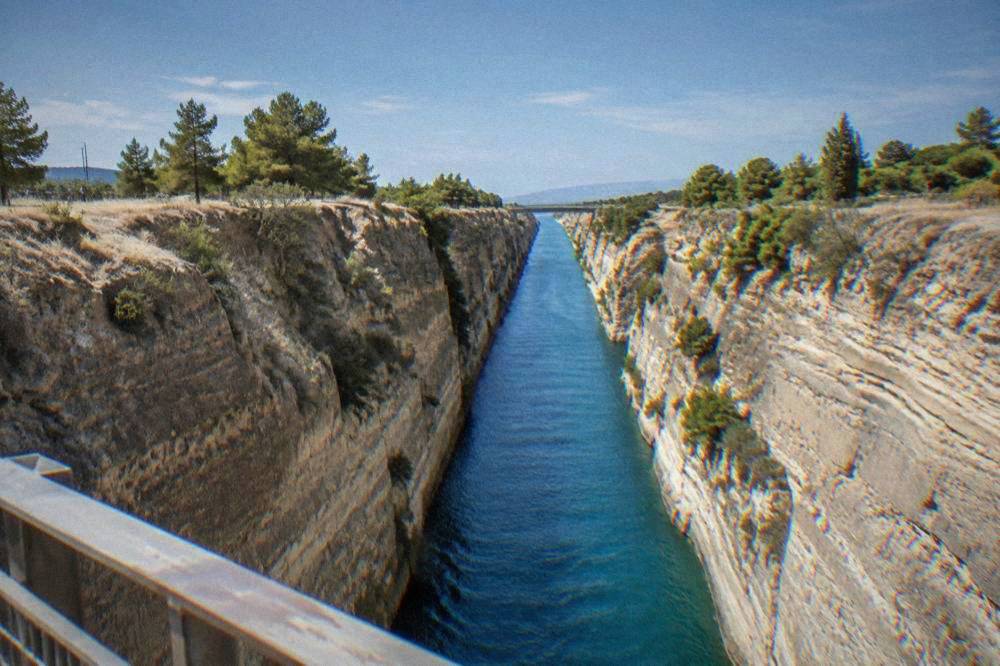
Yes, and the geography argues for it: the Corinth Canal stands at about 72 minutes from Syntagma Square, roughly 11 minutes beyond the ancient site on the same road, so the canal works either as a first stop on the way up or a final stop on the way back. The canal is open to shipping, having reopened in 2026 after slope stabilisation works, and the road crossings at each end are submersible bridges that sink to let vessels pass.
The canal is a stop measured in minutes rather than hours. What a visitor does there is stand on the bridge, look down the sheer cut, and watch the water traffic if the timing is lucky. Older guides that describe the canal as closed are out of date; the operators' own communications confirm it is open to commercial ships and yachts again. No reopening date belongs in your planning, only the fact that it operates.
A sensible self-drive order is canal first, ancient site second, Acrocorinth third if legs allow, then the return drive to the Argolid with an optional Mycenae stop. That sequencing puts the briefest stop at the start of the day when the light on the cut is strong and the site visit in the cooler middle of the day. In the reverse direction, the canal also makes a calm final stop before the drive back down the corridor.
This site keeps a full page on the crossing itself, including the drive times and what the operators publish: Corinth Canal from Nafplio. For the wider picture of how the canal stop fits a loop of the north-eastern Peloponnese, the road-trip guide collects the regional options.
How Does Ancient Corinth Compare With Mycenae And Epidaurus?
Of the three headline archaeological day trips from Nafplio, Mycenae is the closest at about 32 minutes, Epidaurus theatre about 41, and Ancient Corinth the farthest at about 61, and the three offer different things: Mycenae is a Mycenaean citadel, Epidaurus a sanctuary and theatre, Corinth a Roman city. Mycenae and Epidaurus are UNESCO World Heritage sites, inscribed in 1999 and 1988 respectively, while Ancient Corinth is not on the list.
The comparison matters for trip design. Mycenae's Lion Gate and tholos tombs belong to a bronze-age world fifteen centuries before Corinth's forum, and the two sites make an obvious historical pairing, the archaic power and the Roman successor. Epidaurus adds a theatre famous for its acoustics rather than architecture of state. A single very long day can chain all three, but two sites plus a canal stop is the more comfortable shape.
Where the published facts are firm, they are worth carrying. Mycenae costs 20 euro full and 10 euro reduced in 2026, and the ticket covers the site, the museum and the Treasury of Atreus. Epidaurus, theatre, sanctuary and museum together, is likewise 20 and 10. Both follow the state seasonal schedule: winter hours of 08:30 to 15:30, April 08:00 to 19:00, and from 2 May 08:00 to 20:00, with graded reductions through September and October. Ancient Corinth's price and hours are not in the Ministry's published pages, so check the current price on the ticket page before booking.
| Site | Drive from Nafplio | 2026 ticket (full / reduced) | UNESCO |
|---|---|---|---|
| Mycenae | about 32 min | 20 / 10 EUR | Yes, 1999 (with Tiryns) |
| Epidaurus theatre | about 41 min | 20 / 10 EUR | Yes, 1988 |
| Ancient Corinth | about 61 min | confirm locally | No |
| Acrocorinth | about 65 min | confirm locally | No |
| Corinth Canal | about 72 min | viewing free from the bridge | No |
Deeper detail on each pairing sits on this site's own pages: Mycenae, Epidaurus, and the Bronze-Age satellite of Tiryns, which is only about nine minutes from the square and makes an easy add-on if the day runs short of ruins.
Which Tours From Nafplio Include Ancient Corinth?
A handful of guided products run the Corinth corridor from Nafplio or from Athens, and the decision between them comes down to how many stops you want in one day: a four-stop itinerary adds the canal, Mycenae and Epidaurus to Corinth, a licensed-guide option keeps the commentary deep, and a two-stop pairing keeps the day short. Prices, ratings and durations below render from the operators' live listings rather than being typed here.
The related tour for this page, From Athens: Explore Ancient Corinth & Charming Nafplion, is aimed at travellers staying in Athens who want both the ancient site and the town in one day, but it doubles as a useful template for what a Corinth day looks like when someone else drives. Nafplio-based travellers will more naturally pick a multi-stop option. The wider set of guides lives on Nafplio Travel Guide.
That four-stop format is the maximum-density version of the corridor, and it suits a traveller with one full day and no car. For a fuller comparison of the archaeological tours out of the town, this site's tour roundup breaks the options down by itinerary and style.
One caution that applies to every booked option: confirm whether entrance tickets are included before you pay, because products differ on exactly that point, and the site-entry figures for Ancient Corinth are not in the Ministry's published listings.
When Is The Best Time Of Year For A Corinth Day Trip From Nafplio?
The climate record for the Argolid points to April, May, late September and October as the comfortable walking months at Ancient Corinth and Acrocorinth: the HNMS Argos station, 1980 to 2010, shows mean daily highs of 21.3 C in April, 26.5 C in May, 29.7 C in September and 24.7 C in October, against 34.0 C in July, and the Acrocorinth climb has no shade.
The fortress walk is the item that should drive the calendar. The site below is a compact stroll, but Acrocorinth is a sustained uphill path on exposed rock, and the July and August means of 34.0 and 33.7 C belong to early-morning starts or to days when the fortress is skipped. Winter is perfectly usable too, with highs near 14.6 to 15.5 C from December to February, but the rain-day counts climb to over ten a month in midwinter, and the state sites shorten to 08:30 to 15:30, which matters if you are chaining Corinth with Mycenae on state hours.
| Month | Mean daily high (C) | Mean daily low (C) | Rain (mm) |
|---|---|---|---|
| January | 14.6 | 3.0 | 66.5 |
| March | 17.4 | 4.3 | 52.2 |
| April | 21.3 | 6.7 | 33.7 |
| May | 26.5 | 10.5 | 18.7 |
| July | 34.0 | 16.7 | 9.1 |
| September | 29.7 | 14.2 | 20.3 |
| October | 24.7 | 11.5 | 44.3 |
| November | 19.2 | 7.7 | 82.5 |
The same record shows November carrying 82.5 mm of rain against 8.9 mm in June, which is the contrast that matters when the whole day is outdoors. Figures are from the HNMS Argos station, 1980 to 2010, an inland station about 10 km north-west of Nafplio, so the coastal air in town can feel slightly milder than these numbers suggest. This site's full weather and climate page carries the twelve-month table for anyone planning a longer stay.
What Does A One-Day Self-Drive Itinerary Look Like?
A realistic single day from Nafplio runs the corridor in one line: leave the Argolic Gulf side in the morning, stop at the Corinth Canal at about 72 minutes out, descend to Ancient Corinth for the forum and museum, climb or drive toward Acrocorinth, and break the return drive at Mycenae at about 32 minutes from home, with state-site summer hours of 08:00 to 20:00 from 2 May giving the schedule room to breathe.
An early start matters less for the canal than for the ruins. The forum complex rewards an hour to ninety minutes of unhurried walking, and the museum adds another half hour at least. Acrocorinth then takes whatever the group's legs and the season allow; in high summer, either start the whole day early enough to climb before noon or leave the fortress for a cooler visit on another trip. Lunch in the modern village above the site, then the return leg.
| Time | Stop | Notes |
|---|---|---|
| 08:00 | Leave Nafplio | free waterfront lots on Akti Miaouli reported as the parking option |
| 09:15 | Corinth Canal | viewing from the bridge, no ticket needed |
| 10:00 | Ancient Corinth | forum, Temple of Apollo, Peirene fountain, museum |
| 12:30 | Lunch | modern village of Archaia Korinthos |
| 13:30 | Acrocorinth | on-foot climb, exposed path, allow water and time |
| 15:30 | Return drive | optional Mycenae stop at about 32 min from Nafplio |
| 17:30 | Back in Nafplio | evening in the Old Town |
The Mycenae stop on the way home is the one that can bite: its 20 euro ticket, covering site, museum and Treasury of Atreus, is sold at full price only in the summer months, with the 10 euro reduced ticket available from 1 October to 31 May, and its closing times step down through late September and October. If the clock is tight, Mycenae justifies its own day instead, with Nemea, the wine-country base about 49 minutes from the square, as the alternative southern loop. Keep Nemea town and the archaeological site of Ancient Nemea, about 46 minutes out, distinct when planning: the wineries cluster around the former, the ruins at the latter, and no winery opening hours are published here, so confirm any tasting visit directly.
How Do You Get To Ancient Corinth Without A Car?
Without a car, the realistic options are a booked tour or the KTEL bus network with a connection through Corinth: the Athens-bound KTEL from Nafplio reaches the Kifissos terminal in about 2 hours 10 minutes for a reported fare of about 15.70 euro one way, but that route serves Athens rather than the ancient site, and local Corinthia services to Archaia Korinthos are sparse, so a guided day trip is the practical choice for most. There is no train option anywhere on this corridor for a Nafplio traveller.
The bus math is the detail that decides it. The long-distance service runs the highway past the Corinth area but is built for the Athens terminal, and the local connections from Corinth town up to the ancient site do not run at a visitor's rhythm. Reports on the local KTEL network note that even the Argolid's own services to places like Mycenae and Epidaurus are limited, so the Corinthia legs are no better; anyone relying on buses should confirm times at the Nafplio station on Syggrou street before committing a day.
A booked tour also solves the ticket question at a stroke, since operators state whether entrances are included, and it compresses the driving. The trade is simple: independence and free timing on one side, no navigation and no parking on the other. For travellers who choose the car, this site's wider practical pages cover getting around the Argolid and the region's other stops.
What Should You Know Before You Go?
Three things carry the day: confirm Ancient Corinth's price and hours locally because the Ministry's own pages do not publish them; carry water and shoes with grip for Acrocorinth's exposed climb, which has no published facilities list; and remember the state free-admission days, 6 March, 18 April, 18 May, the last weekend of September, the first and third Sundays from November to March, and 28 October, which apply to Greek state sites generally and are worth checking against whichever monuments your day includes.
The free-admission list is the quiet money-saver. Whether it applies to every monument on a Corinth day is a question for the ticket office, since the published free days belong to the state-site system and the Corinth monuments' own listing status is what governs, but on the overlapping days the nearby major sites of the Argolid, Mycenae and Epidaurus among them, are free.
A short equipment list, in plain terms: water in quantity for the fortress, a hat for the forum's open terrace, and nothing fragile for the Acrocorinth path, which is worn stone rather than steps. The general emergency number in Greece is 112, and the General Hospital of Nafplio switchboard is +30 2752 361100 for anything on the Argolid side of the day.
For the town-side end of the trip, this site's pages on Palamidi Fortress, whose stairway is usually counted at about 850 steps and not the legendary 999, and on the harbour islet of Bourtzi, open to visitors by boat, cover the sights waiting when the day returns you to Nafplio's waterfront.
Common Questions About Ancient Corinth From Nafplio
How far is Ancient Corinth from Nafplio?
About 57 km by road and a 61-minute drive in free-flow traffic from Syntagma Square; Acrocorinth above the site adds roughly two more kilometres, about 65 minutes in total.
Can you visit Ancient Corinth and the Corinth Canal on the same day?
Yes, easily. The canal lies about 72 minutes from Nafplio, roughly 11 minutes beyond the ancient site on the same road, and viewing from the bridge takes minutes rather than hours.
Is Acrocorinth worth the climb?
The fortress rock carries layered Frankish, Venetian and Ottoman walls, and the summit takes in both gulfs on clear days. The path is exposed and on foot, so the season and the hour matter more than the distance.
Is there a bus from Nafplio to Ancient Corinth?
Not a direct visitor-friendly one. The Athens-bound KTEL passes the Corinthia but serves the Kifissos terminal in Athens, reported at about 15.70 euro one way, and local connections to the ancient site are sparse; a booked tour is the practical car-free option.
Is Ancient Corinth a UNESCO site?
No. The UNESCO World Heritage sites on Nafplio's day-trip map are Mycenae with Tiryns, inscribed in 1999, and the Sanctuary of Asklepios at Epidaurus, inscribed in 1988.