Nafplio Photography: Best Viewpoints And When To Shoot
Nafplio packs a fortress, an islet, a Venetian old town and a wide gulf into a walkable frame, and this page maps the viewpoints and the light that make the photographs work.
Short answer
The strongest photographic ground in Nafplio is the east wall of Palamidi Fortress at 216 m above the Old Town for the wide shot, the Arvanitia Promenade for the coastline, and the harbour front at first light for Bourtzi. Shoot early or late: the Ministry of Culture's visiting pages keep Palamidi open from 08:00 to 20:00 from 2 May 2026, and the July mean daily high is 34.0 C.
Nafplio gives a camera more variety per square kilometre than almost any town of its size in Greece. A small coastal town of about 14,500 residents in the Argolid, on the north-east Peloponnese and the Argolic Gulf, it stacks a 216 m fortress above a Venetian-era Old Town, a fortified islet in the harbour, and day trips to Mycenae, Epidaurus and Tiryns, two of them UNESCO World Heritage sites, all within an hour's drive. This page, from the Nafplio Travel Guide editorial desk, sets out the viewpoints, the seasonal light and the site hours that shape a photography plan, using official sources for every ticket and opening figure. For a broader grounding, start with the site's things to do in Nafplio overview.
What Are The Best Photography Viewpoints In Nafplio?
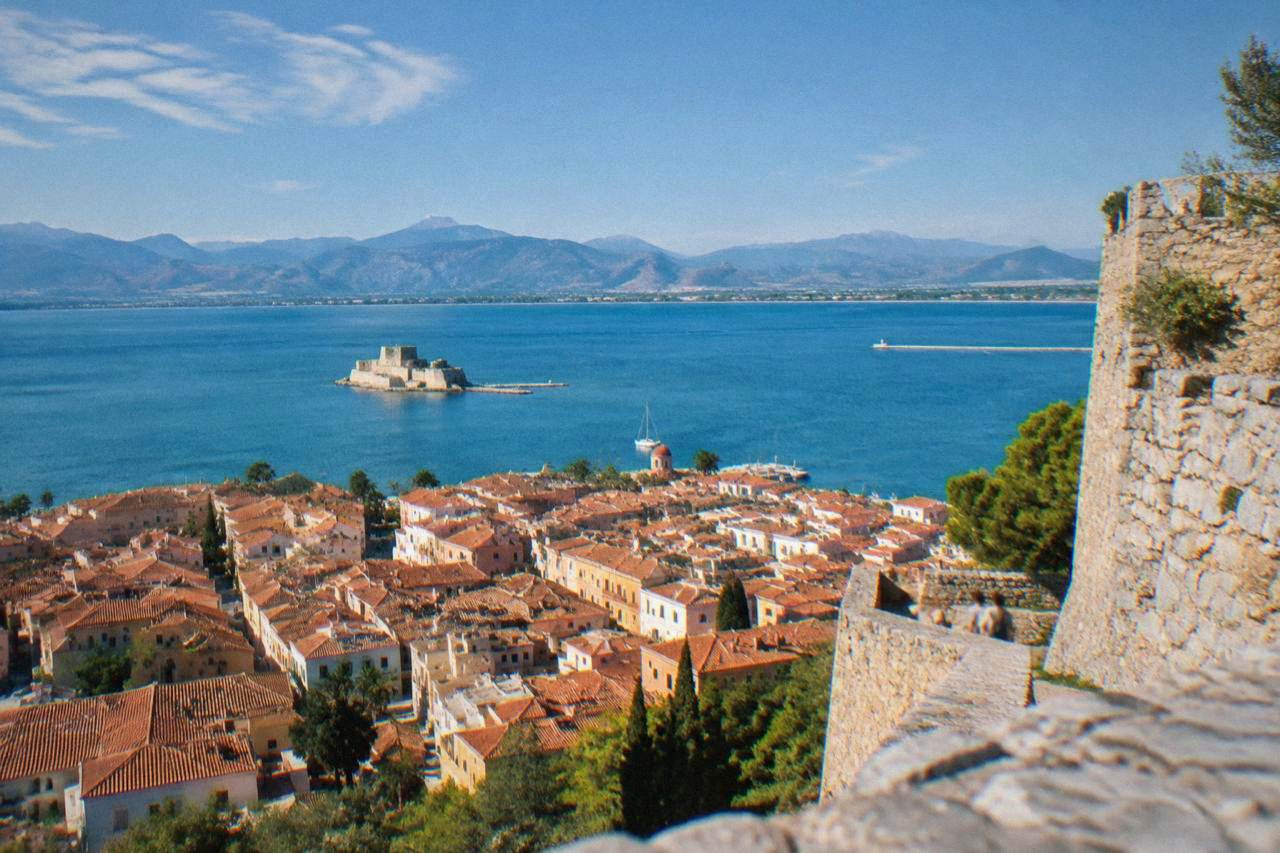
The best viewpoints in Nafplio are the east bastions of Palamidi Fortress at 216 m above the Old Town for the town-and-gulf panorama, the Arvanitia Promenade for the cliff and coastline, the Five Brothers Bastion for Bourtzi and the harbour, and the Pronoia side of the water for the classic skyline with the fortress behind the rooftops. Each is reached on foot from Syntagma Square in under an hour.
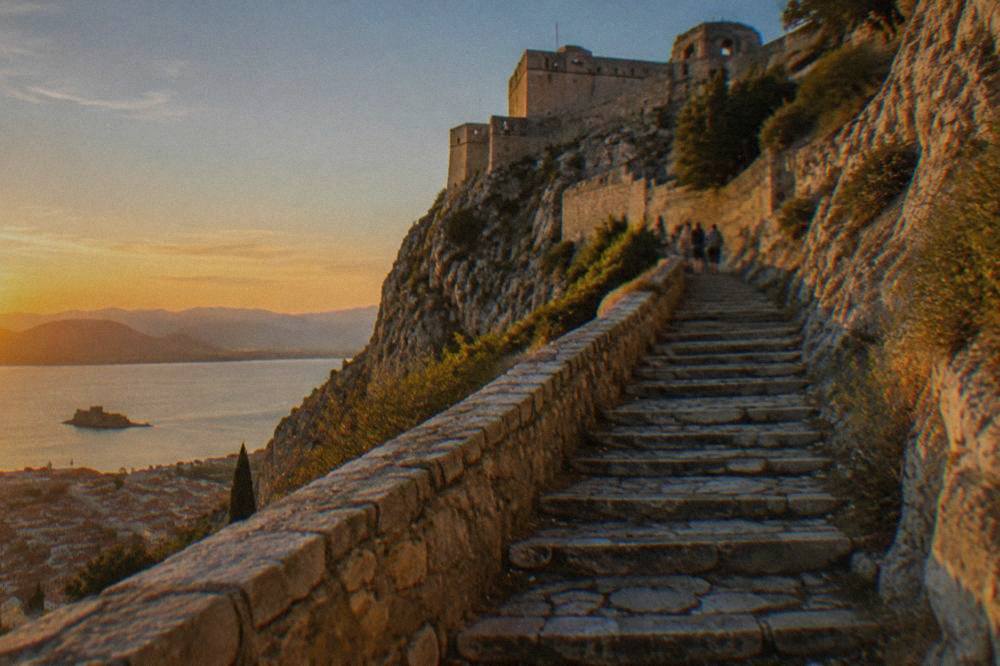
Palamidi is the anchor. The fortress, fortified by the Venetians in the second Venetian period from 1686 to 1715 and taken by Greek forces in 1822, per the Argolis culture authority's monument page, looks down on the whole bowl of the town, the Argolic Gulf and, on clear days, the coast toward Tolo. The stairway from the west side is usually counted at 857 carved steps, about 850 steps and not the legendary 999 that folklore claims, and the climb itself is a strong documentary subject: the steps zigzag up the rock face with the town dropping away behind. Entry costs 20 euro full and 10 euro reduced in 2026, per the Ministry of Culture's visiting page, and the reduced ticket is sold only from 1 October to 31 May.
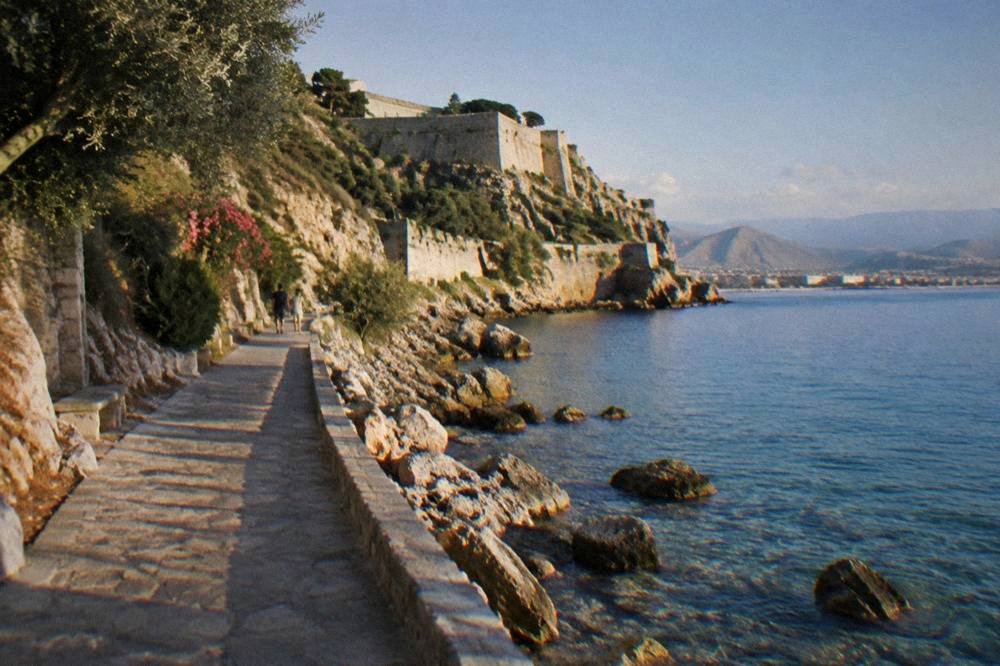
The second tier of viewpoints sits at sea level. The Arvanitia Promenade, a paved coastal path of about 1 km running from the harbour lighthouse below Akronafplia to Arvanitia square, frames the old acropolis walls against the water. Across the harbour, the Pronoia district and the spot near the Lion of Bavaria, carved 1840 to 1841 by Christian Heinrich Siegel per the Argolis culture authority, give the reverse angle: the town piled under the fortress. The site's dedicated Nafplio walking tour guide covers the street geography in detail, as does the Old Town overview page.
| Viewpoint | Subject | Best time of day | Access notes |
|---|---|---|---|
| Palamidi east bastions | Town, gulf, harbour, Bourtzi | Morning to midday | 20 euro full ticket, 10 euro reduced Oct to May |
| Palamidi stairway | Steps, rock face, town below | Late afternoon light on the steps | Same ticket as fortress |
| Arvanitia Promenade | Akronafplia cliffs, coastline | Late afternoon into sunset | Free, paved, about 1 km |
| Five Brothers Bastion | Harbour, Bourtzi, waterfront | Morning | Free, at the harbour edge |
| Pronoia waterfront | Skyline with fortress behind roofs | Sunset and blue hour | Free, flat |
| Syntagma Square | Old town architecture, Vouleftiko | Evening when lamps are lit | Free |
When Is The Best Light For Photography In Nafplio?
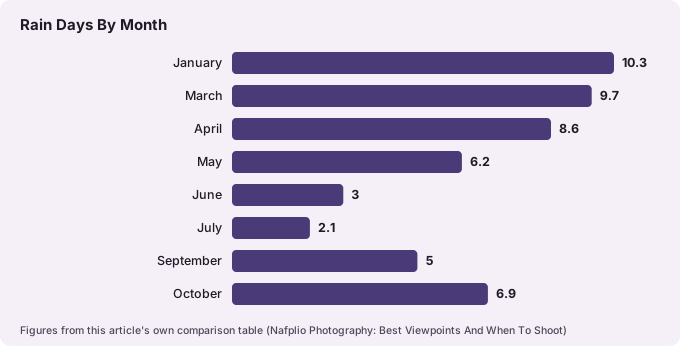
The best light for photography in Nafplio falls in the early morning and again before sunset, and the shoulder months give the most workable combination of light and temperature: the HNMS Argos station table for 1980 to 2010 shows mean daily highs of 21.3 C in April, 26.5 C in May and 24.7 C in October, against 34.0 C in July, with July also among the drier months at 9.1 mm of rain.
The climate figures come from the HNMS Argos station, 1980 to 2010, the nearest official station, about 10 km north-west of Syntagma Square and inland, so the waterfront can differ slightly. What matters for a camera is the pattern those numbers describe. Summer mornings are the workable window: by midday in July the town sits under a 34.0 C mean high, hard light and heat haze flatten the rooftops, and shooting shifts to shaded Old Town alleys or moves indoors. June, with a mean high of 31.4 C and only 8.9 mm of rain across 3.0 rain days, and July are reliable for blue-sky frames. November carries the highest monthly rainfall in the table at 82.5 mm over 9.4 rain days, which makes it a gamble, but the rain-washed streets of the Old Town after a shower are a legitimate subject, and the site keeps a dedicated guide to Nafplio in winter and rain.
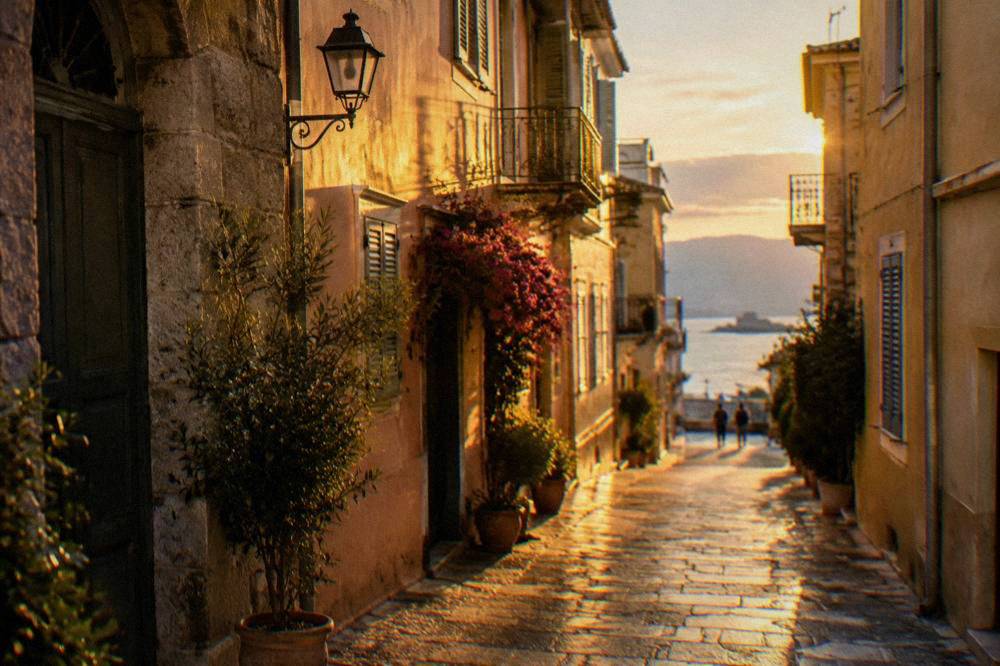
Winter has its own case. The mean daily minimum in February is 2.9 C and the January high is 14.6 C, cold mornings that can put clean, low winter light on the harbour before nine. Palamidi's winter hours are 08:30 to 15:30, per the Ministry of Culture's visiting page, which pulls the fortress panorama into the short-day schedule. Whatever the month, the site hours govern the plan: the fortress runs 08:00 to 19:00 in April, from 08:00 to 20:00 from 2 May 2026, then steps down through September and October to 08:00 to 18:00 by the second half of October.
| Month | Mean daily high (C) | Mean daily low (C) | Rainfall (mm) | Rain days |
|---|---|---|---|---|
| January | 14.6 | 3.0 | 66.5 | 10.3 |
| March | 17.4 | 4.3 | 52.2 | 9.7 |
| April | 21.3 | 6.7 | 33.7 | 8.6 |
| May | 26.5 | 10.5 | 18.7 | 6.2 |
| June | 31.4 | 14.0 | 8.9 | 3.0 |
| July | 34.0 | 16.7 | 9.1 | 2.1 |
| September | 29.7 | 14.2 | 20.3 | 5.0 |
| October | 24.7 | 11.5 | 44.3 | 6.9 |
| November | 19.2 | 7.7 | 82.5 | 9.4 |
All figures HNMS Argos station, 1980 to 2010.
Two small-group options fit a photography day directly. A guided walk of the town keeps the pace slow enough to frame shots, and a private Mycenae-and-Epidaurus outing carries the camera to the two headline ancient sites without parking logistics.
How Do You Photograph Palamidi Fortress And Its Stairway?
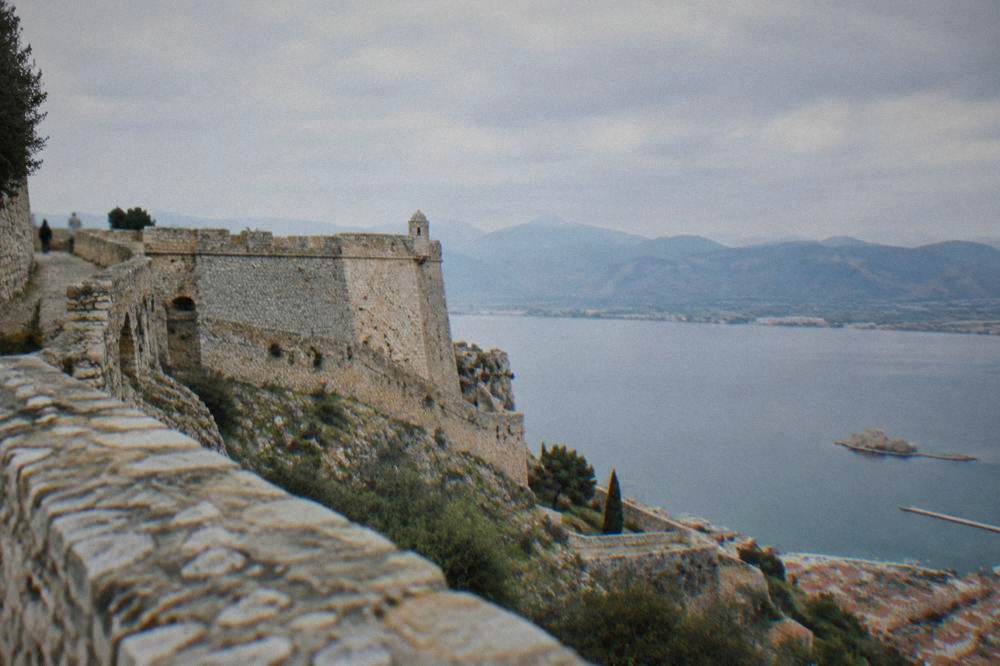
Palamidi photographs best in two passes: the stairway in late afternoon, when low sun rakes across the about-850-step zigzag and the rock face above the west side of town, and the bastion ramparts in the morning, when the sun sits over the gulf and lights the Old Town below. The fortress stands 216 m above sea level, the Ministry of Culture's visiting page confirms, and from 2 May 2026 it stays open until 20:00, long enough for a sunset from the walls.
The stairway is usually counted at 857 steps, not the legendary 999, and the correction matters for planning: the climb is shorter than the folklore suggests but still a sustained ascent, and the frames improve the higher you get. Shoot back down the steps toward the rooftops every few landings, because the angle tightens as you rise. Inside, the fortification was built 1711 to 1714 on Venetian plans and was taken by Staikos Staikopoulos on the night of 29 to 30 November 1822, per the kastra.eu castle record, and the bastions, vaulted casemates and gun ports give strong architectural detail against the sky.
Timing against the calendar is simple. Winter hours of 08:30 to 15:30 mean the low-season fortress is a midday subject by necessity. In summer the 08:00 to 20:00 window from 2 May lets the final hours of light happen inside the walls, and the reduced 10 euro ticket runs only from 1 October to 31 May, so a summer visit carries the 20 euro full price. The Palamidi Fortress guide on this site expands on the history and the bastions.
Where Do You Shoot Bourtzi And The Harbour?
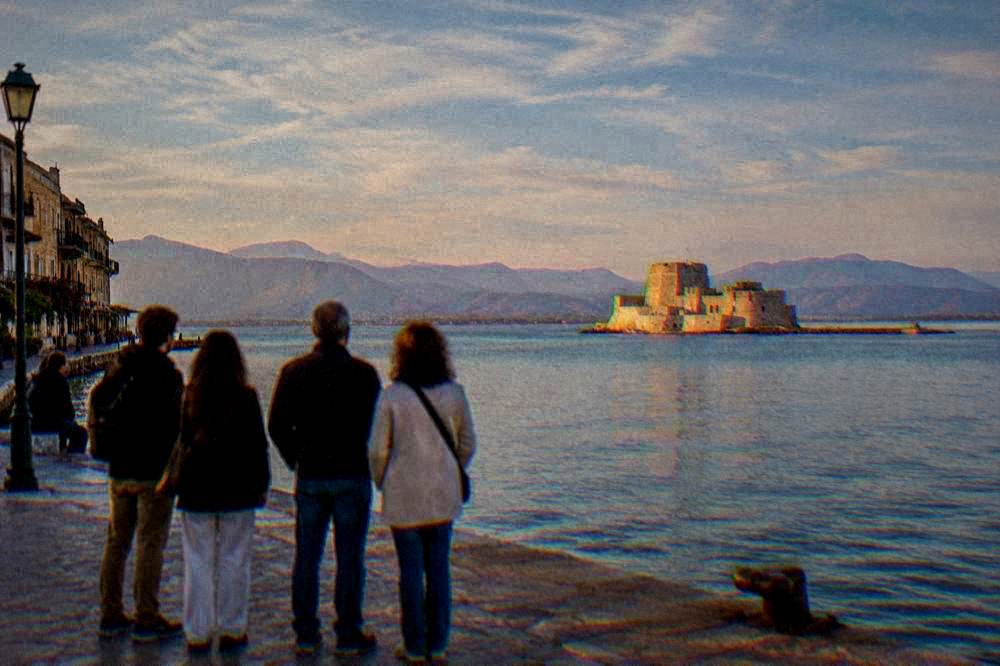
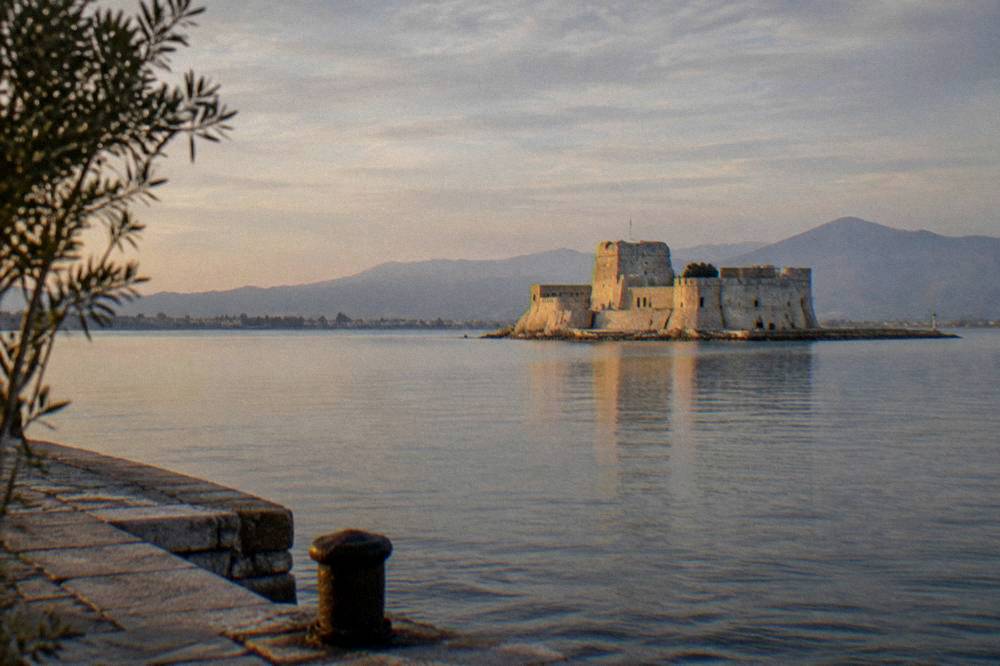
Bourtzi, the small fortified islet in Nafplio's harbour, is best photographed from the waterfront in first light, when the sun rises behind it across the gulf and the water is at its stillest, and from the Five Brothers Bastion for an elevated angle with the town in the frame. The islet is open to visitors, reached by boat for a fee from the harbour, with a 7 euro full ticket and 5 euro reduced, per the Ministry of Culture's listing.
The islet's own history page states construction began in June 1471 under the architect Antonio Gambello, and the sea fort later served, among other uses, as a hotel leased in the early 1930s. Those layers make it worth photographing up close as well as from the shore: the low walls against open water compress well with a longer lens from the promenade. Hours matter here too. The Ministry's listing gives July and August hours of 09:00 to 21:00, September 09:00 to 20:00, and November and December 09:00 to 17:00, and the site is closed on 1 January, Easter Sunday and 25 December.
Around the harbour, the whole waterfront from the lighthouse to the Land Gate works as a dawn strip. The harbour and waterfront guide and the Bourtzi page on this site carry the detail. A tripod on the promenade after the lamps come on catches the islet as a lit reflection, and the blue-hour window is short in summer, so arrive before the sky loses its colour.
What Should You Photograph In The Old Town And Syntagma Square?
The Old Town rewards detail work: Venetian and Ottoman-era doorways, the arcaded facades around Syntagma Square, the Vouleftiko building that hosted the first Greek parliament sessions from 1825, and the alley network of Psaromachalas climbing toward Akronafplia. The square is the natural evening frame, the Archaeological Museum sits in the former Venetian arsenal on its west side, and everything is within a few minutes' walk.
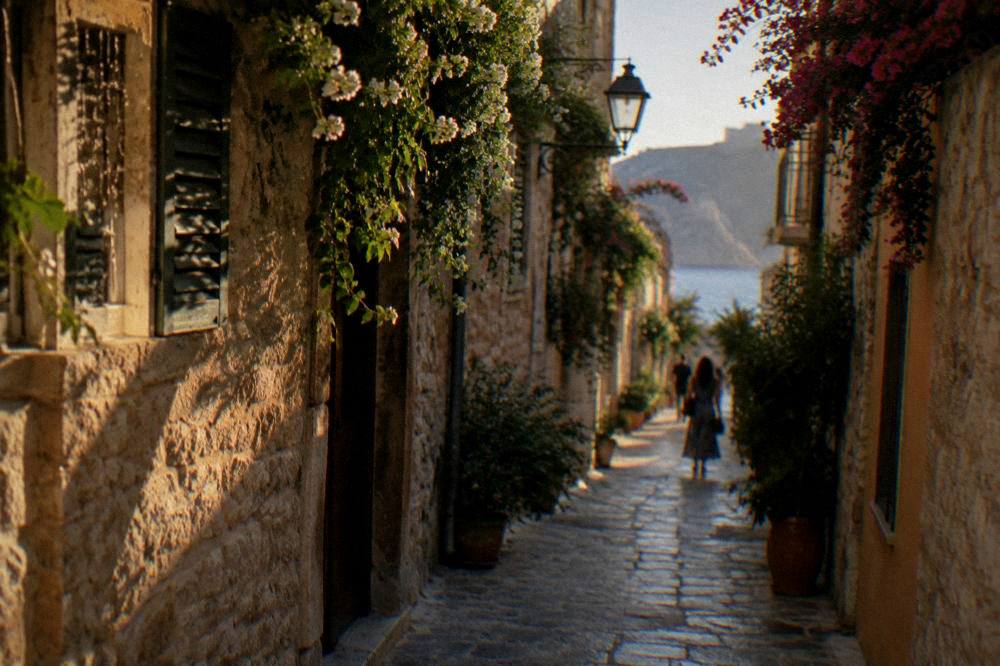
Nafplio was the capital of Greece from 1827 to 1834, the first capital of the modern Greek state, and that decade left the town its densest layer of photographed buildings: the Vouleftiko, the Church of Agios Spyridon outside which Governor Ioannis Kapodistrias was assassinated in September 1831, and the neoclassical rows around the square. The town's longer past runs underneath, with Venetian rule from 1389 to 1540 and again from 1686 to 1715, per the Argolis culture authority. Photographically, the alleys are at their best in the hour after the direct sun leaves them, when reflected light softens the pastel walls. The history of Nafplio guide and the Syntagma Square page go deeper.
For a slow, guided pass through these streets with time to frame each shot, a city walking tour is the natural fit, and a local-led private walk goes further into the back lanes.
Which Day Trips From Nafplio Are Worth The Camera?
The camera-worthy day trips from Nafplio are Mycenae at about 32 minutes' drive for the Lion Gate and the vaulted Treasury of Atreus, Epidaurus at about 41 minutes for the theatre's stone tiers, Tiryns at about 9 minutes for its massive Cyclopean walls, and Ancient Corinth at about 61 minutes, with the Corinth Canal, about 72 minutes, open to shipping as a stopping point on the same road. All drive times are computed from Syntagma Square over free-flow routing and should be treated as about.
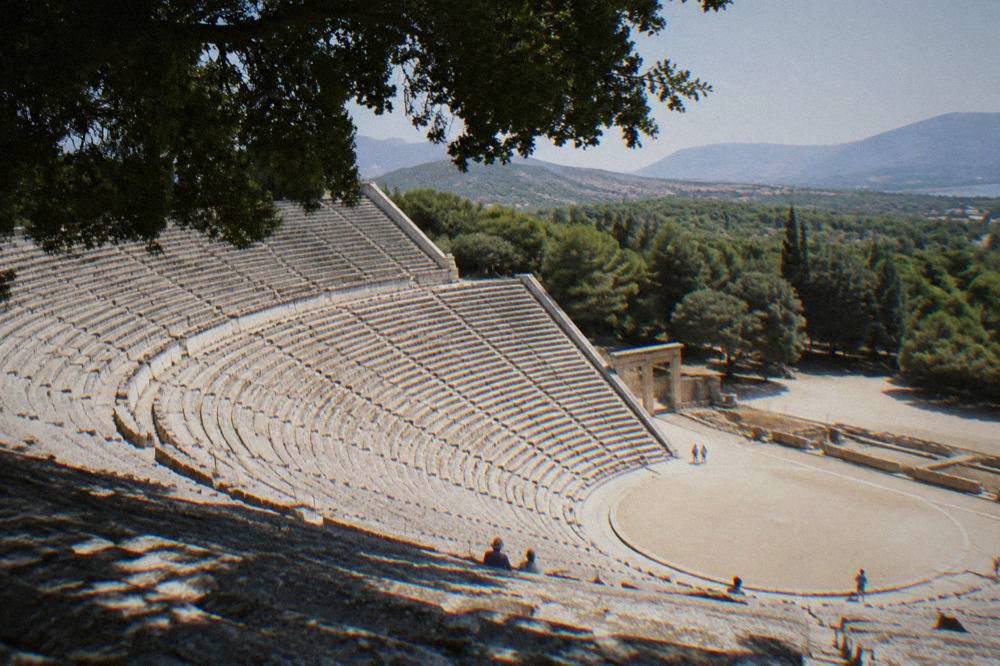
Mycenae and Tiryns form one UNESCO World Heritage inscription, listed in 1999, and the Sanctuary of Asklepios at Epidaurus was inscribed in 1988. Mycenae's 2026 ticket is 20 euro full and 10 euro reduced, covering the site, the museum and the Treasury of Atreus, per the Ministry of Culture's visiting page, and Epidaurus is likewise 20 euro full and 10 euro reduced, valid for the theatre, sanctuary and museum. Both follow the state-site seasonal hours: winter 08:30 to 15:30, April 08:00 to 19:00, from 2 May 08:00 to 20:00, tapering through the autumn. Epidaurus keeps winter hours of 08:00 to 17:00, from 08:00 to 18:00 starting 1 March. The theatre is the single most photographed ancient frame in the Argolid: shoot it from the top tier for the concentric geometry, and early, before groups arrive.
| Site | Drive from Syntagma Square | 2026 ticket | Hours anchor |
|---|---|---|---|
| Tiryns | about 9 min | ticket price not published officially, confirm on site | state winter hours apply |
| Argos (agora and theatre) | about 18 min | 10 euro full, 5 euro reduced | 08:30 to 15:30 |
| Mycenae | about 32 min | 20 euro full, 10 euro reduced | 08:00 to 20:00 from 2 May |
| Epidaurus theatre | about 41 min | 20 euro full, 10 euro reduced | 08:00 to 18:00 from 1 March |
| Palaia Epidavros | about 47 min | as Epidaurus area, confirm locally | seasonal |
| Ancient Corinth | about 61 min | ticket price never printed without confirmation | check the ticket page before booking |
| Corinth Canal | about 72 min | viewing is free | open to shipping |
One correction worth a sentence: older guides still list 12 euro tickets for Mycenae and Epidaurus, which is out of date, the 2026 price at both is 20 euro full. The Little Theatre of Epidaurus is closed to day visits per the Ministry's listing, so plan around the main sanctuary. The Mycenae guide and Epidaurus guide on this site cover both sites in full.
Where Can You Photograph The Coast Around Nafplio?
The coast around Nafplio photographs well from three strands: the Arvanitia Promenade's about-1 km clifftop path below Akronafplia, the organised Blue Flag pebble beach at Arvanitia, and the long sandy stretch at Karathona, about 3 to 4 km from the centre along the coast road, with Tolo's beachfront a further drive of about 17 minutes from Syntagma Square. The promenade and Arvanitia need no ticket and carry the best low-light angles in town.
Arvanitia is a Blue Flag beach, organised in summer with sunbeds and facilities, per the local city guide site, and the pebbles and rocky edges give foreground texture for gulf sunsets. Karathona is the sandy alternative, reached by road or by the coastal walking route, and it frames the fortress from a distance no town viewpoint can manage. For the wider coast, the site's Nafplio beaches guide covers access and facilities, and the Tolo page extends the chain south. A sea-level angle on Akronafplia's walls from the water is the one frame the shore cannot deliver; a kayak or sailing outing changes that, and the Nafplio boat trips guide lists the options. Note that no scheduled public ferry runs from Nafplio or Tolo to Hydra or Spetses; the islands are reached by seasonal day cruise or from another port.
What Should You Pack For A Photography Trip To Nafplio?
A photography kit for Nafplio needs three things above all: a wide lens for the fortress panoramas and the theatre at Epidaurus, a longer lens for compressing Bourtzi across the water and detail on the bastions, and solid footwear for the about-850-step Palamidi stairway and the cobbled alleys, with a summer start time early enough to beat the 34.0 C July mean daily high that the HNMS Argos station table, 1980 to 2010, records.
Water carries more weight here than gear fiddling. The climb to Palamidi and the walk to Epidaurus's top tier both happen in open sun, and the June and July mean highs of 31.4 C and 34.0 C make the first two hours after opening the comfortable window. Hours, not weather, set the hard limits: state sites close on 1 January, 25 March, 1 May, Easter Sunday and 25 and 26 December, and the Archaeological Museum of Nafplio, 10 euro full and 5 euro reduced, is closed every Tuesday, so plan indoor frames around that. The free-admission days, including 18 May and the last September weekend, are busier and best treated as people-photography days rather than empty-frame days. For trip logistics beyond the camera, the site's guides on getting around Nafplio and parking in Nafplio cover the practical ground, since the Old Town is largely closed to visitor parking and the free lots sit on the Akti Miaouli waterfront.
Common Questions About Nafplio Photography
What are the best viewpoints in Nafplio?
The east bastions of Palamidi Fortress at 216 m for the panorama, the Arvanitia Promenade for the cliffs and coast, the Five Brothers Bastion for Bourtzi, and the Pronoia waterfront for the skyline with the fortress behind the rooftops.
When is the best light for photography in Nafplio?
Early morning and the last two hours before sunset. In July, with a mean daily high of 34.0 C per the HNMS Argos station table for 1980 to 2010, the midday hours are better spent in the shaded alleys of the Old Town.
Can you photograph inside Palamidi Fortress?
Yes, within opening hours: 08:00 to 20:00 from 2 May 2026, stepping down through September and October, and 08:30 to 15:30 in winter. The 2026 ticket is 20 euro full and 10 euro reduced, with the reduced price sold only from 1 October to 31 May.
Can you photograph Bourtzi?
Yes. The islet is open to visitors by boat for a fee, with a 7 euro full and 5 euro reduced ticket, and July and August hours of 09:00 to 21:00. Confirm the boat fare at the pier, as the official page does not publish it.
How many steps does Palamidi have for photography?
The stairway is usually counted at 857 steps, about 850 and not the legendary 999. The zigzag itself is one of the strongest photographic subjects in the town, especially in late afternoon light.
Is Epidaurus worth photographing?
Yes. The theatre's concentric tiers are the standout frame, a 20 euro full ticket in 2026 covers the theatre, sanctuary and museum, and the site opens at 08:00, making the first hour after opening the quietest time to shoot it.