Where To Stay In Nafplio: Areas And Hotels
Nafplio, a small coastal town in the Argolid on the Peloponnese's Argolic Gulf, splits its lodging into a pedestrian Old Town, a harbour strip below Akronafplia, and the quieter Arvanitia and Pronia slopes. This guide sets out what each area offers and how to match one to your trip.
Short answer
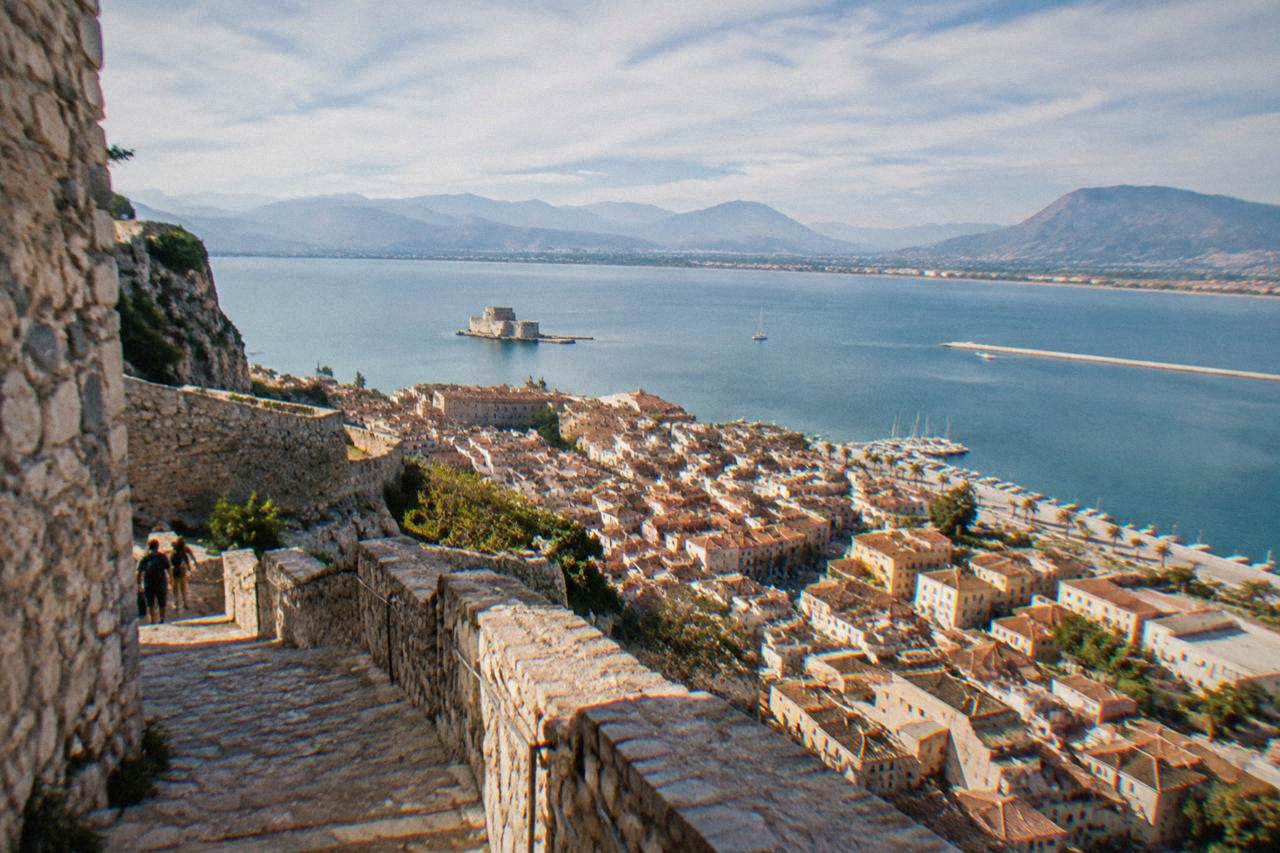
Stay in the Old Town if you want to step out of the door onto Syntagma Square, the harbour and the Palamidi stairway; stay on the Arvanitia or Pronia side for calm and sea views a short drive or walk from the centre; stay in Tolo, about 17 minutes away by road, for a beach-base alternative.
Nafplio, a coastal town of about 14,500 residents on the Argolic Gulf in the Argolid, in the north-east Peloponnese of mainland Greece, was the capital of Greece from 1827 to 1834, and its lodging map still follows that history. The bulk of the hotels and guesthouses sit inside or immediately around the Old Town, the Venetian-and-Ottoman core that fans out from Syntagma Square to the harbour, with the rock of Akronafplia above and Palamidi Fortress standing 216 m over the whole scene. Around that core sit quieter residential slopes, Arvanitia and Pronia to the south and east, and beyond the town the beach areas of Karathona and Tolo. Choosing between them is mostly a choice between atmosphere and convenience, and this guide from the Nafplio Travel Guide editorial desk walks through each area with what the sources say.
One practical fact applies to every bed in every area: Greece charges a climate resilience fee per room per night, collected by the accommodation itself, and it is higher from April to October than from November to March. The per-star amounts float around on secondary sites, but the only safe statement is that the fee exists, is added by the place you book, and should be confirmed at booking.
Which Area Of Nafplio Should You Stay In?
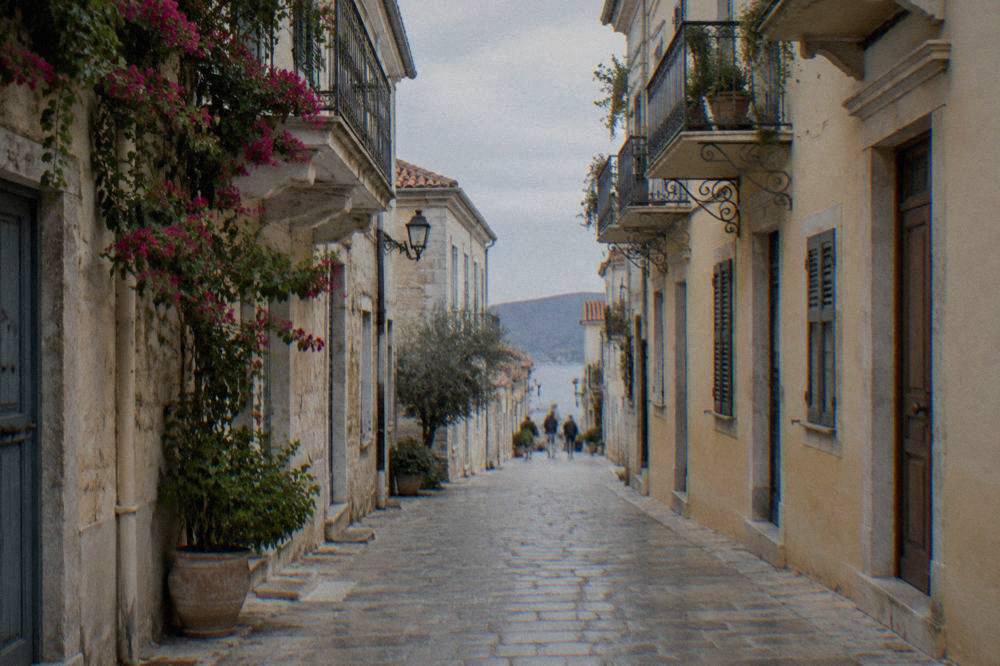
The centre of gravity for Nafplio lodging is the Old Town, the streets between Syntagma Square and the harbour, and it suits a first visit best because Palamidi Fortress, Bourtzi, the Archaeological Museum and the waterfront are all inside a compact walkable core. Akronafplia and the harbour sit at its west end, Arvanitia and the Palamidi side at its east, and Pronia across to the south-east. Tolo, about 17 minutes away by road, is the beach alternative.
The Old Town is largely closed to visitor parking, per the local guidance this site reports, so a room in its lanes means arriving by taxi or on foot from the free lots on the Akti Miaouli waterfront and leaving the car there for the stay. That trade is the whole decision in miniature. Inside the core you give up the car and gain the town: the square, the museums, the Land Gate, the seafront, and the stairway up Palamidi, about 850 carved steps, not the legendary 999 that folklore keeps repeating.
The areas around the core reverse that trade. Arvanitia, Pronia and the Karathona road have normal street life, easier parking and often wider views, at the price of a longer walk or a short drive to dinner. Karathona beach sits roughly 3 to 4 km from the centre along the Arvanitia path or the 25 Martiou road, and Tolo beyond it, at about 17 minutes' drive from Syntagma Square, is a full resort town of its own on the Argolic Gulf.
The Areas Compared
| Area | Character | Suits | Trade-off |
|---|---|---|---|
| Old Town and Syntagma Square | Pedestrian lanes, museums, cafes, shops | First visits, no-car stays | Restricted parking, narrow lanes with luggage |
| Akronafplia and the harbour | Rock above the port, waterfront strip | Harbour views, boat trips, Bourtzi access | Slopes and steps up to the rock itself |
| Arvanitia and the Palamidi side | Quiet slopes, sea cliffs, the Palamidi stairway | Walkers, hikers, calm nights | Climb back up from the centre |
| Pronia | Residential district south-east of the core | Longer stays, self-catering, drivers | Less atmosphere after dark |
| Karathona | Coastal road and beach about 3 to 4 km out | Beach-first trips | Drive or a long walk to the Old Town |
| Tolo | Resort town about 17 minutes by road | Families, beach bases, boat cruises | Not Nafplio: you commute in |
A good way to test which side of that table fits you is to cover the town's geography in a single loop. The cycling tour of Nafplio does exactly that, linking the Old Town, the waterfront and the Arvanitia side on two wheels, and Check availability if you want to ride the loop before committing to an area. Two more options that pair well with an orientation day:
Is The Old Town The Best Base For A First Visit To Nafplio?
For a first visit to Nafplio the Old Town is the strongest base, and the reason is geometry rather than charm: Syntagma Square, the Archaeological Museum, the Vouleftiko, the Church of Agios Spyridon, the Land Gate, the harbour and the Palamidi stairway all sit inside or on the edge of the same compact core, so a visitor without a car loses almost nothing by staying there.
Syntagma Square is the recognised centre of the town, the point from which this site's computed drive times are measured. The Archaeological Museum of Nafplio stands in the square's Venetian arsenal and is open 08:30 to 15:30 all year, closed Tuesdays, with a 10 euro full ticket and a 5 euro reduced ticket in 2026, per the Ministry of Culture's visiting page. The first parliament building, the Vouleftiko, and the Church of Agios Spyridon, outside which Governor Kapodistrias was assassinated in September 1831, are a few lanes away.
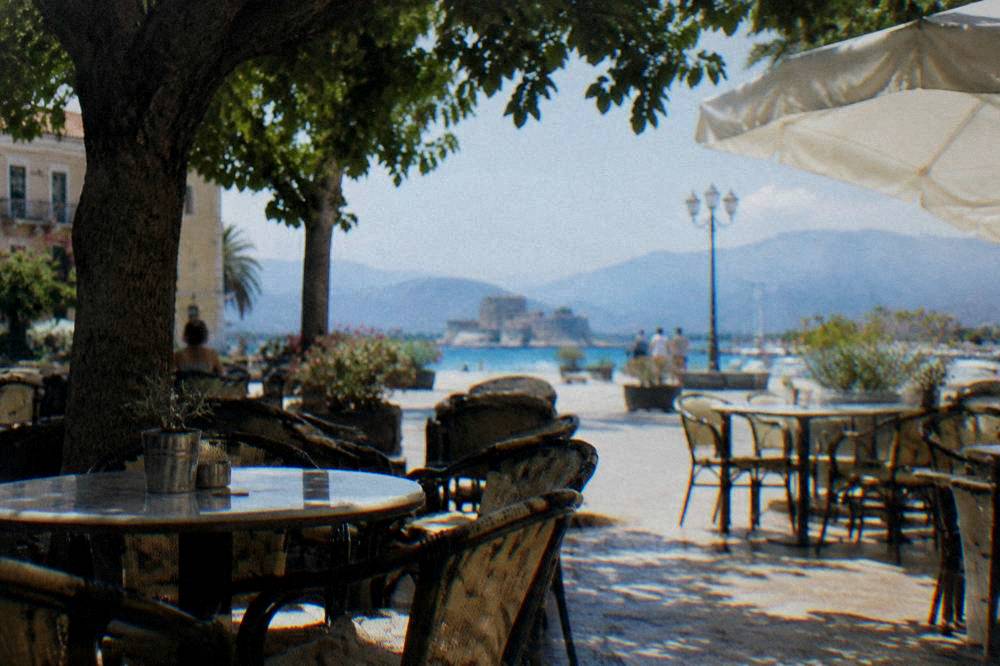
Staying in the core also puts the evening economy on foot.
The trade is the car. Local parking guidance, as reported by the town's own information pages, is that the Old Town is largely closed to visitor parking, with permit zones for residents, and that the free public lots sit on the Akti Miaouli waterfront a short walk out. If you are driving in, plan the arrival around those lots and read the site's parking in Nafplio guide before you set the GPS for your hotel door.
What Is It Like To Stay Near Akronafplia And The Harbour?
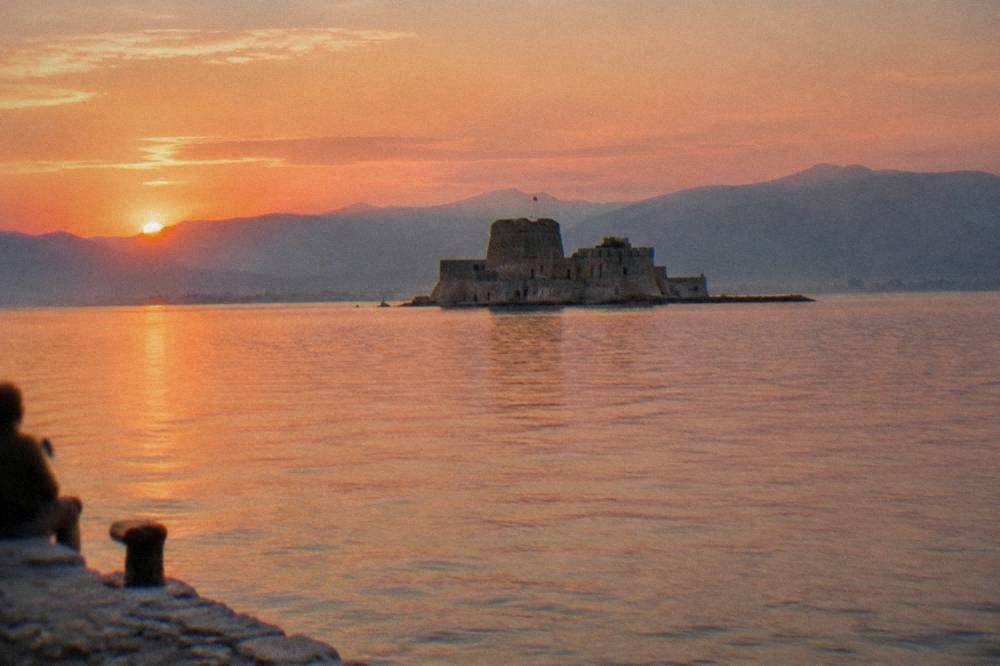
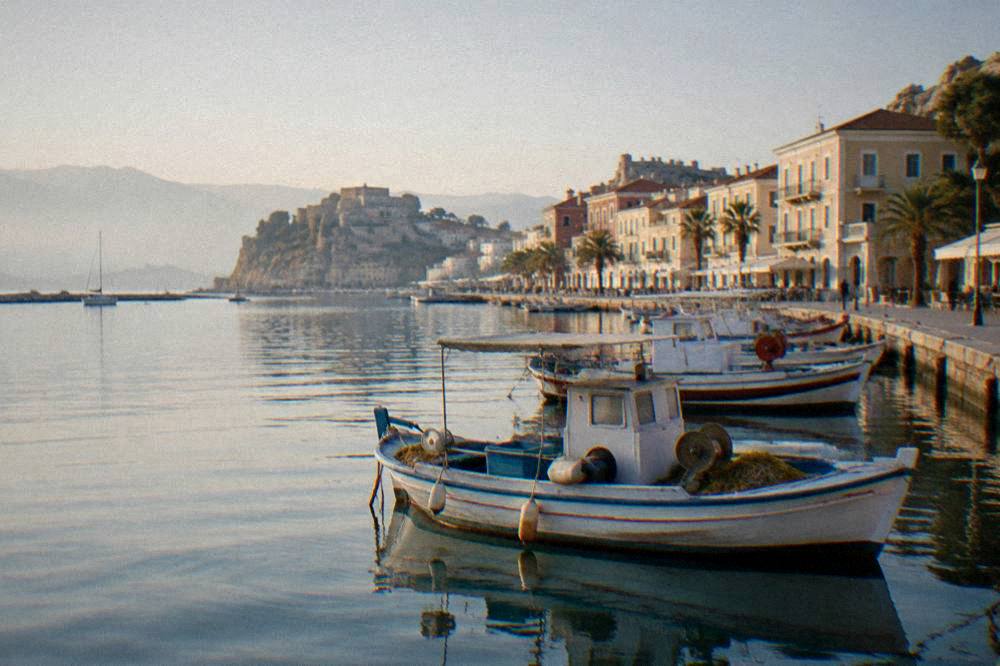
Akronafplia is the old acropolis rock above Nafplio harbour, and the lodging grouped as Akronafplia and the harbour occupies the western end of the core: rooms on or under the rock look straight down the port at Bourtzi, the fortified islet begun in June 1471, and at the cruise tenders and fishing boats, all within the same walkable core as Syntagma Square.
The harbour strip is the flattest part of the whole lodging map, which matters more than it sounds in a town built on a fortress rock. Bourtzi sits in the water a few hundred metres out, is open to visitors by boat for a fee, and carries a 7 euro full and 5 euro reduced ticket in 2026, per the Ministry of Culture's page for the monument. The boat departs from the harbour this area looks onto. The Akronafplia promenade, a paved coastal path of about 1 km, runs from the harbour lighthouse around the rock to Arvanitia beach, so the seafront walk starts at this area's doorstep.
Akronafplia's own walls carry the deepest history in town: polygonal masonry from at least the end of the 4th century BC, Frankish works from 1210 to 1389, and Venetian fortification in the periods 1389 to 1540 and 1686 to 1715, per the Argolis antiquities authority's monument page. Rooms on the rock itself sit inside that fabric, reached by slopes and stairs, a fact worth weighing with heavy luggage or limited mobility in mind, since this site prints no accessibility claims for any sight or building.
For travellers who want the harbour as a view rather than a district, the boat and cruise offer clusters here too: the site's Nafplio boat trips guide lists the sailing and catamaran options that depart from this waterfront. A Catamaran Cruise with a Greek buffet and open bar is one of the most-booked ways onto the water from this harbour:
Why Stay On The Arvanitia And Palamidi Side Of Nafplio?
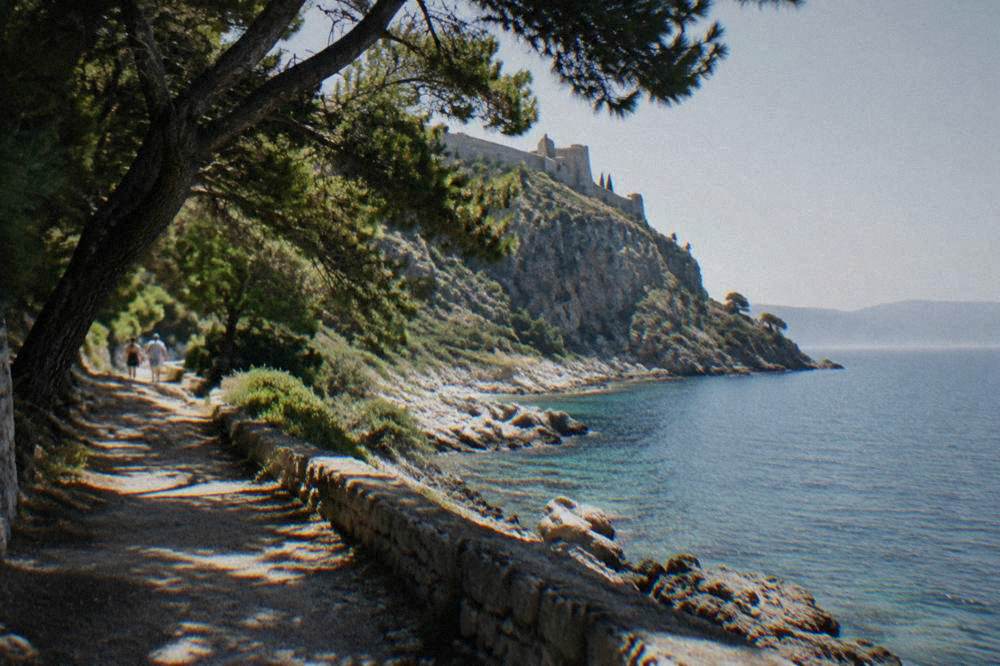
Arvanitia and the Palamidi side is the quiet eastern flank of Nafplio, where the Old Town runs out at the sea cliffs below the fortress, and it suits visitors who want calm nights, walking access to the Arvanitia promenade and beach, and the famous stairway, about 850 steps rather than the legendary 999, up to Palamidi Fortress practically outside the door.
Palamidi stands 216 m above the Old Town, built by the Venetians and taken by the Greeks in 1822, per the Argolis antiquities authority. Its stairway drops from the fortress to the town's eastern edge, and rooms on this side sit closest to it. The 2026 fortress ticket is 20 euro full and 10 euro reduced, with the reduced ticket sold only from 1 October to 31 May, and summer hours from 2 May run 08:00 to 20:00, per the Ministry of Culture's visiting page. Guests on this side can be at the gate for opening and back down before the midday heat, a genuine planning advantage the HNMS Argos station table makes plain: July's mean daily high at that station, 1980 to 2010, is 34.0 C.
Arvanitia beach itself is a Blue Flag pebble beach with summer organisation, as its local listing reports, and the promenade around to it is about 1 km of paved coastal path. The terrain is the trade: this side of town climbs, and every return from the centre ends on an incline. For hikers that is a feature rather than a bug, and the site's Arvanitia guide covers the paths in detail.
This is also the side for walkers who want the town's walking products on foot from the door. A guided walking tour of the city, including a boat trip out to Bourtzi, is a good fit for this base:
Is Pronia A Good Place To Stay In Nafplio?
Pronia is Nafplio's residential district to the south-east of the Old Town, and it is a sound base for longer stays, self-catering trips and anyone driving, because it combines normal streets, easier parking and often larger rooms with a walkable distance to Syntagma Square, at the cost of none of the Old Town's lanes and museums being on the doorstep.
The district's landmark is the Lion of Bavaria, carved from 1840 to 1841 by Christian Heinrich Siegel as a copy of Thorvaldsen's Lion of Lucerne, donated by Ludwig I of Bavaria for the Bavarian soldiers who died in Nafplio, per the Argolis antiquities authority's page. It stands near the old cemetery in Pronia, and it is one of the town's most photographed sculptures, a point the site's Nafplio photography guide picks up.
Pronia's practical case is the car. The Old Town restricts visitor parking, as local guidance reports, while Pronia's residential grid does not, so a driver based here can keep the vehicle useful for the Argolid day trips, Mycenae at about 32 minutes by road, Epidaurus theatre at about 41, Ancient Nemea at about 46 and Ancient Corinth at about 61, all computed from Syntagma Square over free-flow routing. The site's Peloponnese from Nafplio guide assembles those trips in full.
Day-Trip Drive Times From The Centre
| Destination | Drive time from Syntagma Square |
|---|---|
| Tiryns | about 12 minutes |
| Argos | about 18 minutes |
| Tolo | about 17 minutes |
| Mycenae | about 32 minutes |
| Epidaurus theatre | about 41 minutes |
| Ancient Nemea | about 46 minutes |
| Ancient Corinth | about 61 minutes |
| Corinth Canal | about 72 minutes |
Should You Stay In Karathona Or Tolo Instead Of Nafplio Itself?
Karathona and Tolo are the beach alternatives: Karathona is Nafplio's own long sandy beach about 3 to 4 km from the Old Town along the coast road, and Tolo is a full resort town about 17 minutes' drive from Syntagma Square on the Argolic Gulf, so both suit beach-first trips, families who want sand, and anyone happy to commute into Nafplio for the old core.
Karathona is reached on foot via the Arvanitia path, which local listings describe as a short walk from the centre, or by the 25 Martiou road. The site's Nafplio beaches guide covers Karathona and Arvanitia in full.
Tolo, about 11 km and 17 minutes out by road, is the opposite: a resort base with its own beach economy, from which Nafplio is the excursion. It is also the port for seasonal day cruises to the Argolic islands. No scheduled public ferry runs from Nafplio or Tolo to Hydra or Spetses, older guides that say so are out of date, and the islands are reached by seasonal day cruise or from another port, per the operators' own listings, which the site's Nafplio ferries page explains. A full-day Hydra trip with swimming is one such cruise product from Nafplio:
How Much Does It Cost To Stay In Nafplio?
The only lodging cost that can be stated plainly is the climate resilience fee, a Greek charge per room per night that every accommodation in Nafplio collects, and that runs higher from April to October than from November to March; nightly room rates for Nafplio are not stated here, so this page prints none and you should compare live rates at booking.
What can be said about seasons comes from the climate record, not from rate tables. The HNMS Argos station normals, 1980 to 2010, an inland station about 10 km north-west of the town, put July's mean daily high at 34.0 C and June's rainfall at just 8.9 mm, against November's 82.5 mm of rain across 9.4 rain days. Those numbers frame the demand curve: July and August are the heat-and-crowd months, October still averages a 24.7 C mean daily high, and the winter months from November to March carry the bulk of the rain, 471.4 mm across the year at that station. The site's best time to visit Nafplio and Nafplio weather pages work through the implications.
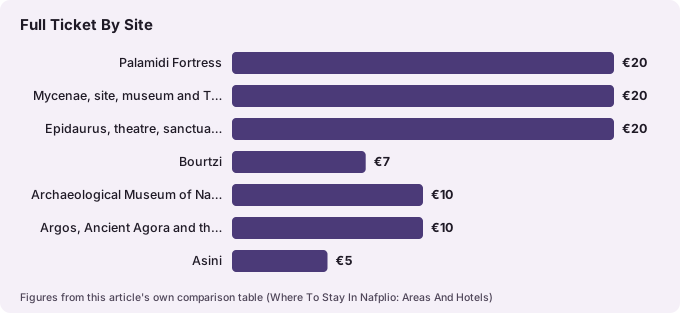
The fee itself is small, charged per room per night rather than as a percentage, and is collected by the accommodation at check-in or on the bill. Confirm the amount when you book, since the per-star figures circulating online are secondary-source numbers this page will not repeat. Beyond that, the only fixed prices a Nafplio visitor can budget from are the state-site tickets, which the table below gathers for trip planning.
Verified State-Site Ticket Prices, 2026
| Site | Full ticket | Reduced ticket |
|---|---|---|
| Palamidi Fortress | 20 EUR | 10 EUR (1 Oct to 31 May only) |
| Mycenae, site, museum and Treasury of Atreus | 20 EUR | 10 EUR (1 Oct to 31 May only) |
| Epidaurus, theatre, sanctuary and museum | 20 EUR | 10 EUR |
| Bourtzi | 7 EUR | 5 EUR |
| Archaeological Museum of Nafplio | 10 EUR | 5 EUR |
| Argos, Ancient Agora and theatre, one ticket | 10 EUR | 5 EUR |
| Asini | 5 EUR | 3 EUR |
State sites are also free on set days: 6 March, 18 April, 18 May, the last weekend of September, the first and third Sunday of each month from November to March, and 28 October, per the Ministry of Culture's pages. A November or March stay therefore pairs lower-season rooms with free-site Sundays, a combination worth building an itinerary around.
Where Should Families Stay In And Around Nafplio?
Families are best served either by the flat harbour strip of Nafplio, where the walk to Bourtzi's boat, the seafront and Syntagma Square is level, or by Tolo, the resort town about 17 minutes by road with a sandy beach economy, and the choice between them comes down to whether the trip is a town trip or a beach trip.
In town, the terrain argument from earlier applies in reverse: the Old Town's lanes are charming but cobbled and stepped in places, while the waterfront from the harbour east toward Akti Miaouli is the level ground, next to the free visitor parking lots local guidance points drivers to. The Archaeological Museum, the Bourtzi boat and the square's open space are the core family sights, and the site's Nafplio with kids guide develops the full day-by-day case.
Out of town, Tolo's case is sand and shallow water, plus the day-cruise departures. Families splitting a week can reasonably do both: nights in the Old Town, then nights in Tolo, with the 17-minute drive as the transfer.
For families who want the town covered efficiently, the hop-on hop-off bus is the product built for exactly this, and the cooking class is the rainy-day counterweight:
Where Should You Stay In Nafplio Without A Car?
A visitor without a car should stay inside the Old Town or on the harbour strip, because Nafplio's core is compact and walkable and the town's public transport, the KTEL Argolida buses reported at 2.20 euro to Tolo or Argos and 3.50 euro to Mycenae or Epidaurus, is sparse on the big day-trip routes, making a central base the practical choice.
The bus facts, as reported from the local operator's own fare pages, are these: Athens to Nafplio runs about 2 hours 10 minutes from the Kifissos terminal at a reported 15.70 euro one way, covered in full on the site's Athens to Nafplio bus page, and local services from Nafplio reach Tolo, Argos, Tiryns, Mycenae and Epidaurus at the fares above, with the Mycenae and Epidaurus departures described as limited. There is no train to Nafplio in 2026, a point the site's train to Nafplio page sets out, so the bus, a car or an organised day trip are the three modes that exist.
That transport reality is why car-free visitors lean on organised trips for the Argolid. The shared half-day tour to Mycenae and Epidaurus is the budget version of that dependency:
Drivers, by contrast, should read the Nafplio car rental page alongside this one, because where you sleep and whether you keep the car are one decision in Nafplio, not two.
Car-Free Versus Car-Based Bases At A Glance
| Base | Car-free fit | Driver fit | Why |
|---|---|---|---|
| Old Town and Syntagma Square | Strong | Workable | Walkable core, parking sits on the Akti Miaouli waterfront |
| Akronafplia and the harbour | Strong | Workable | Flat waterfront, same core, boat departures on the doorstep |
| Arvanitia and Palamidi side | Good | Good | Walks and stairway at the door, quieter streets |
| Pronia | Fair | Strong | Easier parking, larger rooms, drive to the core |
| Karathona | Weak | Strong | Beach reachable on foot but lodging is thin |
| Tolo | Fair (bus, reported 2.20 EUR) | Strong | Resort base, 17 minutes by road from Syntagma Square |
What About A Romantic Stay In Nafplio?
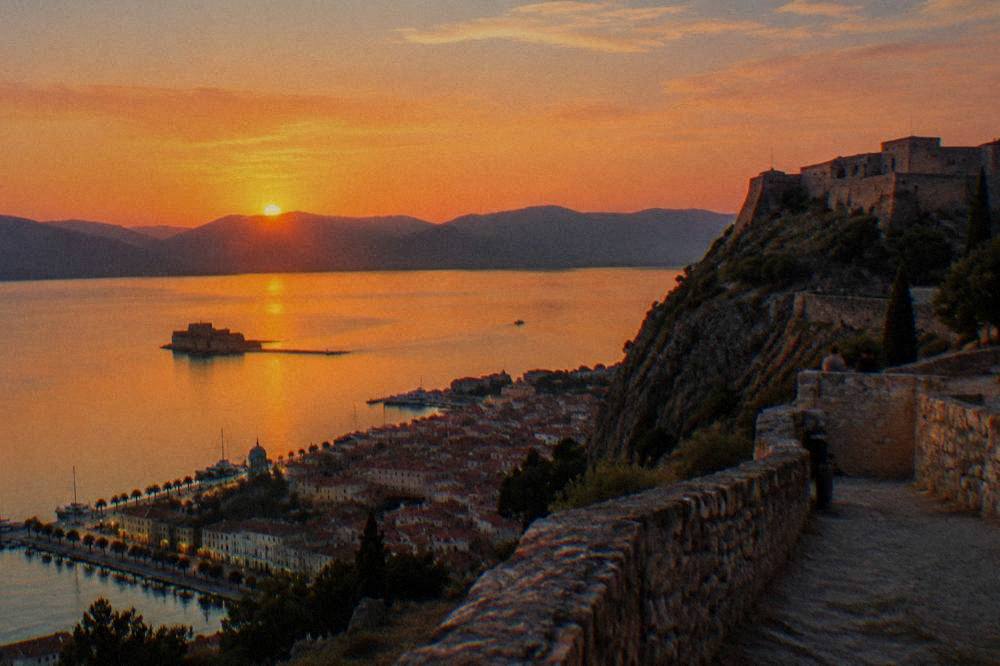
Nafplio has a strong romantic case built on its setting rather than marketing: a harbour with a fortress islet in it, a 216 m fortress above the town, a lit seafront promenade of about 1 km around Akronafplia to Arvanitia, and the designation of first capital of modern Greece from 1827 to 1834, and the rooms that serve that case best are the Old Town lanes and the Akronafplia and harbour strip.
The evening walk is the heart of it. The Arvanitia promenade runs about 1 km from the harbour lighthouse around the rock to Arvanitia beach, and the sunset light falls across the Argolic Gulf toward the fortress walls. The site's romantic Nafplio guide assembles the full case, including the sunset sailings, and the two days in Nafplio itinerary schedules the pace. For a couple's booking, the same area logic as every other traveller applies, with the harbour and Old Town strip maximising what can be done on foot after dark.
The cooking class with lunch or dinner is the product most often paired with a couples' stay, and it belongs to the town rather than to any drive:
Quick Answers On Nafplio Areas And Hotels
Where to stay in Nafplio for a first visit?
The Old Town, the lanes between Syntagma Square and the harbour, is the strongest first-visit base: the Archaeological Museum, the Vouleftiko, the Church of Agios Spyridon, the Land Gate and the Palamidi stairway all sit in or beside that compact core, and the harbour boat to Bourtzi departs a few hundred metres away.
Where to stay in Nafplio with a car?
Pronia or the harbour end of town, with the car parked on the Akti Miaouli waterfront lots. The Old Town is largely closed to visitor parking per local guidance, while Pronia's residential streets handle cars more easily and sit close to the roads out to Mycenae, Epidaurus and Ancient Corinth.
Is it better to stay in Nafplio or Tolo?
Stay in Nafplio for the Old Town, the fortresses and the restaurants; stay in Tolo, about 17 minutes away by road, for a sandy beach base. Tolo is a resort town in its own right, and a beach-first family trip often works better there, commuting into Nafplio for the sights.
What is the climate resilience fee in Nafplio?
Greece charges a climate resilience fee per room per night, collected by the accommodation, and it is higher from April to October than from November to March. The amount depends on the accommodation's category and should be confirmed at booking.
Can you stay in Nafplio without a car?
Yes. The core is walkable, KTEL buses reach Athens and the local towns, with reported fares of 2.20 euro to Tolo or Argos and 3.50 euro to Mycenae or Epidaurus, and organised day trips cover the big sites. Mycenae and Epidaurus bus services are reported as sparse, so book tours or time the buses carefully.
Which Nafplio area is quietest?
Editorially, Pronia and the Arvanitia slopes are the calmer bases: both sit just outside the core's evening economy, Arvanitia against the sea cliffs below Palamidi and Pronia in the residential grid, each with a walk back to Syntagma Square rather than a spot inside the busiest lanes.
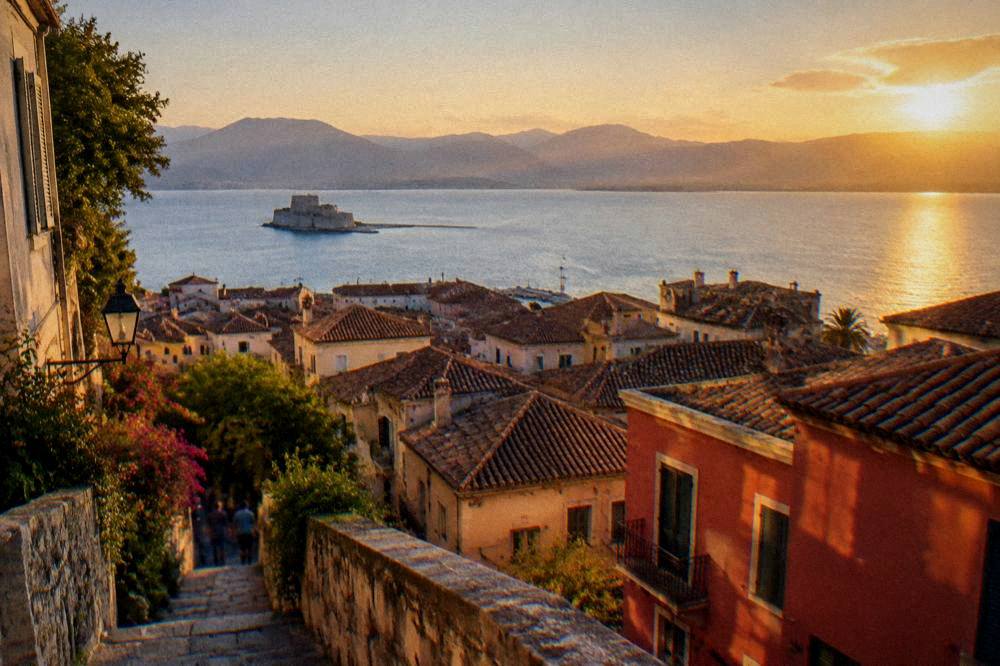
The final rule of thumb: match the area to the trip, not to the brochure. A first visit wants the Old Town, a driving trip wants Pronia or the waterfront lots, a walking holiday wants the Arvanitia side, and a beach week wants Karathona's coast or Tolo.