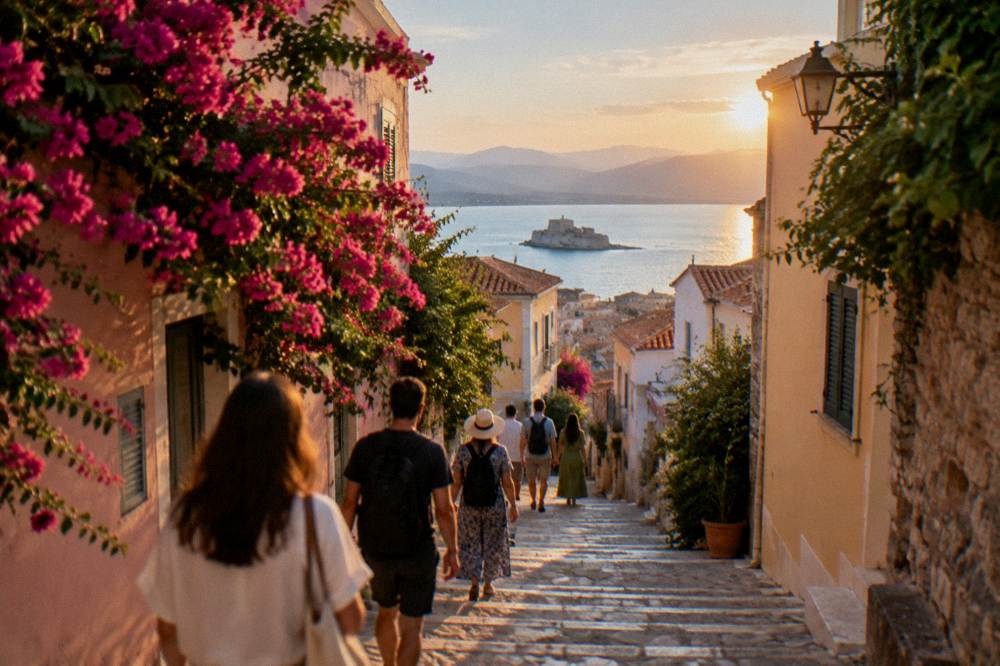
Best Time To Visit Nafplio, Season By Season
Nafplio sits on the Argolic Gulf in the north-east Peloponnese, and the honest answer to when to go is the shoulder months: the HNMS Argos station table and the Ministry of Culture's own seasonal hours both point to May, late September and October.
Short answer
May, late September and October combine HNMS mean highs of 21 to 27°C, thin crowds and full summer opening hours at Palamidi, Mycenae and Epidaurus; July and August bring 34°C means and the year's shortest hours of daylight comfort, while November to March is quiet and rainy.
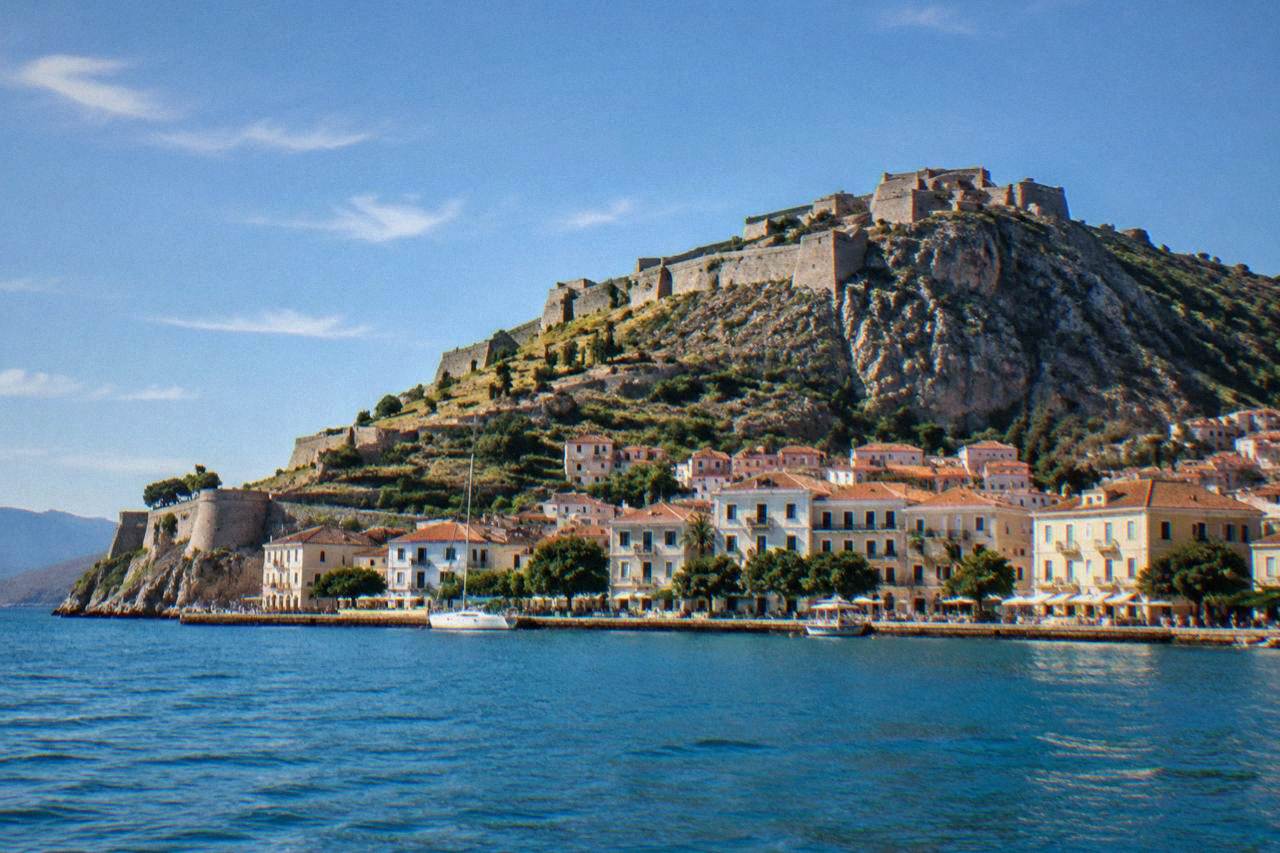
Nafplio, the small coastal town of about 14,500 residents on the Argolic Gulf in the Argolid, answers the timing question more clearly than many Greek destinations: it is a year-round town with a sharp summer peak, and the numbers that decide it are public. The Hellenic National Meteorological Service's Argos station table fixes the climate, the Ministry of Culture's visiting pages fix the opening hours and ticket seasons at Palamidi Fortress, Mycenae and Epidaurus, and the drive times to the day-trip sites are short enough that one well-chosen week covers a great deal. This guide sets out those figures season by season, then matches each stretch of the year to the kind of trip it suits.
For planning around specific months and what each one offers on the ground, the companion pages on Nafplio weather and the things to do in Nafplio overview carry the detail this page only summarises.
When Is The Best Time To Visit Nafplio?
The best time to visit Nafplio is May, late September or October, when the HNMS Argos station, 1980 to 2010, shows mean daily highs of 21.3 C in April, 26.5 C in May, 24.7 C in October and 19.2 C in November, rainfall drops to 18.7 mm in May and 20.3 mm in September, and the Ministry of Culture's summer hours keep Palamidi open to 20:00 from 2 May. Crowds thin after summer without the sites closing early.
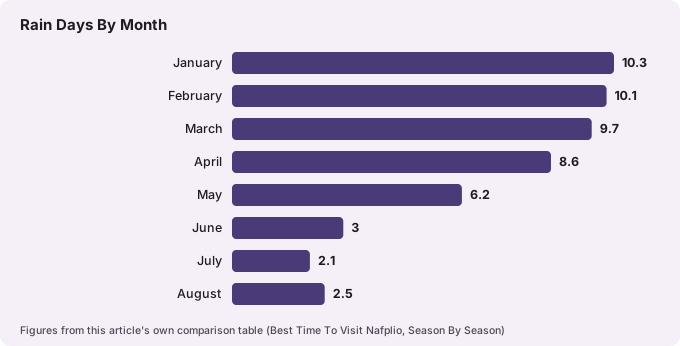
The case for the shoulder rests on three numbers that work together. First, the rain-day counts: May averages 6.2 rain days and September 5.0, against 10.3 in January and 12.2 in December. Second, the temperatures: a 26.5 C mean high in May makes the climb to Palamidi's ramparts reasonable, while July's 34.0 C mean high turns midday sightseeing into an endurance exercise. Third, the site calendar: from 2 May the big state sites run on the long summer schedule, and they hold broadly generous hours into October, so a shoulder visit loses almost nothing in access compared with August.
May has one specific advantage worth naming: the reduced ticket at Palamidi, Mycenae and Epidaurus is sold only from 1 October to 31 May, so a May visitor can still buy the 10 euro reduced ticket where they qualify, while a June visitor cannot. October works in reverse: the reduced season restarts on 1 October, and the mean high of 24.7 C with 44.3 mm of rain across 6.9 rain days still supports full days outdoors.
What Does The Climate In Nafplio Actually Look Like Month By Month?
The HNMS Argos station, 1980 to 2010, the nearest official station, about 10 km north-west of Syntagma Square and inland so the waterfront can differ slightly, gives a mean daily high of 34.0 C in July and 33.7 C in August against 14.6 C in January, and annual rainfall of 471.4 mm, of which November alone carries 82.5 mm. June has the lowest rainfall in the table at 8.9 mm.
The temperature curve is a Mediterranean one with a real interior tilt: because the station sits inland, the numbers run warmer by day and cooler by night than the harbour itself often feels. February's mean nightly low of 2.9 C is the lowest minimum in the table, which tells you winter nights in the Argolid are genuinely cold, not merely cool. Summer nights stay warm, 16.7 C in July and 16.8 C in August on average.
| Month | Mean daily high (C) | Mean daily low (C) |
|---|---|---|
| January | 14.6 | 3.0 |
| February | 14.7 | 2.9 |
| March | 17.4 | 4.3 |
| April | 21.3 | 6.7 |
| May | 26.5 | 10.5 |
| June | 31.4 | 14.0 |
| July | 34.0 | 16.7 |
| August | 33.7 | 16.8 |
| September | 29.7 | 14.2 |
| October | 24.7 | 11.5 |
| November | 19.2 | 7.7 |
| December | 15.5 | 4.8 |
Rainfall is where the seasons really separate. The table concentrates its rain in the November-to-March stretch, with 82.5 mm in November, 69.7 mm in December and 66.5 mm in January, while June through September stays between 8.9 and 20.3 mm. The rain-day column matters as much as the totals: 12.2 rain days in December means roughly every second or third day sees some rain, whereas July's 2.1 rain days mean a wet afternoon is the exception.
| Month | Rainfall (mm) | Rain days |
|---|---|---|
| January | 66.5 | 10.3 |
| February | 52.5 | 10.1 |
| March | 52.2 | 9.7 |
| April | 33.7 | 8.6 |
| May | 18.7 | 6.2 |
| June | 8.9 | 3.0 |
| July | 9.1 | 2.1 |
| August | 13.0 | 2.5 |
| September | 20.3 | 5.0 |
| October | 44.3 | 6.9 |
| November | 82.5 | 9.4 |
| December | 69.7 | 12.2 |
Whatever month you settle on, a guided walk is the activity least exposed to the weather: the streets of the Old Town give shade in summer and quick shelter in a shower. The Nafplion city walking tour, which pairs the Old Town walk with a boat trip out to Bourtzi, works in every season, and you can Check availability for your dates.
What Are The Opening Hours And Tickets At Nafplio's Sites Through The Year?
State sites in the Argolid run winter hours of 08:30 to 15:30, April hours of 08:00 to 19:00, and from 2 May 08:00 to 20:00, tapering through late September and October to 08:00 to 18:00 by 16 to 31 October, per the Ministry of Culture's visiting pages, and the 2026 full ticket is 20 euro at Palamidi, Mycenae and Epidaurus with a 10 euro reduced ticket sold only from 1 October to 31 May.
The stepwise schedule rewards reading closely. A visitor in the first half of October gets 08:00 to 18:30; one in the second half gets 08:00 to 18:00. September shortens in two stages, to 19:30 through the 15th and 19:00 through the 30th. Winter's 08:30 to 15:30 window means an afternoon arrival in January sees the fortress gate already shut, so winter trips should front-load the sightseeing into the morning. Epidaurus runs its own winter hours of 08:00 to 17:00, moving to 08:00 to 18:00 from 1 March before joining the shared summer schedule.
| Period | State-site hours (Palamidi, Mycenae) |
|---|---|
| Winter season | 08:30 to 15:30 |
| April | 08:00 to 19:00 |
| From 2 May | 08:00 to 20:00 |
| 1 to 15 September | 08:00 to 19:30 |
| 16 to 30 September | 08:00 to 19:00 |
| 1 to 15 October | 08:00 to 18:30 |
| 16 to 31 October | 08:00 to 18:00 |
The ticket table is short and worth memorising, because outdated 8 and 12 euro figures still circulate in older guides. The 20 euro Mycenae ticket covers the site, the museum and the Treasury of Atreus; the Epidaurus ticket covers the theatre, the sanctuary and the museum.
| Site | Full ticket | Reduced ticket |
|---|---|---|
| Palamidi Fortress | 20 euro | 10 euro (1 Oct to 31 May) |
| Mycenae (site, museum, Treasury of Atreus) | 20 euro | 10 euro (1 Oct to 31 May) |
| Epidaurus (theatre, sanctuary, museum) | 20 euro | 10 euro (1 Oct to 31 May) |
| Bourtzi | 7 euro | 5 euro |
| Archaeological Museum of Nafplio | 10 euro | 5 euro |
| Argos agora and theatre (one ticket) | 10 euro | 5 euro |
| Asini | 5 euro | 3 euro |
Bourtzi runs its own seasonal clock, open by boat from the harbour: 09:00 to 21:00 in July and August, 09:00 to 20:00 in September, and 09:00 to 17:00 through November and December. The Little Theatre of Ancient Epidaurus is closed to day visits, per the Ministry's listing; it hosts festival performances only. For sites whose prices sit outside this table, check the current price on the ticket page before booking.
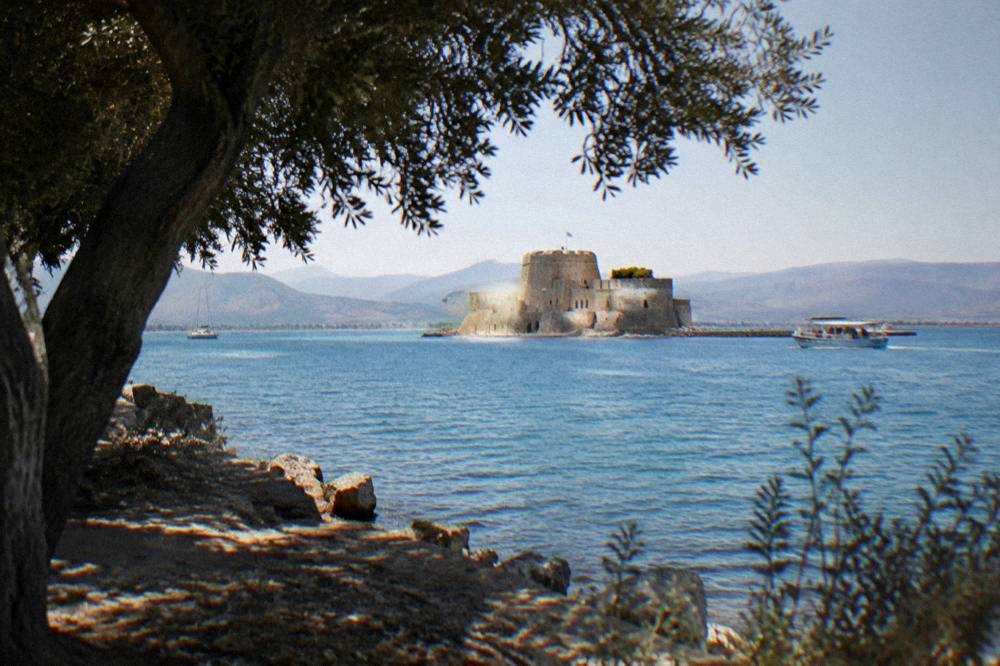
Timing shapes how a first day in town feels, and a walking tour solves the midday heat problem by keeping the route in the shade of the Old Town's streets.
When Is Nafplio's Peak Season, And What Actually Changes?
July and August are the peak, defined by HNMS Argos station means of 34.0 C and 33.7 C daily highs, just 2.1 and 2.5 rain days, the year's longest site hours (08:00 to 20:00, and Bourtzi to 21:00), and the Athens Epidaurus Festival's summer performances at the ancient theatre, an annual season that runs in Friday-Saturday pairs through midsummer. The trade is heat, thinner lodging availability and peak-season rates.
Peak season in Nafplio is real but concentrated: it follows the school-holiday calendar and the festival calendar rather than stretching across half the year. The practical consequences are specific. Sightseeing shifts to early morning and evening: Palamidi opens at 08:00, and the about 850 steps up to it (the usual count is 857, not the legendary 999) are far better tackled at opening time than at 14:00 under a 34°C mean high. The waterfront and the beaches around Nafplio, Arvanitia and Karathona among them, fill the middle of the day instead.
The summer also changes what you can book. Boat trips, from harbour cruises to seasonal day sails, run at their fullest schedules, and the boat and cruise options from Nafplio page tracks that side of the summer. One correction to a common planning assumption: no scheduled ferry runs from Nafplio or Tolo to Hydra and Spetses, which older guides still state; the islands are reached by seasonal day cruise or from another port.
A note on the festival: the Athens Epidaurus Festival holds its Epidaurus season at the ancient theatre each summer, with performances concentrated in weekend pairs. The 2027 programme had not been announced, so check the festival's own pages for dates before anchoring a trip to a performance.
Is Winter A Good Time To Visit Nafplio?
Winter in Nafplio is quiet and genuinely cold at night, with HNMS Argos station means of 14.6 C daily highs and 3.0 C nightly lows in January, and 10.3 rain days in January rising to 12.2 in December, while every key indoor sight stays open, the state sites run 08:30 to 15:30, and the reduced 10 euro ticket is sold from 1 October to 31 May, making it the cheapest and emptiest season to see the town.
The winter case is cultural rather than beach-focused. Palamidi, Bourtzi, the Archaeological Museum of Nafplio and the Argolid's ancient sites all remain visitable, and the winter free-admission structure is unusually generous: state sites are free on the first and third Sunday of each month from November to March, plus 6 March and 28 October. Combined with the reduced-ticket season, a winter week can be remarkably inexpensive at the gate.
| Free-admission day | Applies to |
|---|---|
| 6 March | Greek state sites and museums |
| 18 April | Greek state sites and museums |
| 18 May | Greek state sites and museums |
| Last weekend of September | Greek state sites and museums |
| First and third Sundays, November to March | Greek state sites and museums |
| 28 October | Greek state sites and museums |
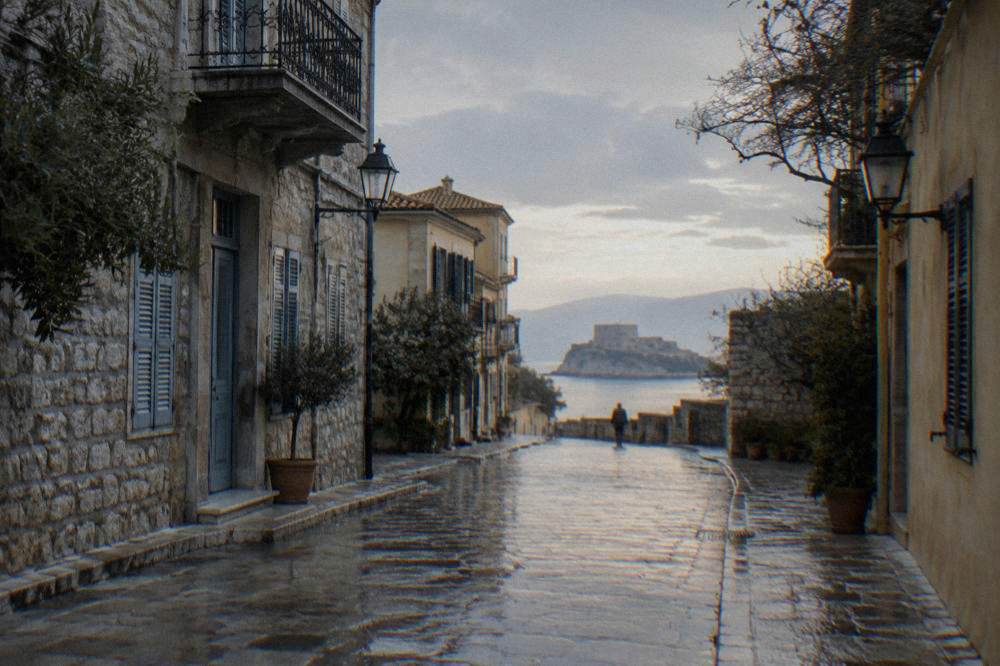
The winter limits are just as concrete. Short site hours mean the day's outdoor sightseeing must end by mid-afternoon, and the museum's Tuesday closure removes one of the few indoor options on that day. Rain arrives every second or third day on average, so build in a flexible day. The town does not shut down, and the history of Nafplio, from its years as capital of Greece from 1827 to 1834 through the Venetian and Ottoman periods, fills museums and churches that are open regardless of the weather. If a winter trip coincides with a hard rain day, the indoor standbys are the Archaeological Museum, the Peloponnesian Folklore Foundation museum and the churches around Syntagma Square.
When Do The Events And Festivals Around Nafplio Run?
The Athens Epidaurus Festival holds its Epidaurus season at the ancient theatre across the summer, Nemea's Grand Wine Days bring the wineries of the Nemea district open for tastings over a weekend in early September each year, and Orthodox Easter, 12 April in 2026 and 2 May in 2027, fills Nafplio's Holy Week with choral concerts at the Vouleftiko and processions through the Old Town. Each is annual, and each anchors a different season.
Easter is the local highlight that outside planning guides underweight. The municipality's own Easter programme lists choral concerts of ecclesiastical music at the Vouleftiko during Holy Week, along with philharmonic marches and processions, and because the date moves with the Orthodox calendar the festival shifts between April and May from year to year. A spring trip built around Easter combines those events with the year's first stretch of warm weather.
The September wine weekend pairs naturally with a shoulder-season stay: Nemea sits about 49 minutes' drive from Syntagma Square, and the Nemea wine country coverage explains how the vineyards fit a Nafplio base. The full picture of what runs when is on the festivals and events in Nafplio page.
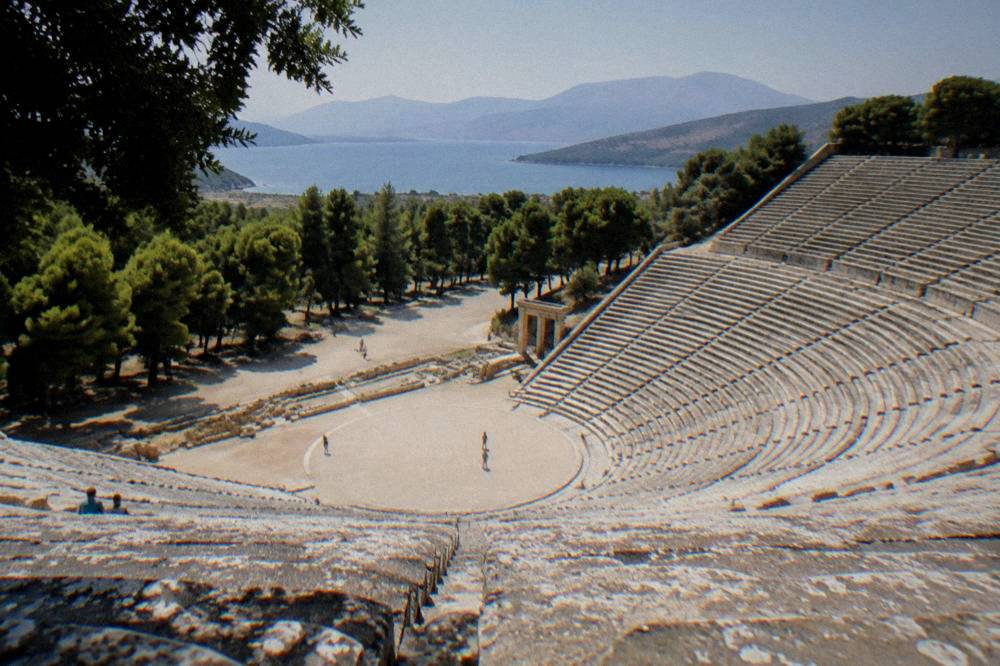
The theatre itself is a year-round site with a 20 euro ticket covering theatre, sanctuary and museum, and a pre-booked entry ticket with optional audio guide lets a summer visitor arrive late in the afternoon when the stone has cooled.
Which Season Suits Which Kind Of Trip To Nafplio?
A first sightseeing trip suits May or October, a beach-and-boating trip suits July and August, a food and wine trip suits September around the Nemea weekend, and a budget or museum-led trip suits November to March with the reduced-ticket season and the free Sunday admissions, per the HNMS Argos station table, the Ministry of Culture's hours, and the free-admission calendar. Each match follows from a number, not a preference.
The pairing works because each season's weakness for one trip is its strength for another. Summer heat that rules out a midday fortress climb is irrelevant on a boat; winter rain that empties a beach itinerary leaves the museums untouched. Spring's 6.2 rain days in May barely disturb an archaeology itinerary built around morning site visits.
| Trip type | Best months | Why |
|---|---|---|
| First visit, main sights | May, late September, October | 21 to 27°C mean highs, full summer site hours, thin crowds |
| Beach and boat trips | July, August | 2.1 and 2.5 rain days, warm nights, fullest boat schedules |
| Food and wine | September | Nemea wine weekend, 5.0 rain days, 29.7 C mean high easing |
| Budget and museums | November to March | Reduced tickets sold, free first and third Sundays, quiet town |
| Festival and Easter | April or May (moves) | Orthodox Easter Holy Week events at the Vouleftiko |
Day trips scale the same way. Mycenae is about 32 minutes' drive from Syntagma Square, the Epidaurus theatre about 41, Argos about 18 and Tiryns about 9, all computed over free-flow routing, so a shoulder-season base in town reaches every major Argolid site comfortably. Winter shortens the effective sightseeing day at exactly those sites, which argues for fewer, closer trips: Tiryns, Argos and Asini all sit within about 20 minutes of the square.
How Does The Season Change Getting To Nafplio And Staying There?
Getting in does not change with the seasons: Nafplio has no train, the KTEL Argolida coach from Athens' Kifissos terminal is reported at about 15.70 euro one way and about 2 h 10 min, and driving is about 141 km from Athens, while lodging in the April-to-October stretch carries Greece's climate resilience fee, collected by the accommodation and higher in those months than in winter, per the national scheme.
The seasonal effects on logistics are softer than the climate ones. Arriving by coach or car takes the same time in January as in July; what changes is demand for beds near the Old Town and the pressure on the free waterfront parking, which reportedly fills early at the summer peak. The getting to Nafplio from Athens guide covers the routes, and where to stay in Nafplio matches the districts to the seasons: harbour-front and Old Town rooms trade convenience for summer noise, while Pronoia and the streets above Arvanitia stay quieter.
One seasonal trap worth naming once: the drive out to the Corinth Canal is about 72 minutes, and the canal is open to shipping; older claims that it is closed are out of date. Nothing about the canal visit depends on Nafplio's season, though midsummer midday viewpoints are best traded for morning.
Common Questions About The Best Time To Visit Nafplio
What is the best month to visit Nafplio?
May is the single best month: the HNMS Argos station, 1980 to 2010, shows a 26.5 C mean daily high with 18.7 mm of rain over 6.2 rain days, state sites run the full 08:00 to 20:00 summer hours from 2 May, and the 10 euro reduced ticket is still on sale through 31 May.
Is Nafplio too hot in summer?
The HNMS Argos station table gives July a 34.0 C mean daily high and August 33.7 C. It is manageable with early starts, since Palamidi opens at 08:00 and evening light lasts late, but midday fortress climbs and midday walking are best avoided.
Does it rain a lot in Nafplio in winter?
November carries 82.5 mm of rain across 9.4 rain days and December 69.7 mm across 12.2, per the HNMS Argos station, 1980 to 2010. Expect a wet day roughly every second or third day, and plan indoor backups such as the Archaeological Museum, closed Tuesdays.
When are the sites in Nafplio free?
Greek state sites, including Palamidi, Mycenae and Epidaurus, are free on 6 March, 18 April, 18 May, the last weekend of September and 28 October, and on the first and third Sunday of each month from November to March, per the Ministry of Culture's visiting pages.
Is winter a bad time to visit Nafplio?
No, if the trip is built around history rather than beaches. Sites run 08:30 to 15:30, the reduced 10 euro ticket is sold, free Sunday admissions apply, and the town's museums and churches stay open; the trade-offs are cold nights, with a February mean nightly low of 2.9 C, and regular rain.
When does the Epidaurus theatre season run?
The Athens Epidaurus Festival holds its annual summer season at the ancient theatre of Epidaurus, concentrated in weekend performance pairs. Dates shift each year and the next programme is announced by the festival, so check the festival's own pages before booking around a performance.
The short version: pick May or October for a first visit, July and August for water and boats, September for wine, and any quiet winter week for museums at reduced prices. The numbers above, from the HNMS Argos station table and the Ministry of Culture's own pages, are the whole decision, and whichever month this Nafplio Travel Guide sends you in, the town's gates, fortress steps and harbour stays open year-round.