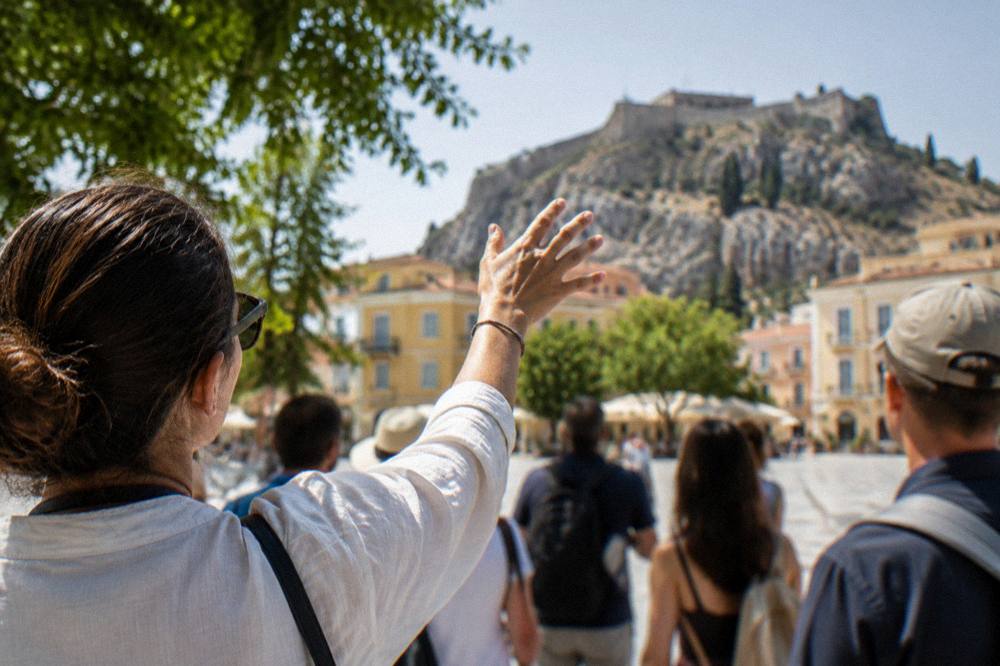
What Is Nafplio Famous For?
Nafplio is famous for Palamidi Fortress, the Bourtzi islet, its Venetian Old Town and its years as the first capital of modern Greece, from 1827 to 1834.
Nafplio is a small coastal town of about 14,500 residents on the Argolic Gulf, in the Argolid region of the north-east Peloponnese in southern Greece. It is famous above all for its fortifications: Palamidi Fortress on the hill above town, the old acropolis of Akronafplia, and the small fortified islet of Bourtzi sitting in the harbour. Around them sits a Venetian-era Old Town that was the capital of modern Greece from 1827 to 1834, and beyond it lie two UNESCO World Heritage sites, Mycenae and Epidaurus, close enough for a half-day visit. This page sets out what the town is genuinely known for, with the 2026 ticket prices and the drive times the day trips actually involve.
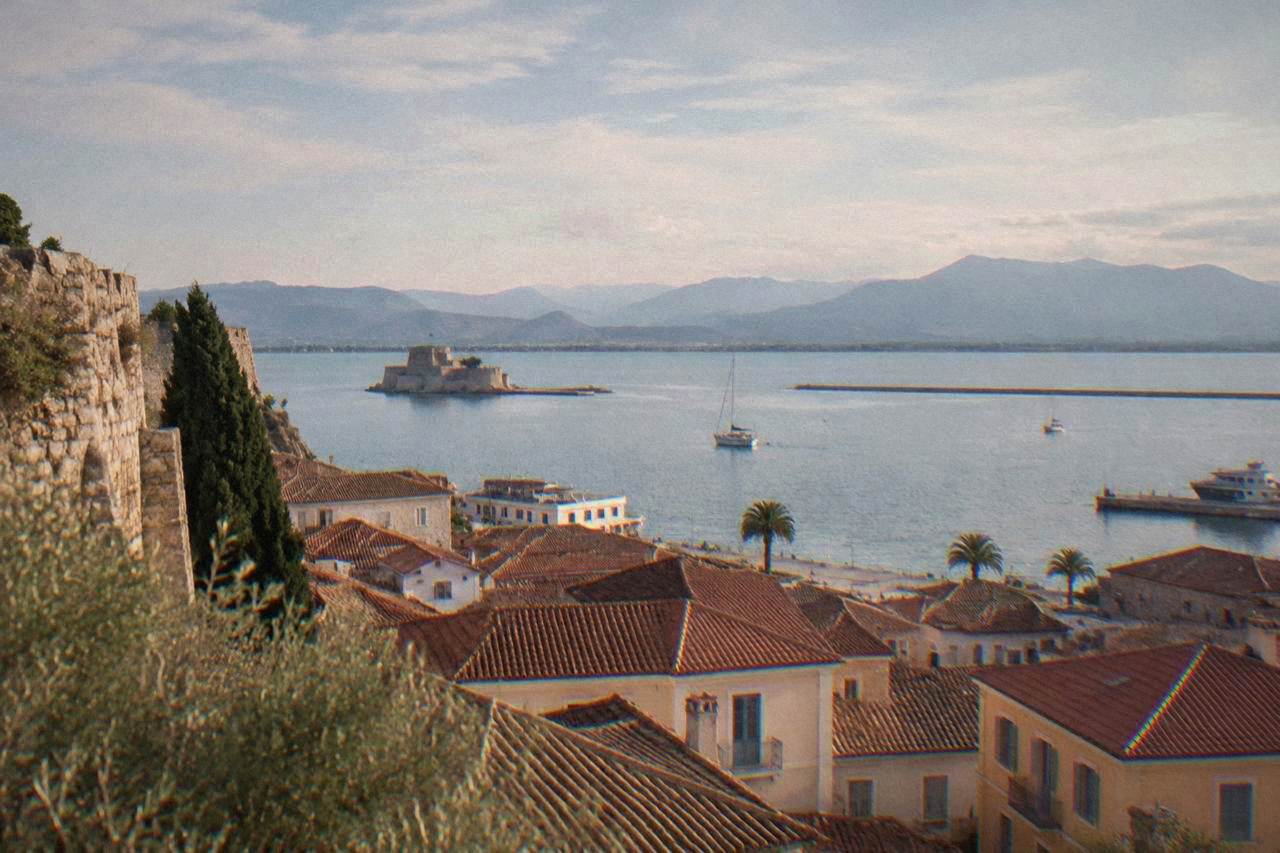
What Is Nafplio Famous For?
Nafplio is famous for Palamidi Fortress standing 216 m above the Old Town, for the Bourtzi islet in its harbour, for its Venetian-era Old Town around Syntagma Square, and for being the first capital of modern Greece from 1827 to 1834. It is equally known as the base for the Mycenae and Epidaurus day trips, two UNESCO World Heritage sites within about 32 and 41 minutes' drive of the square.
The town's fame rests on geography as much as architecture. It sits on the Argolic Gulf, with the mass of Palamidi directly above the rooftops and the sea on three sides of the old centre. The Ministry of Culture's visiting page lists Palamidi's 2026 ticket at 20 euro full and 10 euro reduced, with summer opening until 20:00 from 2 May. The Bourtzi site's own history page records that construction of the islet fort began in June 1471 under the architect Antonio Gambello. Together with the Old Town's arcaded lanes, these are the images the town is recognised by, and the reason cruise ships call at the port through the autumn.
What the town is not famous for, despite what older guides say, is a train or a ferry. There is no passenger rail to Nafplio in 2026, and no scheduled public ferry from Nafplio or Tolo to Hydra or Spetses; the islands are reached by seasonal day cruise or from another port. Athens is about 141 km away by road, roughly two hours by car or the KTEL coach, which makes the town a realistic base or a long day trip. For a fuller rundown of activities, the site's things to do in Nafplio page covers the whole town, and is Nafplio worth visiting weighs the question honestly.
Why Is Palamidi Fortress The Town's Landmark?
Palamidi Fortress is Nafplio's landmark because it dominates the town from 216 m above sea level, a Baroque-style Venetian fortress of eight bastions begun in 1711 and taken by Greek forces under Staikos Staikopoulos on the night of 29 to 30 November 1822. Its stairway back down to town is usually counted at 857 carved steps, about 850, not the legendary 999.
The Ephorate's monument page attributes the design to the engineers Giaxich and Lasalle of the second Venetian period, which lasted from 1686 to 1715. The Ottomans took the fortress in 1715, and Greek revolutionaries seized it in 1822, an event that decided the town's future as the seat of the new Greek state. The east bastion held the prison cells where the fighter Theodoros Kolokotronis was later held, and his statue stands today below the walls near the Old Town. The fortress is the single most photographed object in Nafplio, and the view from its ramparts takes in the whole Argolic Gulf.
A visit needs planning around the calendar. The Ministry of Culture's page lists the 2026 ticket at 20 euro full and 10 euro reduced, with the reduced ticket sold only from 1 October to 31 May. Winter hours run 08:30 to 15:30; from 2 May the site stays open until 20:00, with stepped reductions through September and October. The site closes on 1 January, 25 March, 1 May, Easter Sunday and 25 and 26 December. Free-admission days across Greek state sites include 6 March, 18 April, 18 May, the last weekend of September and 28 October. The site's Palamidi Fortress guide goes deeper on the bastions and the climb.
What Are The Old Town, Syntagma Square And Bourtzi Known For?
The Old Town is known for its Venetian and Ottoman fabric packed inside the walls below Akronafplia, with Syntagma Square at its centre holding the Vouleftiko, the building that housed the first Greek parliament, and the Archaeological Museum in the old Venetian arsenal. Bourtzi, the fortified islet in the harbour, is known for its boat access and its odd later life as a hotel.
Syntagma Square is the town's living room, ringed by the city's most history-dense buildings. The Vouleftiko, a former mosque, hosted the first Greek parliament's sessions from 1825. The Archaeological Museum of Nafplio, in the Venetian arsenal on the square's west side, is open 08:30 to 15:30 all year, closed Tuesdays, with a 2026 ticket of 10 euro full and 5 euro reduced. Nearby stand the Church of Agios Spyridon, outside which the first governor of Greece, Ioannis Kapodistrias, was assassinated in September 1831, and the Church of Agios Georgios with its tall dome. In the Pronoia district, the Lion of Bavaria, carved 1840 to 1841 by Christian Heinrich Siegel as a copy of Thorvaldsen's Lion of Lucerne, commemorates Bavarian soldiers who died in the town.
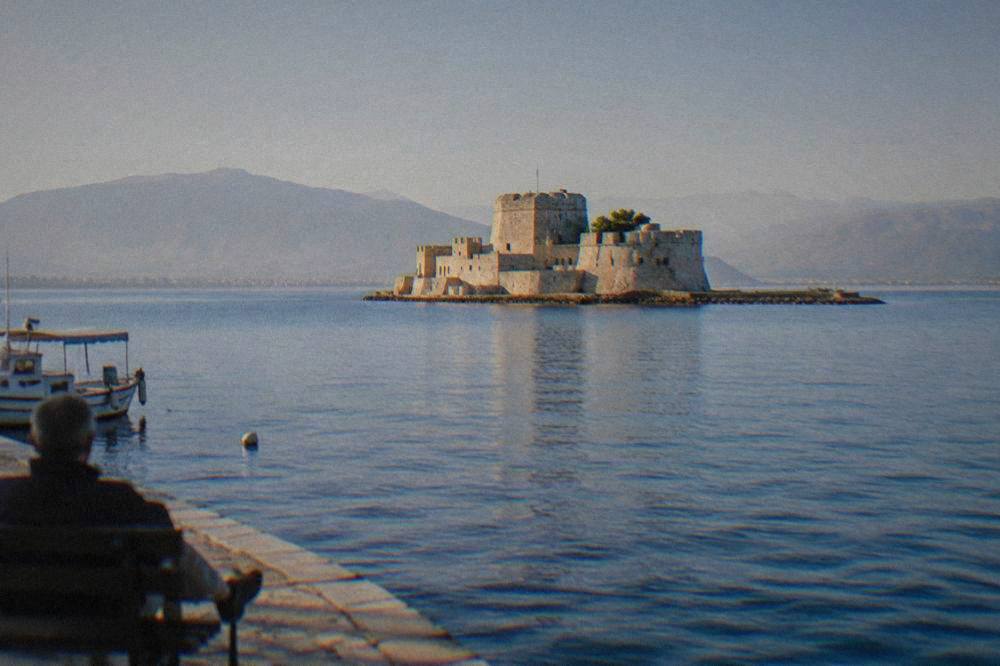
Bourtzi is the second silhouette everyone recognises. Built from June 1471 and strengthened in the second Venetian period, it guarded the harbour entrance, and in the 1930s the state leased it as a hotel and restaurant, a use that lasted into the 1960s. Today the Ministry's page lists it as open to visitors by boat for a fee, with a 7 euro full and 5 euro reduced ticket and summer hours running to 21:00 in July and August; the boat fare itself is not published, so ask at the quay. The best short orientation to all of this is the Nafplion city walking tour, which pairs the Old Town lanes with the Bourtzi boat trip, and the desk also rates the Nafplio walking tour guide for a self-guided version. Check availability
Why Was Nafplio The First Capital Of Modern Greece?
Nafplio was the first capital of modern Greece because the Third National Assembly chose it in 1827 as the seat of the new state, Ioannis Kapodistrias arrived in January 1828 to govern from the town, and the government stayed there until the capital moved to Athens in 1834, a seven-year span the municipality states plainly as 1827 to 1834.
The story is what separates Nafplio from every other pretty harbour town in Greece. After the fortress fell in 1822, the town served the revolutionary government, and the Assembly's 1827 decision made it the official capital. Kapodistrias, the state's first governor, landed in January 1828 and governed from Government House, built in 1829, until his assassination outside the Church of Agios Spyridon in September 1831. King Otto arrived in February 1833, and in December 1834 the capital moved to Athens. The Vouleftiko, the Archaeological Museum and the restored mansions of the Old Town all date from or were repurposed in that period, which is why the town centre feels like a government seat of the Kapodistrian era rather than a fishing port.
The full story, with the Venetian and Ottoman periods that frame it, sits on the site's dedicated page on why Nafplio was the first capital of Greece. Venetian rule ran twice, from 1389 to 1540 and again from 1686 to 1715, with Ottoman rule between and after, until 1822. That layered past is the second thing the town is famous for: three powers left three layers of walls, and all of them still stand.
Which Famous Archaeological Sites Sit Near Nafplio?
Mycenae and Epidaurus, both UNESCO World Heritage sites, sit within about 32 and 41 minutes' drive of Syntagma Square, alongside the lower-key citadel of Tiryns, itself part of the Mycenae UNESCO listing since 1999, and the Argos agora and theatre. Nafplio is famous as the natural base for all of them, closer than Athens by more than an hour on every route.
Mycenae, the Bronze Age citadel of the Lion Gate, holds a 2026 ticket of 20 euro full and 10 euro reduced covering the site, its museum and the Treasury of Atreus. Epidaurus, inscribed by UNESCO in 1988, pairs the famous theatre with the Sanctuary of Asklepios and its museum on the same 20 and 10 euro ticket; its winter hours run 08:00 to 17:00, from 08:00 to 18:00 out of winter. The Little Theatre of Ancient Epidaurus, a separate monument near Palaia Epidavros, is listed by the Ministry as closed to day visits, used only for festival performances, so do not plan a stop there.
| Site | Drive from Syntagma Square | 2026 ticket (full / reduced) |
|---|---|---|
| Palamidi Fortress | In town | 20 / 10 euro |
| Bourtzi | Boat from harbour | 7 / 5 euro |
| Tiryns | About 9 min | Confirm on site |
| Argos agora and theatre | About 18 min | 10 / 5 euro |
| Mycenae | About 32 min | 20 / 10 euro |
| Epidaurus theatre | About 41 min | 20 / 10 euro |
| Archaeological Museum of Nafplio | In town | 10 / 5 euro |
Is Nafplio Also Famous For Food And Boat Trips?
Nafplio is increasingly famous for its food traditions and its water-based outings: sailing and catamaran cruises around the Argolic Gulf, sea kayaking beneath the castle walls, and a local food culture built on the Peloponnesian pantry of the Argolid plain and the Nemea wine region about 49 minutes' drive away.
The desk's view is that these are real strengths, stated as editorial judgement rather than ranking. The harbour is the operational base for a cluster of small-group sailing and catamaran cruises, and the coastline beneath Akronafplia and out toward Arvanitia and Karathona gives sea kayak routes past medieval walls that few Greek towns can match; Arvanitia Beach holds a Blue Flag and the promenade around Akronafplia runs about 1 km from the harbour lighthouse. Inland, the Nemea wine region, whose Grand Wine Days each September open the wineries for tastings, lies about 49 minutes away by road, and the site's page on cooking classes and wine tastings in Nafplio covers the options. The one correction worth making here: no scheduled ferry runs from Nafplio or Tolo to Hydra or Spetses, older guides say otherwise, and the islands are reached by seasonal day cruise or from another port.
For visitors weighing the town against other Peloponnese bases, how many days you need in Nafplio and is Nafplio too touristy both give straight answers. The short version: the town rewards two or three nights, and its crowds are concentrated in the Old Town lanes at midday.
Common Questions About What Nafplio Is Famous For
What Is Nafplio Famous For?
Palamidi Fortress, the Bourtzi islet, the Venetian-era Old Town around Syntagma Square, its years as the first capital of modern Greece from 1827 to 1834, and the Mycenae and Epidaurus day trips. Bourtzi's own history page records construction from June 1471, and the Ministry of Culture lists Palamidi's 2026 ticket at 20 euro full and 10 euro reduced.
Does Palamidi Really Have 999 Steps?
No. The stairway is usually counted at 857 carved steps, so say about 850; the 999 figure is folklore that local guide sites explicitly debunk. The fortress stands 216 m above the Old Town, and the Ministry of Culture's page gives the 2026 hours and the 20 and 10 euro ticket prices.
Was Nafplio The Capital Of Greece Before Athens?
Yes. Nafplio was the capital of modern Greece from 1827 to 1834, per the municipality's own history pages. Kapodistrias arrived in January 1828 and governed there until his assassination in September 1831, and the capital moved to Athens in December 1834.
Can You Visit Mycenae And Epidaurus From Nafplio?
Yes, easily. Mycenae is about 32 minutes' drive from Syntagma Square and the Epidaurus theatre about 41, and both are 20 euro full and 10 euro reduced in 2026. The Little Theatre of Ancient Epidaurus near Palaia Epidavros is closed to day visits, so plan around the main sanctuary and theatre.
Is Nafplio An Island?
No. Nafplio is a coastal town on the Argolic Gulf in the Argolid, on the Peloponnese mainland of Greece. Bourtzi is the only islet, a small fortified one sitting in the town's own harbour, reached by boat.
Is Bourtzi Open To Visitors?
Yes. The Ministry of Culture's page lists the islet as open by boat for a fee, with a 7 euro full and 5 euro reduced ticket and July and August hours to 21:00. The boat fare is not published, so confirm it at the quay before boarding.
For everything else the town offers beyond its famous sights, start with the site's Nafplio Travel Guide round-up and build outward from Syntagma Square.