Is Nafplio Worth Visiting?
An honest, source-based answer to whether Nafplio is worth visiting: the sights, the day trips, the costs and the crowds of the first capital of Greece.
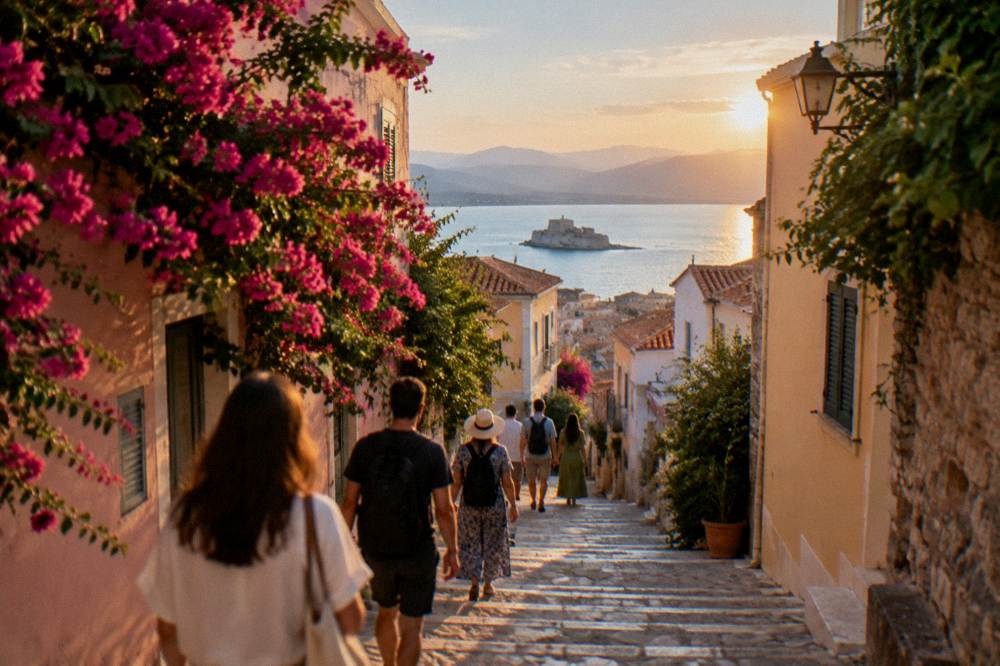
Nafplio sits on the Argolic Gulf in the Argolid, in the north-east Peloponnese of mainland Greece, about 141 km from Athens by road, and the short answer to whether it is worth visiting is yes, for reasons the record supports rather than slogans. It was the capital of Greece from 1827 to 1834, a fact the municipality states plainly, and it retains three fortresses, a museum-filled Old Town and a working harbour within walking distance of one another. Mycenae and Epidaurus, both UNESCO World Heritage sites, sit roughly half an hour and three quarters of an hour away by road. The town is small, walkable and free of the traffic of a big city, which is precisely the case this page makes, with the numbers attached.
Is Nafplio Worth Visiting?
Yes, Nafplio is worth visiting, and the case rests on density: a first-capital Old Town, Palamidi Fortress at 216 m above it, Bourtzi in the harbour and Mycenae about 32 minutes away by road, all in a town of about 14,500 residents that is covered on foot. The Ministry of Culture's visiting pages list Palamidi, Mycenae and Epidaurus at 20 euro full and 10 euro reduced in 2026, so the headline sights are cheap by major-site standards.
The strongest argument is variety within a short radius. You can stand in Syntagma Square in the morning, climb about 850 steps to Palamidi before noon, and still reach the Archaeological Museum of Nafplio before it closes at 15:30, since the Ministry lists its hours as 08:30 to 15:30 all year, closed Tuesdays. In the afternoon the Arvanitia Promenade, a paved coastal path of about 1 km around the base of Akronafplia according to the local guide site, connects the harbour lighthouse to the Blue Flag beach at Arvanitia without a single car.
The town's history also earns the trip in a way few Greek towns of this size can match. The municipality's own history pages record that Nafplio served as the capital of Greece from 1827 to 1834, that Ioannis Kapodistrias arrived in January 1828 and governed from the town until his assassination in September 1831 outside the Church of Agios Spyridon, and that Vouleftiko, on Syntagma Square, housed the first Greek parliament from 1825. For a fuller account, the site's page on why Nafplio became the first capital traces the sequence.
A reasonable question is whether it works as a base rather than a stop. It does, and cheaply by regional standards: the state sites cluster within an hour's drive, and the reported KTEL fares to Argos and Tiryns run about 2.20 euro one way, which makes even the bus a low-cost option for a car-free day. For travellers weighing it against the islands, the page on whether the Peloponnese is worth visiting covers the wider region.
What Makes Nafplio Worth The Trip?
The three fortresses and the day-trip ring make Nafplio worth the trip. Palamidi Fortress stands 216 m above the Old Town with a 20 euro full ticket in 2026, Bourtzi sits in the harbour at 7 euro full, and Mycenae, Epidaurus and Tiryns, one of them a UNESCO site with Mycenae, all lie within about 41 minutes of Syntagma Square by road.
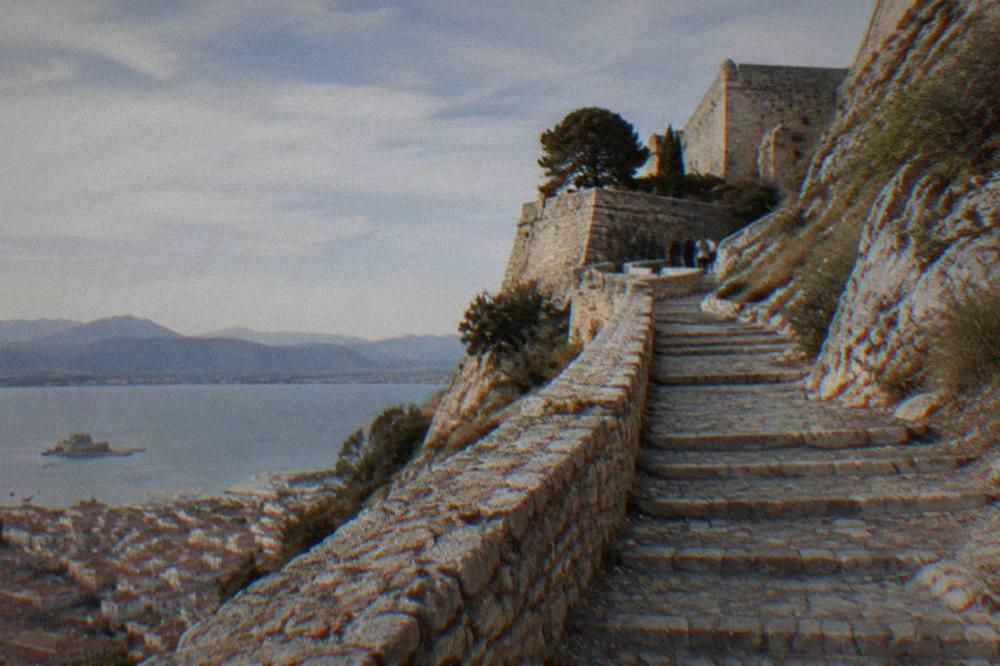
Palamidi is the anchor. The Ministry of Culture's visiting page gives its hours as 08:00 to 20:00 from 2 May 2026, with a stepped reduction through September and October to an 08:00 to 18:00 day, and a winter day of 08:30 to 15:30. The stairway from town is usually counted at about 850 steps, not the legendary 999 that older guides still print. The fortress was built by the Venetians in 1711 to 1714 and taken by the Greeks under Staikos Staikopoulos on the night of 29 to 30 November 1822, per the Ephorate's monument page.
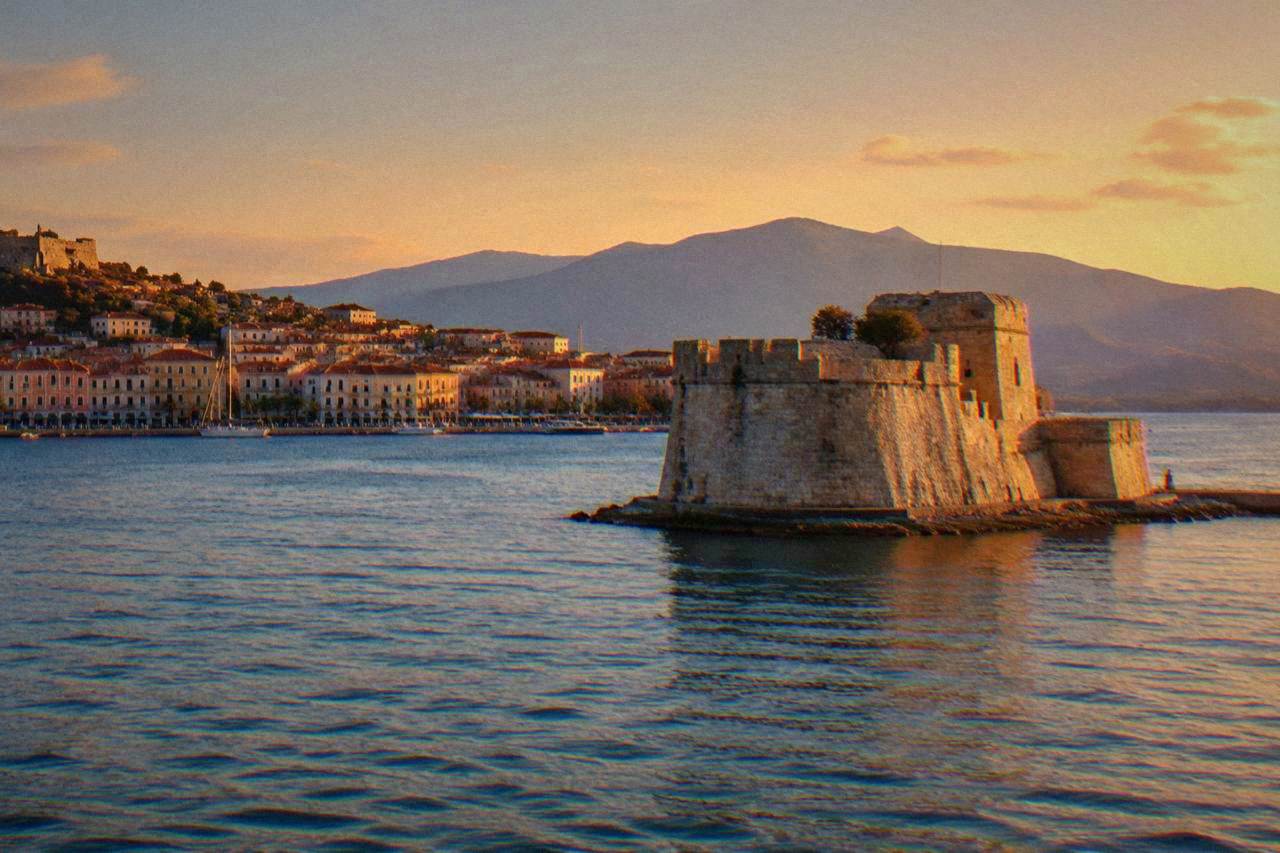
Bourtzi, the small fortified islet in the harbour, is open to visitors by boat, with a 7 euro full ticket and 5 euro reduced, according to the Ministry's listing. Its own history page records that construction began in June 1471 under the architect Antonio Gambello, and that the state leased it in the early 1930s as a fourteen-room hotel. Akronafplia, the old acropolis above the harbour, carries polygonal walls from at least the end of the fourth century BC and can be walked freely.
The day-trip ring is what turns a pleasant town into a base. The drive times below are computed from Syntagma Square over free-flow routing.
| Destination | Drive time from Syntagma Square |
|---|---|
| Tiryns | About 9 minutes |
| Argos | About 18 minutes |
| Mycenae | About 32 minutes |
| Epidaurus Theatre | About 41 minutes |
| Palaia Epidavros | About 47 minutes |
| Ancient Nemea | About 46 minutes |
| Ancient Corinth | About 61 minutes |
| Corinth Canal | About 72 minutes |
For travellers who prefer a guided loop, a shared Argolis tour covers Mycenae and the town in one outing, and a cooking class turns an afternoon in the Old Town into something more hands-on.
The town itself rewards slow movement. A bicycle flattens the distances between the harbour, Arvanitia and Karathona, and the cycling tour of Nafplio is the site's featured pick for exactly that reason; Check availability if a car-free day appeals.
How Much Time Do You Need In Nafplio?
Two days is the comfortable answer, and one day is enough for the core. Palamidi at 216 m, Syntagma Square, the Archaeological Museum at 10 euro full and the Arvanitia Promenade fit into a single day on foot; a second day buys Mycenae and Epidaurus, which sit about 32 and 41 minutes away by road and each charge 20 euro full in 2026.
The one-day version works because the town is compact and the sights cluster. The Ministry lists the Archaeological Museum of Nafplio at 08:30 to 15:30 all year and closed Tuesdays, so it belongs in the morning, with Palamidi climbed before the afternoon heat. The bold count of about 850 steps, not 999, is the number the local guide site gives. Evenings belong to the harbour and the Land Gate. Everything else covered here is indexed on Nafplio Travel Guide.
The two-day version adds the UNESCO ring. Mycenae and Tiryns were inscribed together in 1999 and the Sanctuary of Asklepios at Epidaurus in 1988, and the Epidaurus ticket covers the theatre, the sanctuary and the museum. Whether both headline sites fit into one outing is a fair question, and the page on visiting Mycenae and Epidaurus in one day works it through with the drive times. For the fuller breakdown by trip length, see how many days you need in Nafplio.
Travellers arriving from Athens face a simple trade. The drive is about 127 minutes, and the bus runs from the Kifissos terminal at a reported fare of about 15.70 euro one way, a figure to confirm with the operator before travel. The question of whether Nafplio works as an Athens day trip gets its own treatment, but the short version is that a day trip buys the town, not the ruins.
Is Nafplio Too Touristy?
Nafplio is busy in summer but not overwhelmed, and the honest framing is seasonal rather than absolute. July and August bring a mean daily high of 34.0 C and 33.7 C respectively at the HNMS Argos station, 1980 to 2010, the cruise port takes regular calls, and November carries 82.5 mm of rain across 9.4 rain days, so the shoulder months of May, June, September and October balance warmth against rain of 18.7 to 44.3 mm.
The cruise-port question is answered by geography: the port is beside the Old Town, and the page on walking from the cruise port into Nafplio confirms the town is covered on foot from the berth. Crowd pressure concentrates around Syntagma Square and the Palamidi stairway on call days, and thins within minutes along the Arvanitia Promenade and in Pronoia, where the Lion of Bavaria, carved 1840 to 1841 by Christian Heinrich Siegel, stands with no ticket at all.
The climate table below, from the HNMS Argos station 1980 to 2010, an inland station about 10 km north-west of the town, gives the numbers to plan around. Note that June is the drier month at 8.9 mm against July's 9.1 mm, and that February has the lowest mean daily low at 2.9 C.
| Month | Mean high C | Mean low C | Rain mm |
|---|---|---|---|
| May | 26.5 | 10.5 | 18.7 |
| June | 31.4 | 14.0 | 8.9 |
| July | 34.0 | 16.7 | 9.1 |
| August | 33.7 | 16.8 | 13.0 |
| September | 29.7 | 14.2 | 20.3 |
| October | 24.7 | 11.5 | 44.3 |
For the crowd question in full, including how the summer season actually feels against the town of about 14,532 residents recorded at the 2021 census, see is Nafplio too touristy. On the beauty contest, this site declines to rank towns as a fact, but the page on whether Nafplio is the prettiest town in Greece gives an editorial judgement with reasons.
What Does It Cost To Visit Nafplio?
The headline sights cost 20 euro full at Palamidi, Mycenae and Epidaurus, 7 euro at Bourtzi and 10 euro at the Archaeological Museum of Nafplio in 2026, per the Ministry of Culture's own pages, and the reduced rate of 10 euro at the big three is sold only from 1 October to 31 May. State sites are free on 6 March, 18 April, 18 May, the last weekend of September, the first and third Sundays from November to March, and 28 October.
That is a genuinely low ceiling for a destination of this weight.
| Site | Full ticket 2026 | Reduced ticket | Notes |
|---|---|---|---|
| Palamidi Fortress | 20 euro | 10 euro | Reduced valid 1 Oct to 31 May |
| Mycenae | 20 euro | 10 euro | Includes site, museum, Treasury of Atreus |
| Epidaurus | 20 euro | 10 euro | Theatre, sanctuary and museum |
| Bourtzi | 7 euro | 5 euro | Reached by boat; boat fare not stated |
| Archaeological Museum of Nafplio | 10 euro | 5 euro | Closed Tuesdays, 08:30 to 15:30 |
| Argos agora and theatre | 10 euro | 5 euro | One combined ticket |
| Asini | 5 euro | 3 euro |
Two cautions. Tickets for Tiryns, Ancient Corinth, Nemea, Mystras, Olympia and Monemvasia are not confirmed here, so check the current price on the ticket page before booking any itinerary that leans on them. And a climate resilience fee applies to accommodation in Greece, collected by the lodging itself and higher from April to October; the accommodation will state the exact amount at booking.
Beyond the sights, the costs bend to the traveller. Walking, swimming at Arvanitia and the free fortifications of Akronafplia cost nothing, the reported local bus fares of about 2.20 euro to Tolo and Argos open the coast without a car, and a bike loop or a food-and-cooking afternoon fills a spare half day at a single booking's price. For the broader money picture, the trio below pairs the town's most practical guided options with the full-day Argolis circuit.
The verdict, then, is a reasoned yes. Nafplio stacks a first-capital Old Town, three fortresses, two UNESCO sites within an hour and a Blue Flag beach into a town you cross on foot, at ticket prices the Ministry itself publishes. The town that governed Greece from 1827 to 1834 and lost the capital to Athens in 1834 never grew into a city, and that restraint is exactly why the trip works.
Common Questions About Nafplio
Is Nafplio Worth Visiting?
Yes. The town combines Palamidi Fortress, Bourtzi and a walkable first-capital Old Town with Mycenae and Epidaurus about 32 and 41 minutes away by road, at state ticket prices of 20 euro full in 2026.
How Many Days Should You Spend In Nafplio?
One day covers the Old Town, Palamidi and the museum; two days add Mycenae and Epidaurus comfortably. The Epidaurus theatre is about 41 minutes and Mycenae about 32 minutes from Syntagma Square.
Is Nafplio A Good Base For The Peloponnese?
Yes. Tiryns, Argos, Tolo, Mycenae, Epidaurus, Nemea and Ancient Corinth all sit within about an hour's drive of Syntagma Square, and reported local bus fares of about 2.20 to 3.50 euro reach several of them without a car.
When Is The Best Time To Visit Nafplio?
The shoulder months. Per the HNMS Argos station, 1980 to 2010, May and June bring mean highs of 26.5 and 31.4 C with 18.7 and 8.9 mm of rain, and September 29.7 C with 20.3 mm, against 34.0 C in July.
Can You Visit Nafplio Without A Car?
Largely yes. The town itself is walked end to end, the Arvanitia Promenade runs about 1 km from the harbour to Arvanitia beach, and reported KTEL buses reach Argos, Tiryns, Tolo, Mycenae and Epidaurus, though services to Mycenae and Epidaurus are sparse and worth confirming first.