Is Nafplio Too Touristy?
An honest look at how touristy Nafplio gets in peak season, when the crowds thin out, and which parts of this Peloponnesian coastal town stay quiet year-round.
Nafplio is a small coastal town of about 14,500 residents on the Argolic Gulf, in the Argolid region of the Peloponnese in southern Greece, and the honest answer to the touristy question is seasonal. In July and August the Old Town fills up with summer visitors and day trippers, and the waterfront buzzes late into the evening. For the other ten months of the year it is a working Greek town where the bus station sits next to the Old Town edge and the museums keep short winter hours.
This page lays out what the primary sources say about when Nafplio is busy, where the pressure points are, and which parts of the town stay quiet. It ends with a plain editorial judgement, reasons attached, so you can decide for yourself whether the town fits your trip. For the wider question of whether the town deserves your time at all, see is Nafplio worth visiting, and for how long to stay, how many days you need in Nafplio.
Is Nafplio Too Touristy?
In July and August, yes, parts of Nafplio are genuinely busy, and for the rest of the year, no. The Ministry of Culture's visiting pages show the machinery of peak season clearly: Palamidi Fortress keeps 08:00 to 20:00 from 2 May, Bourtzi stays open until 21:00 in July and August, and the whole schedule then contracts back to 08:30 to 15:30 winter hours. A town that adjusts its fortress hours so sharply between seasons is telling you exactly when it expects crowds.
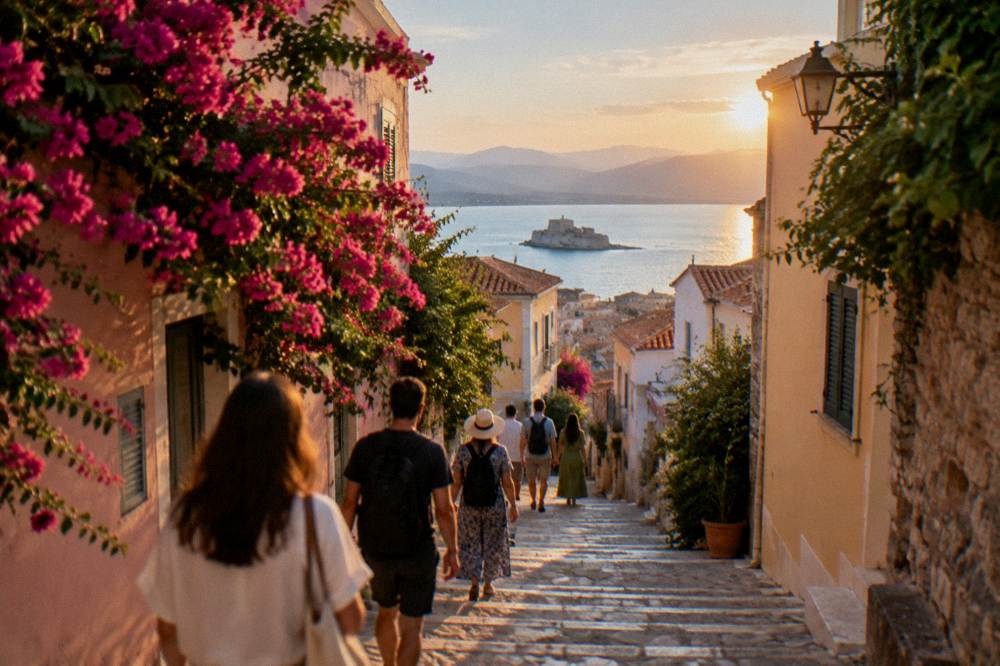
The pressure is also concentrated rather than spread. It sits on the Old Town lanes around Syntagma Square, the waterfront plateia, and the stairway up to Palamidi. Arvanitia, Pronoia, Psaromachalas and the roads toward Karathona absorb far less of it, and the archaeological sites around the Argolid spread visitors out over dozens of kilometres. Mycenae is about 32 minutes' drive from Syntagma Square, the Epidaurus theatre about 41, Ancient Corinth about 61, so the day-trip traffic leaves town rather than stacking up in it.
There is a second, structural reason the town does not drown in visitors: it is not on a main line. There is no passenger rail to Nafplio in 2026, and the KTEL coach from Athens, reported at about 2 hours 10 minutes each way, does not bring the volume a train line would. Cruise calls add pulses of day visitors; whether that counts as "too touristy" is a judgement, and the walkable Old Town makes it an easy one to live with, as covered in is Nafplio walkable from the cruise port.
The Nafplio Travel Guide editorial desk's judgement, stated plainly: if you arrive in August and expect a sleepy fishing village, the waterfront will disappoint you. If you come in May, June, September or October, you get the same restaurants, the same fortress and the same light with a fraction of the foot traffic.
When Is Nafplio Most Crowded?
July and August are the peak, with the summer schedule running from 2 May 2026 at Palamidi (08:00 to 20:00) and Bourtzi extending to 21:00 daily in July and August, while the state sites then slide back down through September to winter hours of 08:30 to 15:30. The hours are the clearest public statement of when the town expects visitors, because staffing and opening windows track demand at Greek state monuments. August is the month Greek domestic travel stacks on top of international arrivals.
The shoulder seasons behave differently in ways the sources support. The HNMS Argos station table, 1980 to 2010, gives June a mean daily high of 31.4 C against July's 34.0 C, and June averages 3.0 rain days against November's 9.4, so early summer is both slightly cooler and drier than the peak. September stays warm at a 29.7 C mean high with 5.0 rain days, and October still averages 24.7 C with the sea-facing town holding lunchtime warmth while the sites cut hours progressively from 16 September.
| Month (HNMS Argos station, 1980 to 2010) | Mean daily high | Mean daily low | Rain days | Site hours signal |
|---|---|---|---|---|
| June | 31.4 C | 14.0 C | 3.0 | Palamidi 08:00-20:00 |
| July | 34.0 C | 16.7 C | 2.1 | Bourtzi until 21:00 |
| August | 33.7 C | 16.8 C | 2.5 | Bourtzi until 21:00 |
| September | 29.7 C | 14.2 C | 5.0 | Sliding down to 08:00-19:00 |
| October | 24.7 C | 11.5 C | 6.9 | 08:00-18:30, then 18:00 |
Winter is the counter-season argument. From November the state sites run 08:30 to 15:30, the Archaeological Museum of Nafplio is open 08:30 to 15:30 but closed every Tuesday, and the HNMS table shows November carrying 82.5 mm of rain over 9.4 rain days. That is the quietest the town gets, with the trade-off of short days and rain; Nafplio in winter and rain covers that season in detail.
If you want a guided introduction to the Old Town without joining a large group in peak season, a private option exists: the Secrets of Nafplio private walking tour with a local guide, Check availability for dates and pricing on the operator's live listing.
Where Do The Crowds Actually Gather In Nafplio?
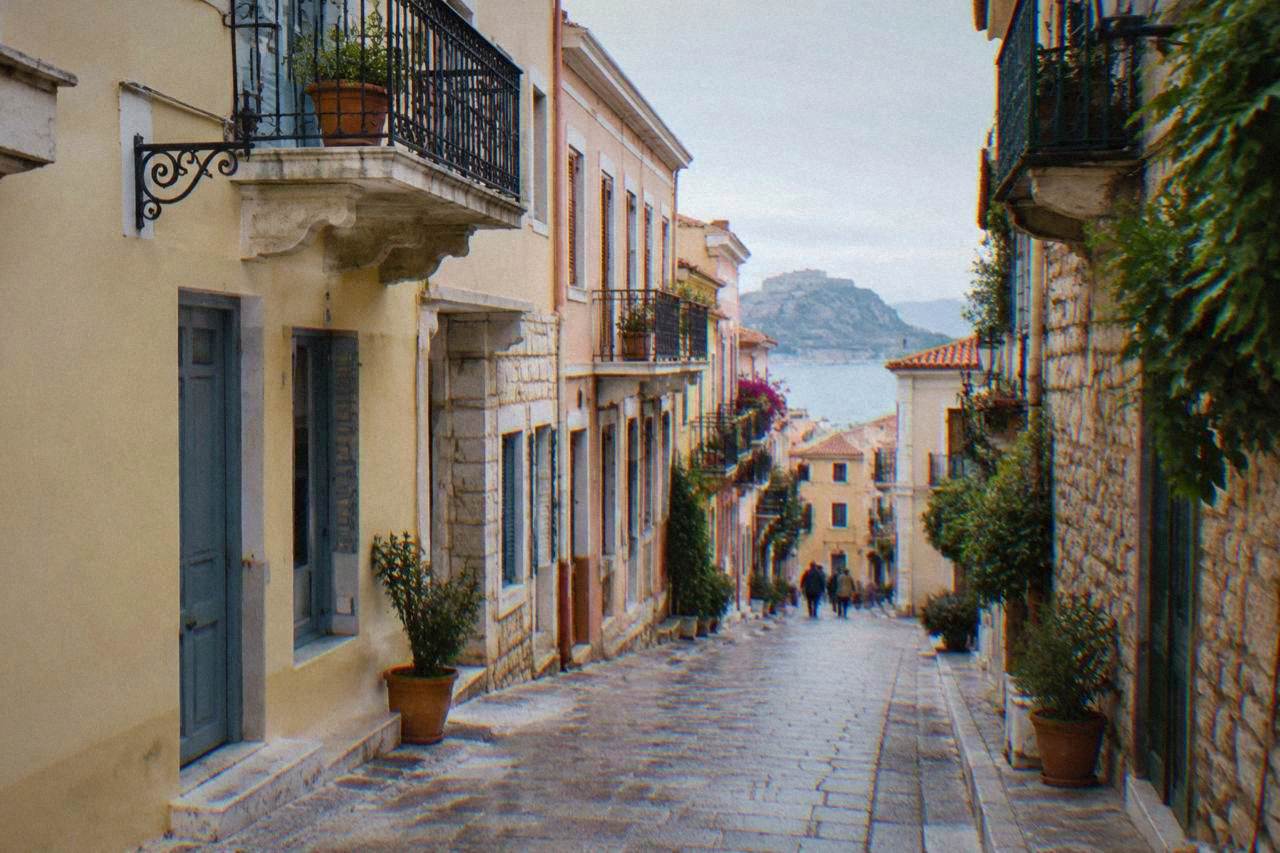
The crowd pressure in Nafplio concentrates on Syntagma Square, the waterfront between the harbour and Arvanitia, the Bourtzi boat departure point, and the Palamidi stairway, roughly the same few hundred metres of streets that every arrival walks first. The rest of the town is larger than its postcard. Pronoia sits across the water under the Lion of Bavaria, carved 1840 to 1841, and Arvanitia's roughly 1 km paved promenade loops the Akronafplia headland away from the shopping lanes entirely. Karathona beach, about 3 to 4 km from the centre, spreads out along a long sandy stretch that the Old Town crowd rarely reaches.
The stairway point deserves precision, because the folklore inflates it. Palamidi is usually counted at 857 carved steps, about 850, not the legendary 999 that older guides repeat. Climbing it at midday in August means sharing a stone staircase with everyone else who had the same idea at the same hour, and the fortress itself, 216 m above the Old Town, is big enough to absorb people once they are through the gate. The Ministry of Culture's page gives the ticket as 20 euro full and 10 euro reduced in 2026, with the reduced ticket sold only from 1 October to 31 May.
| Nafplio spot | Why it is busy | When pressure eases |
|---|---|---|
| Syntagma Square | Central plateia, museums and cafes | Early morning, October to April |
| Palamidi stairway | Single famous ascent, about 850 steps | Before 10:00, late afternoon |
| Waterfront to Bourtzi pier | Boat access point and cruise-call days | Days without cruise calls |
| Arvanitia promenade | About 1 km loop, wide and linear | Midday siesta hours |
| Karathona | About 3 to 4 km out, long beach | Weekdays outside August |
The day trips thin the town out rather than adding to it. Mycenae and Tiryns are UNESCO World Heritage sites, Epidaurus too, and visitors who come for them spend their daylight hours out in the Argolid rather than inside Nafplio's lanes. A shared transfer such as the shared transfer to Mycenae and Epidaurus from Nafplio moves a whole group out and back in half a day, Check availability on the operator's live listing.
Does Nafplio Feel Like A Tourist Town Or A Real Greek Town?
Structurally, Nafplio remains a real Greek town of about 14,500 residents, with the municipality at about 32,600 and a working bus station, hospital and municipal administration all inside or beside the historic centre, which is the strongest evidence that tourism has not hollowed it out. The General Hospital of Nafplio has a switchboard on +30 2752 361100, a facility no mere resort would carry. The Old Town sits beside the KTEL stop on Siggrou street, so local life and visitor life share the same few blocks rather than separating into zones.
History also gives the town depth that tourism did not install. It was the capital of Greece from 1827 to 1834, the first capital of the modern Greek state, and the buildings carry that: the Vouleftiko housed the first Greek parliament from 1825, and Ioannis Kapodistrias governed from the town after arriving in 1828 until his assassination in September 1831 outside the Church of Agios Spyridon. Visitors walk past these because they are on the way to everything else, not because a tourist board planted them.
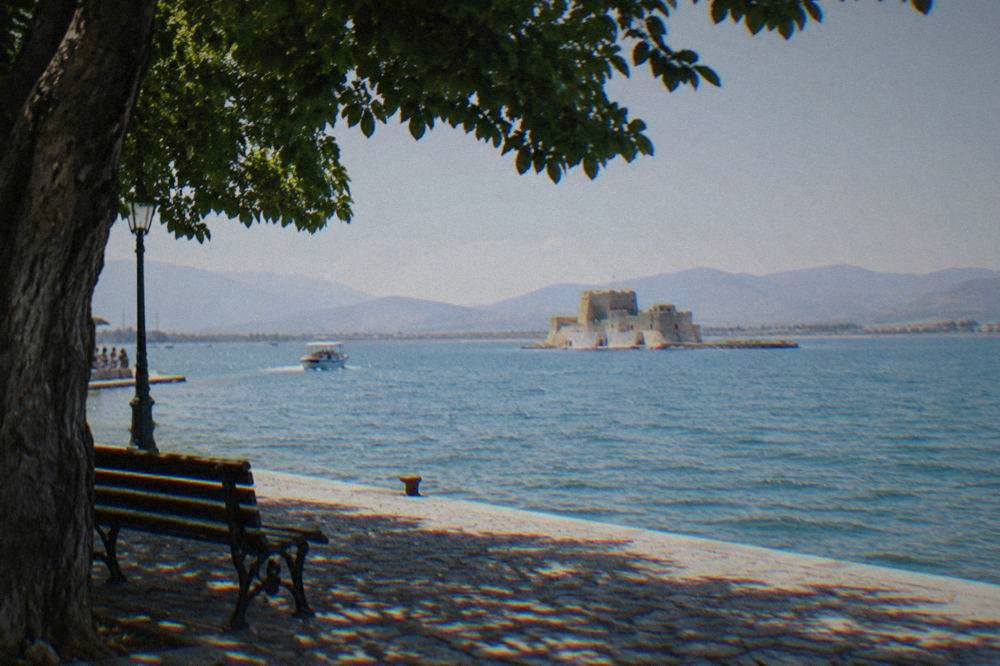
The tourist-facing layer is real but thin: boutique shops on the main lanes, gelato near the square, boats to Bourtzi (7 euro full, 5 euro reduced, per the Ministry's page). Two streets back from the waterfront the tone changes. The balance question is really whether you mind sharing that balance with others, and the town's food scene, covered on the Nafplio food page, gives a good excuse to leave the busy lanes; a Nafplio food tour runs the same logic with a guide attached.
How Do You Visit Nafplio Without The Crowds?
Pick May, June, September or October, arrive midweek, do Palamidi and Bourtzi before mid-morning or after late afternoon, and spend the middle of the day in the Argolid rather than the Old Town, and you will largely remove the touristy parts of a Nafplio trip. The state-site hours make the plan for you. From 2 May 2026 Palamidi opens at 08:00 and runs to 20:00, so an 08:00 start beats both the heat and the coach arrivals, and the same hours apply at Mycenae and Epidaurus. The sites are free on the first and third Sundays of November to March, 6 March, 18 April, 18 May, the last weekend of September and 28 October, which also makes those the busiest free days to avoid if you want solitude.
Three practical moves, all source-backed:
- Travel outside July and August, when Bourtzi's 21:00 closing tells you the evening economy is at full stretch, and instead use September, when the fortress still opens at 08:00 and the HNMS Argos station table, 1980 to 2010, shows a 29.7 C mean high with only 5.0 rain days.
- Sleep in Pronoia or near Arvanitia rather than the core lanes, and walk in; the Arvanitia promenade's roughly 1 km route connects you to the centre without passing through the busiest streets.
- Day-trip on the busy days. Mycenae is about 32 minutes' drive, the Epidaurus theatre about 41, Ancient Corinth about 61, and Tiryns barely 9, so a car or a tour turns a crowded waterfront afternoon into an uncrowded ruin.
One correction worth a sentence, because older guides still repeat it: no scheduled ferry runs from Nafplio or Tolo to Hydra and Spetses, which is out of date; the islands are reached by seasonal day cruise or from another port. That limits the island-day-trip traffic funnelled through Nafplio's harbour, which is part of why the port stays manageable. For the island angle see is the Peloponnese worth visiting.
Common Questions About Nafplio Crowds
Is Nafplio Too Touristy?
Editorial judgement: only in July and August, and mainly on the waterfront and around Syntagma Square. The Ministry of Culture's own hours show the seasonal shape, with fortress hours stretching to 20:00 and Bourtzi to 21:00 in high summer and contracting to 08:30 to 15:30 in winter. Outside the peak the town reads as a small Greek regional centre that happens to be beautiful.
Is Nafplio busier than other Peloponnese towns?
No ranking is stated as fact, because no crowd figures are published. What the sources do show is that Nafplio carries a full regional infrastructure, a hospital, a KTEL hub and a municipality of about 32,600, so its visitor traffic sits on top of a real town rather than replacing one.
What is the quietest month to visit Nafplio?
No superlative ranking is printed, but the figures point clearly: November carries 82.5 mm of rain over 9.4 rain days and December 69.7 mm over 12.2 (HNMS Argos station, 1980 to 2010), and state sites run short 08:30 to 15:30 winter hours. Those months trade quiet for rain and early closing.
Do cruise ships overwhelm Nafplio?
Cruise calls bring day pulses of visitors, and the port is steps from the Old Town, so an arrival morning is busier than an afternoon. The town has no train and no scheduled island ferry feeding it additional volume, so the pulses pass rather than accumulate.
Is the Palamidi climb crowded?
The stairway, about 850 steps rather than the legendary 999, is a single route and shares its traffic with daylight hours. An 08:00 start, when the fortress opens from May onward, is the simple way around the midday queue, and the ticket is 20 euro full, 10 euro reduced, with the reduced price only from 1 October to 31 May.
Are Mycenae and Epidaurus crowded too?
Both are major UNESCO sites with 20 euro tickets in 2026, so they draw their own traffic, but they sit about 32 and 41 minutes' drive from Nafplio respectively, which spreads arrivals across a wide area rather than concentrating them in one lane. Early opening at 08:00 applies across the summer schedule.