Is Nafplio The Prettiest Town In Greece?
Is Nafplio the prettiest town in Greece? An honest look at what the town actually offers, its castles, Old Town and waterfront, and how it compares on the facts.
Beauty contests between Greek towns are settled by taste, not measurement, and no ranking of "prettiest" exists as a fact. What can be weighed is the case itself, and Nafplio's is unusually strong: a coastal town of about 14,500 residents on the Argolic Gulf, in the Argolid region of the north-east Peloponnese, with Palamidi Fortress standing 216 m above the Old Town, the old acropolis of Akronafplia above the harbour, and the fortified islet of Bourtzi floating just offshore. Add the distinction of being the first capital of modern Greece, from 1827 to 1834, and the town carries both scenery and story. The editorial desk at Nafplio Travel Guide walks through the evidence below.
Is Nafplio The Prettiest Town In Greece?
No ranking names Nafplio the prettiest town in Greece as a matter of record, because none exists, but the town is a repeated contender, and the case rests on three castles within one view, a largely intact Old Town of lanes and Venetian-era houses, and a waterfront position on the Argolic Gulf. Whether that beats other contenders is a judgement of taste, and this page gives the reasons rather than a verdict.
The honest framing first: "prettiest" is an opinion, and the only defensible way to answer is to lay out what Nafplio demonstrably has and let a reader compare. What it demonstrably has is density. Very few Greek towns pack a baroque fortress on a 216 m rock, a walled acropolis peninsula, a sea-castle islet and a neoclassical square into a walkable area of roughly a kilometre. The Ministry of Culture's own pages catalogue Palamidi, Bourtzi and the Archaeological Museum in the Venetian arsenal on Syntagma Square, all within the Old Town.
The counter-candidates usually named in the same breath are island towns, and that comparison matters in both directions. Nafplio is not an island, it is a mainland town in the Peloponnese, which means it is reachable by road year-round and serves as a base for Mycenae, Epidaurus, Tiryns, Argos, Nemea and Ancient Corinth, two of which are UNESCO World Heritage listings (Mycenae and Tiryns in 1999, Epidaurus in 1988). An island town offers white cubes and blue sea; Nafplio offers layered fortification history on the sea. Which reads as prettier depends entirely on the eye.
There is also a practical beauty argument: the town stays visitable outside high summer. The HNMS Argos station, 1980 to 2010, records mean daily highs of 14.6 C in January and 34.0 C in July, so the shoulder months sit in a comfortable band, and the state sites run long summer hours (from 2 May 2026, Palamidi is open 08:00 to 20:00). A pretty town you can actually walk in, in April or October, earns points that a July-only beauty does not.
For readers weighing the town against other Peloponnese bases, the fuller comparison is in which part of the Peloponnese to choose.
What Makes Nafplio's Setting So Distinctive?
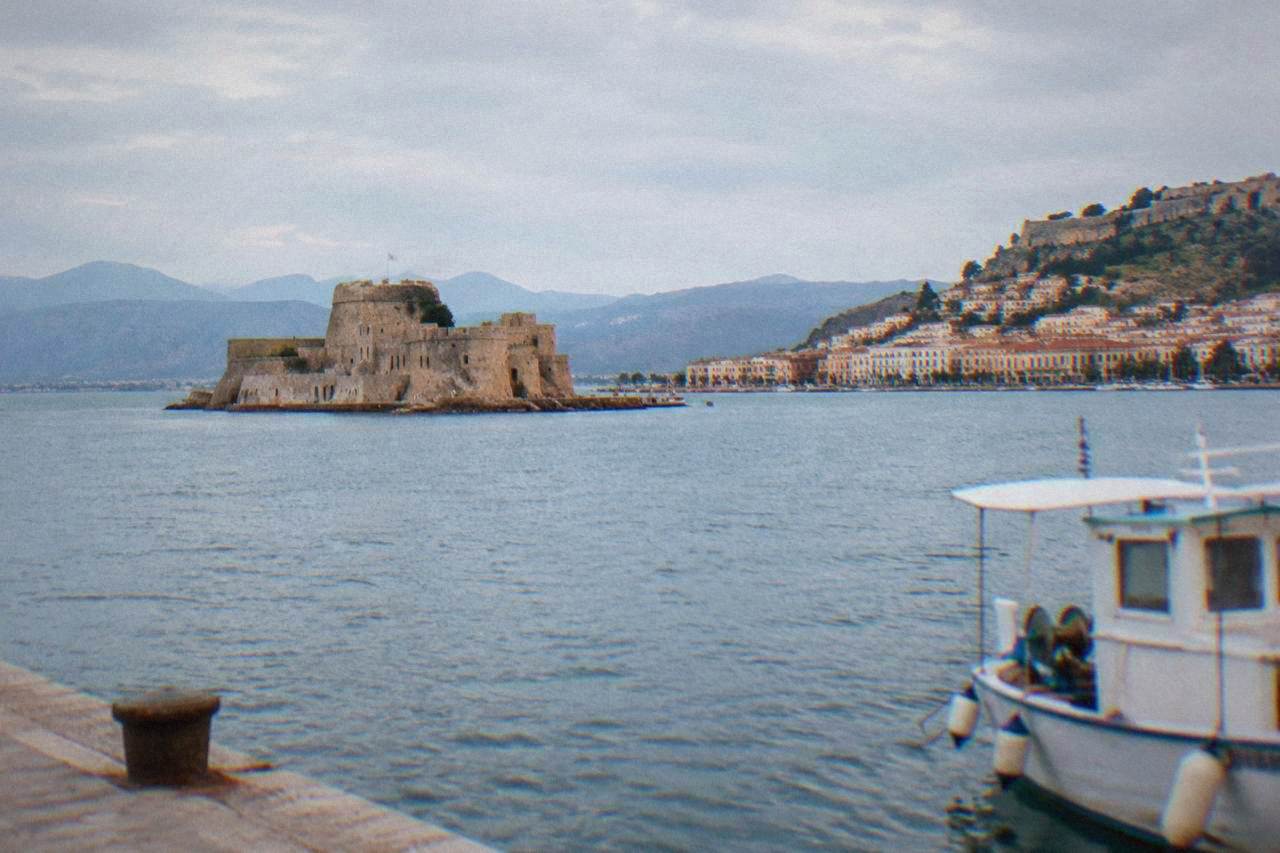
Nafplio's distinctiveness comes from vertical geography: Palamidi Fortress at 216 m above the Old Town, Akronafplia's walls on the rocky peninsula above the harbour, and Bourtzi on its islet in the bay, all visible from the waterfront at once, with the Argolic Gulf behind them. The Arvanitia Promenade, a paved coastal path of about 1 km, loops the Akronafplia headland below the walls.
That trio of fortifications in one view is the town's visual signature, and it is documented rather than hyped. The Ministry of Culture's Palamidi page records the fortress and its stairway of about 850 steps (the usual count is 857, not the legendary 999 that folklore claims), reached from the town or driven to the gate. The stairway is usually counted at 857 carved stone steps, and older guides still say 999, which is out of date. The fortress was fortified by the Venetians in the second Venetian period, from 1686 to 1715, and taken by the Greeks in 1822.
Bourtzi, begun in June 1471 to the design of the architect Antonio Gambello, guards the harbour entrance and is open to visitors who reach it by boat; the Ministry of Culture's page lists a 7 euro full ticket and a 5 euro reduced ticket. Akronafplia, the old acropolis, carries polygonal walls from at least the end of the 4th century BC, according to the Argolis Ephorate's monument page, with Frankish and Venetian layers above them. The point is not that one castle is beautiful; it is that all three share a single frame.
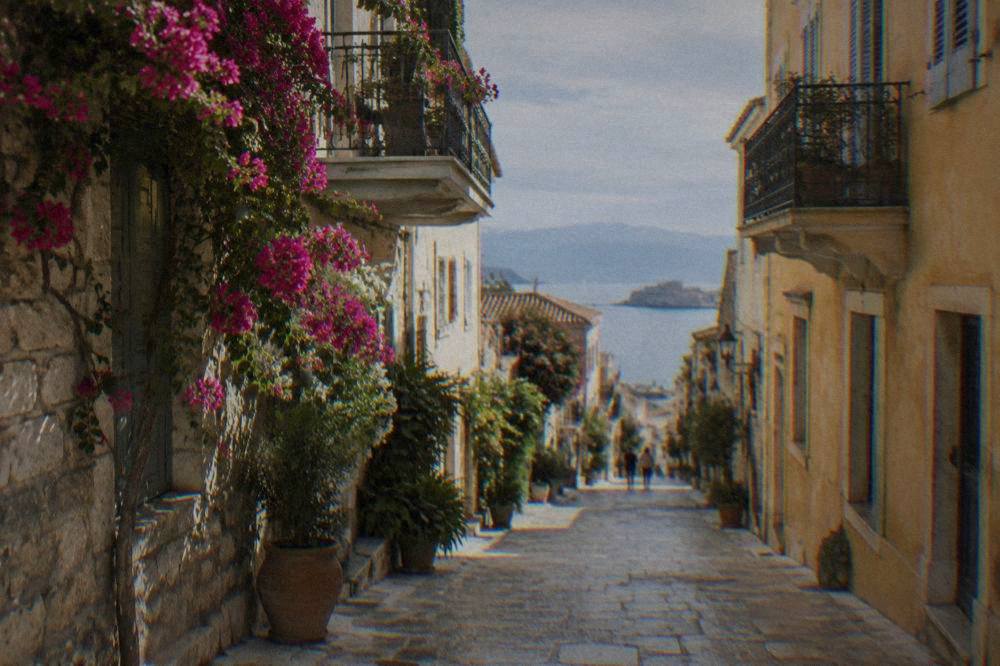
Below the walls, the town itself is the second act. Syntagma Square holds the Archaeological Museum in the old Venetian arsenal and the Vouleftiko, the building that housed the first Greek parliament from 1825, per the municipality's history pages. Pronoia, across from the Old Town, holds the Lion of Bavaria, carved 1840 to 1841 by Christian Heinrich Siegel as a copy of Thorvaldsen's Lion of Lucerne. The lanes of Psaromachalas climb the hillside beneath Akronafplia in a stack of balconies and stairs.
The easiest way to test the argument is to walk it. The related City Walking Tour of Nafplio covers the lanes, squares and harbour viewpoints in the company of a guide, and Check availability if a fixed slot suits your dates.
How Does Nafplio Compare With Other Contenders?
Against island towns such as Hydra or the Cycladic ports, Nafplio trades whitewash for fortification and history: it was the capital of Greece from 1827 to 1834, and its old quarter is stone-and-neoclassical rather than blue-and-white. Against other mainland towns it stands out for having the sea on three sides and three castles in one view, plus UNESCO-listed Mycenae and Epidaurus within an hour's drive, which no comparable rival can match.
What the sources do allow is a side-by-side of what each kind of place offers, and that is what the table below does. The drive times are computed from Syntagma Square over OpenStreetMap routing, free-flow.
| What Nafplio offers | The fact behind it |
|---|---|
| Three fortifications in one view | Palamidi at 216 m, Akronafplia's walls, Bourtzi islet |
| First-capital history | Capital of Greece from 1827 to 1834 |
| UNESCO day trips | Mycenae and Tiryns (1999), Epidaurus (1988) |
| Coastal walking | Arvanitia Promenade, about 1 km paved |
| Sea access | Argolic Gulf waterfront, Arvanitia (Blue Flag) and Karathona beaches |
Set against an island port, Nafplio loses the ferry-arrival romance and gains reachability: it is about 141 km from Athens by road, with no train and no scheduled ferry connection of its own (seasonal day cruises aside). Set against other Peloponnese towns, it has the rare combination of a real Old Town fabric and a swimming beach within the municipality's edge at Karathona, reachable on foot via the Arvanitia path or by a short drive. The beaches question, and the water, are covered in the wider is Nafplio worth visiting assessment.
One caveat belongs here: the town's beauty is concentrated. The Old Town, Akronafplia, the harbour and Arvanitia form a compact stage, and a visitor who stays a week will walk it many times over. The surrounding modern town is ordinary, and the honest answer to how long to stay is usually two or three days, which the how many days you need in Nafplio page works through in detail.
Does The First-Capital History Add To The Appeal?
Yes, materially: Nafplio was the capital of modern Greece from 1827 to 1834, Governor Ioannis Kapodistrias arrived in January 1828 and was assassinated in September 1831 outside the Church of Agios Spyridon, and the town's parliament, arsenal and government buildings still stand inside the Old Town. That layer of history gives the pretty lanes a substance most rivals lack.
The dates matter because they are so often misstated. Older guides sometimes say the capital period ran from 1829 to 1834, which is out of date; the municipality's own history pages give 1827 to 1834. Kapodistrias landed in January 1828 and governed from the town until his assassination on the steps of the Church of Agios Spyridon in September 1831. The capital moved to Athens in 1834, after King Otto's arrival the previous year.
The buildings survive in daily use, which is the point. The Vouleftiko, a former mosque remodelled to house the first Greek parliament, stands on Syntagma Square. The Archaeological Museum occupies the Venetian arsenal, open 08:30 to 15:30 all year except Tuesdays, with a 10 euro full ticket and a 5 euro reduced ticket per the Ministry of Culture's page. The Land Gate, the Five Brothers Bastion and the Lion of Bavaria in Pronoia each carry a chapter of the same story, and none requires a ticket to see from the street.
This is also where a guide earns their fee. A walk that names the buildings as they pass turns a pretty square into a documented sequence, and the related walking tour does exactly that; Check availability for your dates.
When Is Nafplio At Its Most Photogenic?
By the climate record, May and late September to October pair the mildest walking weather with the longest site hours: the HNMS Argos station, 1980 to 2010, records mean daily highs of 26.5 C in May and 24.7 C in October against 34.0 C in July, with 18.7 mm of rain in May and 44.3 mm in October against 82.5 mm in November. The fortress light over the Argolic Gulf in the late afternoon is the town's signature shot.
The climate table comes from an inland station about 10 km north-west of the town, so the waterfront runs slightly milder, but the pattern holds: a dry early summer, a warm peak, and rain rising through autumn. Photographically, the town rewards the hours when the low sun crosses the harbour: Bourtzi silhouetted from the waterfront, the Palamidi stairway in side light, and the west-facing lanes of the Old Town in the golden hour before dinner.
| Month | Mean daily high (C) | Rain (mm) | Rain days |
|---|---|---|---|
| May | 26.5 | 18.7 | 6.2 |
| June | 31.4 | 8.9 | 3.0 |
| July | 34.0 | 9.1 | 2.1 |
| September | 29.7 | 20.3 | 5.0 |
| October | 24.7 | 44.3 | 6.9 |
Hours matter as much as light. State sites run winter hours of 08:30 to 15:30, then extend from April's 08:00 to 19:00 to 08:00 to 20:00 from 2 May, stepping back down through September and October. The free-admission days at Greek state sites (6 March, 18 April, 18 May, the last weekend of September, the first and third Sundays from November to March, and 28 October) are worth planning around, since a pretty morning can double as a free fortress morning. Visitors unsure about winter conditions can read the fuller take in is Nafplio too touristy, which also covers the quiet months.
For the practical frame of a visit built around photography and walking, the one day in Nafplio itinerary sequences the viewpoints in order.
So Should You Judge For Yourself?
On the facts, Nafplio belongs on any shortlist of Greece's prettiest towns: it has three castles in one harbour view, a walkable Old Town with 1827-to-1834 capital history, Blue-Flag Arvanitia and Karathona beaches on its edge, and UNESCO-listed Mycenae and Epidaurus within about 32 and 41 minutes' drive. Whether it tops your personal list is yours to decide, but the raw material is as strong as any mainland rival's.
The reasonable plan is two or three days in town, one of them given to a fortress morning (Palamidi's 2026 ticket is 20 euro full and 10 euro reduced, with the reduced ticket sold only from 1 October to 31 May, per the Ministry of Culture's visiting page), one to a Mycenae-and-Epidaurus day trip, and at least one unhurried circuit of the Arvanitia Promenade at sunset. Seasonal day cruises and the town's food and cooking scene round out the stay; the Nafplio cooking class and wine tasting roundup covers the latter.
Whatever the final verdict on the title, the case has to be walked to be felt. Start on Syntagma Square, climb toward Akronafplia's walls, and let the harbour answer the question in person.
Common Questions About Nafplio
Is Nafplio The Prettiest Town In Greece?
There is no official ranking, so the title is a matter of taste, but Nafplio is a strong contender on the facts: three fortifications in one view, an intact Old Town, a waterfront on the Argolic Gulf, and first-capital history from 1827 to 1834.
What is Nafplio famous for?
Nafplio is famous for being the first capital of modern Greece, from 1827 to 1834, and for its three castles: Palamidi Fortress above the town, Akronafplia on the headland, and Bourtzi on its islet in the harbour. The fuller answer is on the what Nafplio is famous for page.
Is Nafplio an island?
No. Nafplio is a mainland coastal town in the Argolid, in the north-east Peloponnese, on the Argolic Gulf. Bourtzi is a small islet in its harbour, but the town itself is on the mainland, about 141 km from Athens by road.
How many steps does Palamidi have?
About 850 steps, 857 by the usual count, not the legendary 999 that folklore claims and older guides repeat. The 2026 ticket is 20 euro full and 10 euro reduced, and the reduced ticket is sold only from 1 October to 31 May, per the Ministry of Culture's visiting page.
Can you swim in Nafplio?
Yes. Arvanitia, below the Akronafplia walls at the end of the about 1 km promenade, is a Blue Flag pebble beach organised in summer, and the sandy Karathona beach sits about 3 to 4 km from the centre, reachable on foot or by a short drive.
How many days do you need in Nafplio?
Two or three days cover the Old Town, Palamidi, Bourtzi and one major day trip such as Mycenae and Epidaurus. A fourth day allows Nemea's wineries or a slower pace; the itinerary pages break each option down day by day.