Monemvasia: The Rock Town And Whether To Go In A Day
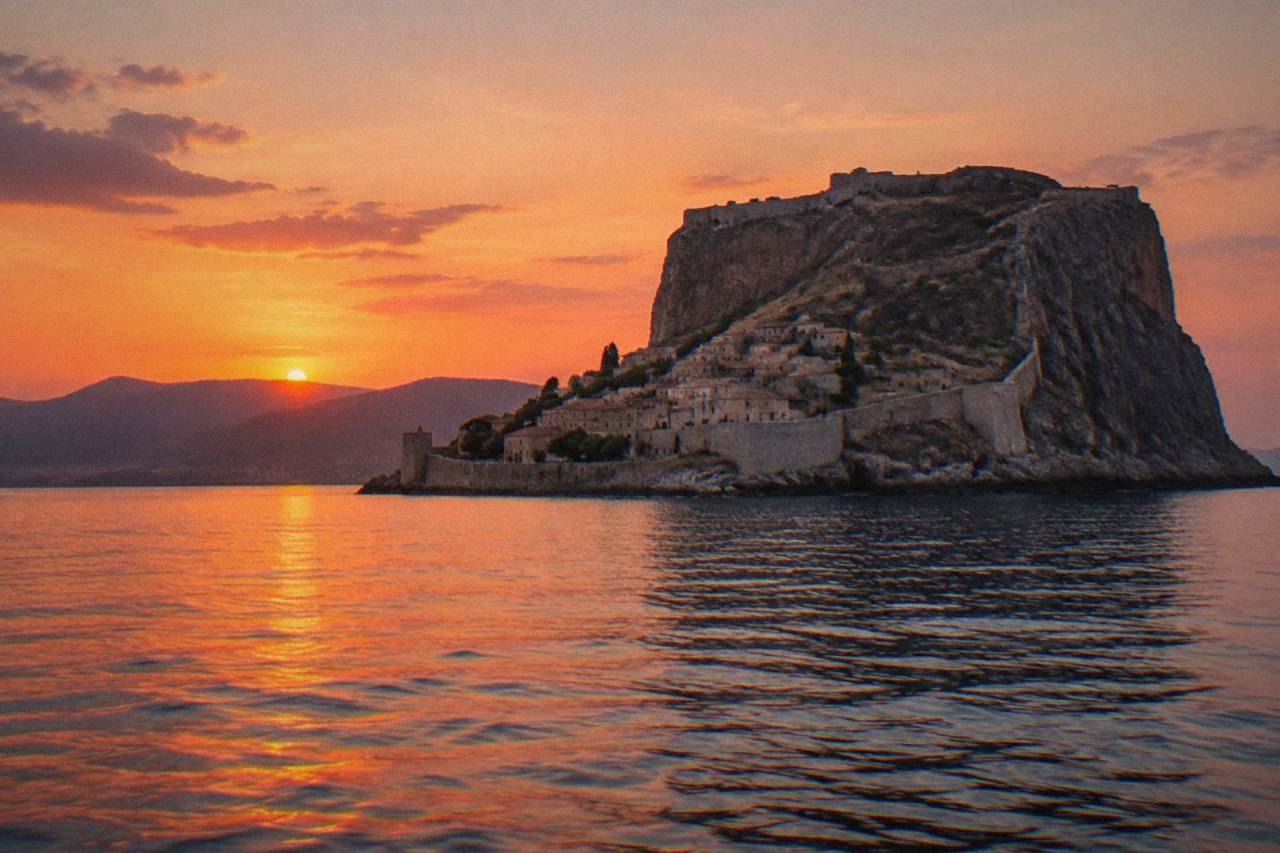
Monemvasia sits on a rock island off the south-east Peloponnese coast, about 208 km and 219 minutes by road from Syntagma Square in Nafplio, and this guide sets out what the sources say about the town and whether a day trip from the Argolid is realistic.
Short answer
Monemvasia is about 208 km and 219 driving minutes from Nafplio, which makes it one of the longest day trips on this site's map, practical only as a full-day outing with an early start, and better suited to an overnight stay.
Monemvasia is a walled medieval town built on a rock island just off the south-eastern coast of the Peloponnese, joined to the modern shore by a short causeway, and from Nafplio, the small coastal town in the Argolid on the Argolic Gulf, it is about 208 km by road and roughly 219 driving minutes from Syntagma Square. That single number shapes everything on this page. Mycenae, Epidaurus and Tiryns are short hops from Nafplio; Monemvasia is another category of trip entirely, a long day on Greek roads for a place many travellers rank among the sights of the whole peninsula.
Where Is Monemvasia From Nafplio?
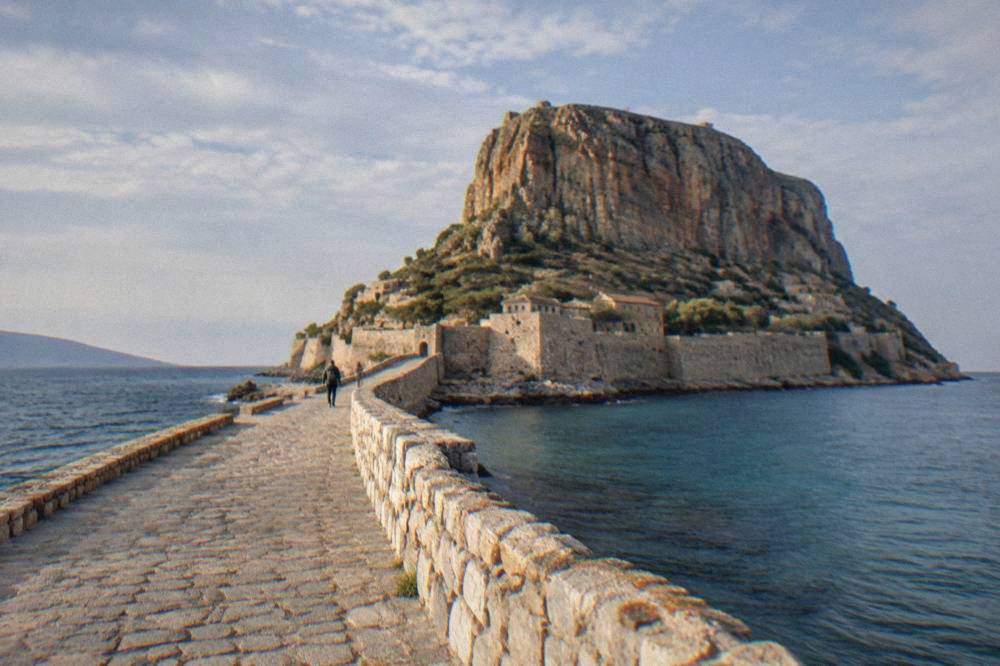
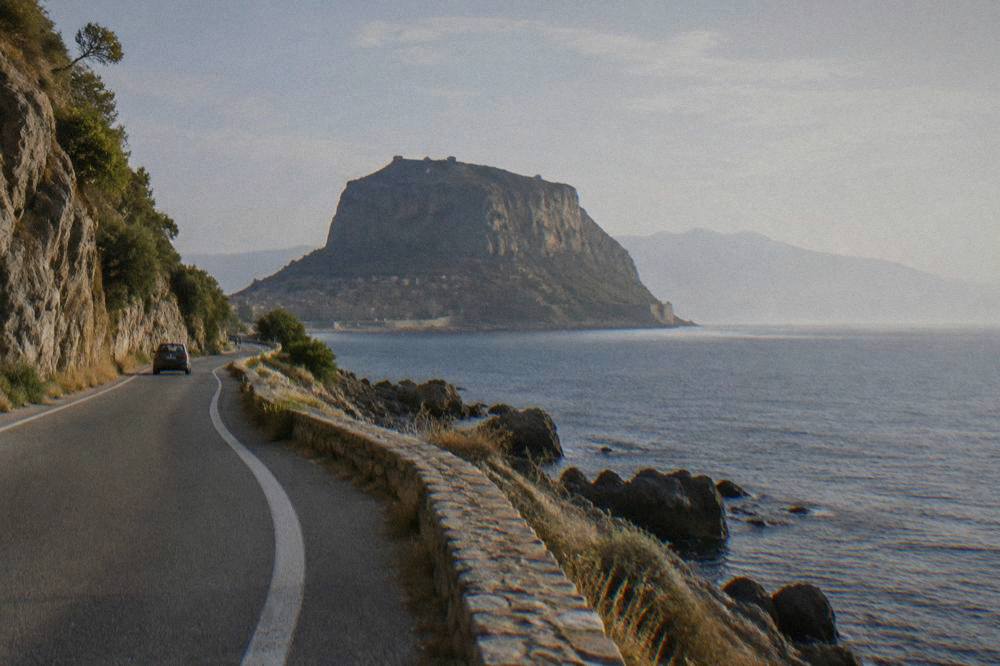
Monemvasia lies on the south-eastern edge of the Peloponnese, in the region of Laconia, about 208 km by road from Syntagma Square in Nafplio, a computed free-flow drive of about 219 minutes each way. The town occupies a flat-topped rock island just offshore, connected to the mainland by a causeway, with the modern service town of Gefyra on the shore opposite. Nothing about it is close to Nafplio's usual day-trip ring.
The geography matters because it decides the day. Nafplio sits on the Argolic Gulf in the north-east Peloponnese; Monemvasia faces the Myrtoan Sea to the south-east. Between them the road runs south past Argos, crosses into Arcadia and then Laconia, and only in the final stretch drops toward the coast. There is no train and no ferry on any part of this route: as with everything on this site, the 2026 reality is road only, and the numbers in this article are computed free-flow driving times, not timetables.
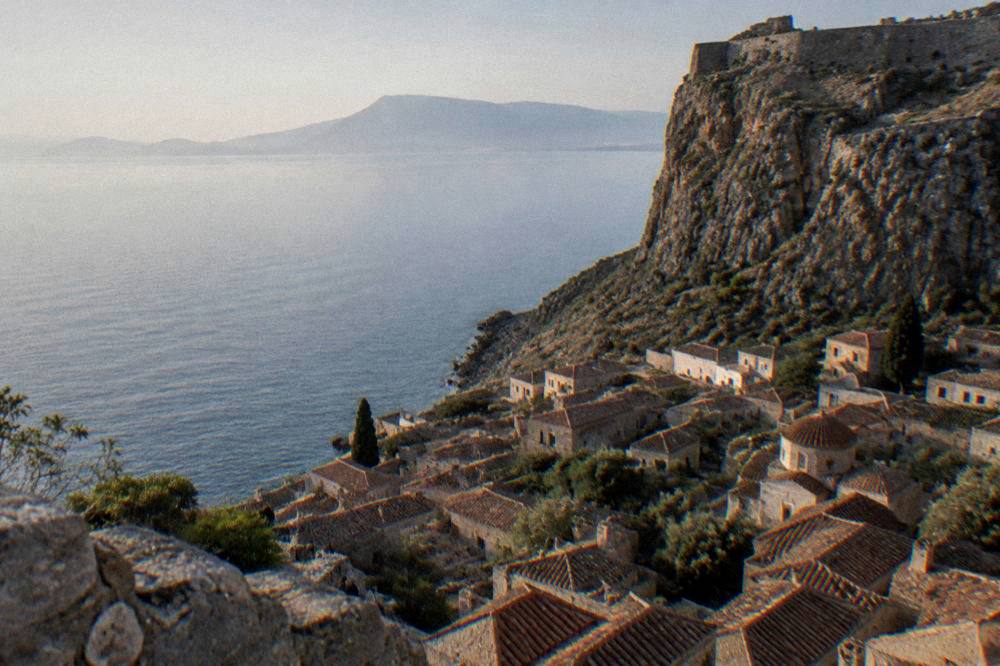
The rock itself is the sight. The name refers to its single approach, the causeway that gave the fortress town one way in, and the lower town inside the walls is a preserved settlement of stone houses, lanes and churches, with a ruined upper town reached by a steep path near the summit.
How Long Is The Drive From Nafplio To Monemvasia?
The computed drive from Syntagma Square in Nafplio to Monemvasia is about 208 km and about 219 minutes each way without stops, which means roughly seven and a half hours of driving for a round trip in a single day. That is more than twice the drive to Mystras, about 124 minutes, and comfortably longer than Ancient Olympia at about 186 minutes. Free-flow means exactly that: no traffic, no pauses, no wrong turns.
For comparison, here is where Monemvasia sits among the farther destinations on this site's day-trip map, all computed from Syntagma Square:
| Destination | Distance by road | Free-flow drive from Nafplio |
|---|---|---|
| Mystras | 128 km | about 124 minutes |
| Ancient Olympia | 173 km | about 186 minutes |
| Monemvasia | 208 km | about 219 minutes |
| Ermioni | 73 km | about 96 minutes |
| Porto Heli | 78 km | about 98 minutes |
| Corinth Canal | 69 km | about 72 minutes |
The practical reading of that table: Monemvasia is the longest single day trip from Nafplio that this site covers. A one-day plan means leaving before 08:00, accepting about three hours and forty minutes of total driving beyond the sightseeing itself, and returning after dark in most of the year.
The alternative, which the arithmetic favours, is to pair Monemvasia with Mystras and stay a night in Laconia. Mystras is about 124 minutes from Nafplio, and the two sites are often combined on a Peloponnese circuit because the road south passes close to Sparta. This site's Peloponnese road trip itinerary covers that circuit in detail, including where Monemvasia fits in a multi-day loop.
For travellers who cannot spare the days but still want a big-landscape day out from the Argolid, the closer options carry much of the same weight with a fraction of the wheel time. The shared half-day Mycenae and Epidaurus outing is the classic:
What Is Monemvasia And Why Is It Famous?
Monemvasia is a fortified medieval town founded on a rock island off the Laconian coast, a Byzantine stronghold later held by Venetians and Ottomans, famous for its complete stone lower town inside the walls and its car-free lanes where nothing taller than a bell tower interrupts the silhouette. The name comes from its single entrance, and the town served as a major Byzantine port and, later, a refuge community.
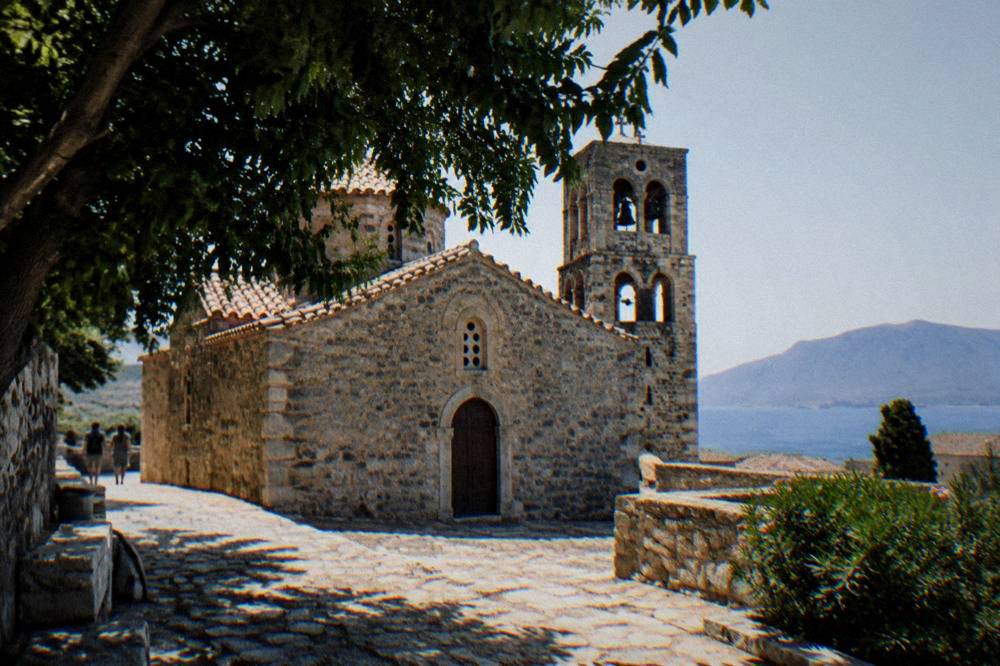
The preserved church architecture inside the walls is the other headline, with several medieval churches standing among the houses.
Confirm locally at the gate.
A useful framing for Argolid-based travellers: Nafplio gives you fortress architecture in spades, with Palamidi at 216 m above the Old Town and Akronafplia above the harbour, but Monemvasia's version is a whole town rather than a single fortress. If your interest is walking a walled settlement rather than climbing ramparts, the rock delivers that and Nafplio's castles do not.
Can You Visit Monemvasia As A Day Trip From Nafplio?
Yes, but only as a committed full day: about 219 minutes of driving each way leaves roughly four to five hours on the rock itself, and the free-flow figures allow no margin for a late start, a long lunch or heavy weekend traffic. An overnight in Monemvasia or nearby turns the same journey into an evening-and-morning visit, which the town's atmosphere arguably deserves.
The one-day shape, on the numbers:
| Leg | Computed time |
|---|---|
| Nafplio to Monemvasia, free flow | about 219 minutes |
| Time on the rock, one-day plan | about 4 to 5 hours |
| Return drive to Nafplio | about 219 minutes |
| Total round-trip driving | about 7 hours 20 minutes |
Those hours are driving only. Add the walk from the causeway car park, the lanes of the lower town, and, for the fit and determined, the stepped path to the upper town, and a one-day visit is a 12-hour door-to-door proposition in summer daylight. In winter, with state-site-style closing hours the rule across Greek heritage towns and sunset before 18:00, the window narrows sharply; this site's Nafplio in winter and rain guide covers how the Argolid changes in the low season.
The overnight alternative deserves the arithmetic. Staying in or near the rock removes 219 minutes from one of the days, lets you see the town after the day crowds leave, and opens the option of adding Mystras, about 124 minutes from Nafplio, or the central Peloponnese on the way back. For a two-base trip built around Nafplio, see two days in Nafplio for how the Argolid half of the plan is usually structured.
Every Monemvasia visit from the Argolid is self-driven, a rented car with a named driver, or a private arrangement quoted individually. If a listing promises a group day trip from Nafplio to the rock, read exactly what transport it includes before booking.
What Do You Actually See Inside The Rock Town Of Monemvasia?
The visitable substance of Monemvasia is the walled lower town, a car-free grid of stone lanes, restored houses, shops and medieval churches, plus the steep stepped path to the ruined upper town at the top of the rock, and the causeway and sea walls that frame the first view from the shore. The rock stands tall and sheer above the water, and the upper town path is a genuine climb, not a stroll.
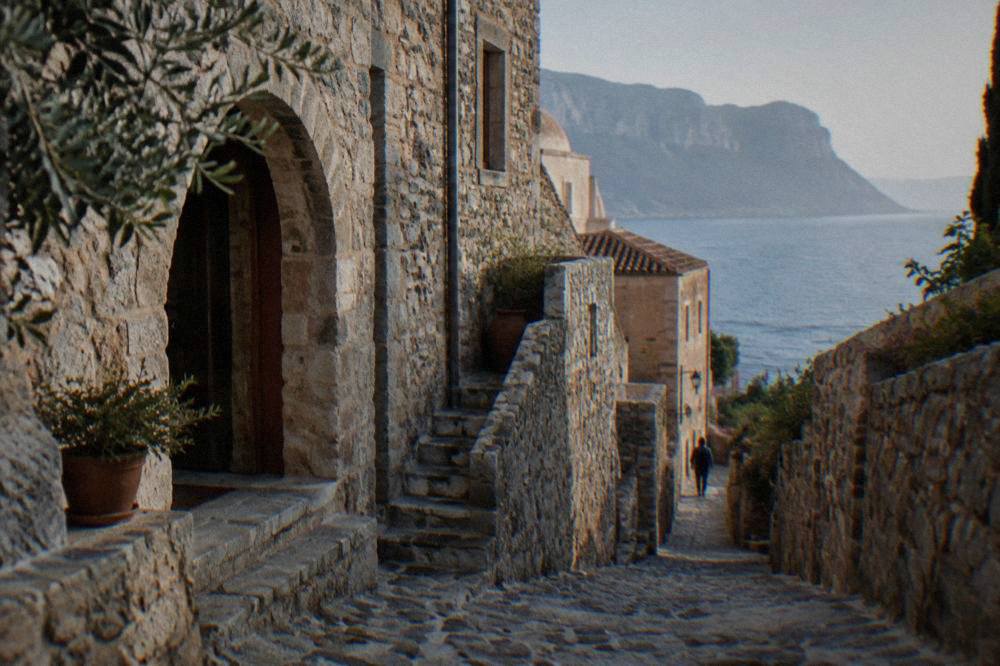
The lower town holds the day. Its lanes run between stone houses to small squares and church facades, and the built fabric, rather than any single museum piece, is the attraction. Churches inside the walls carry the medieval architectural weight, and several are signposted on the town's own walking routes. The sea wall on the east side looks straight down the Aegean, and the terrace at the top of the lower town is the standard first viewpoint. The wider set of guides lives on Nafplio Travel Guide.
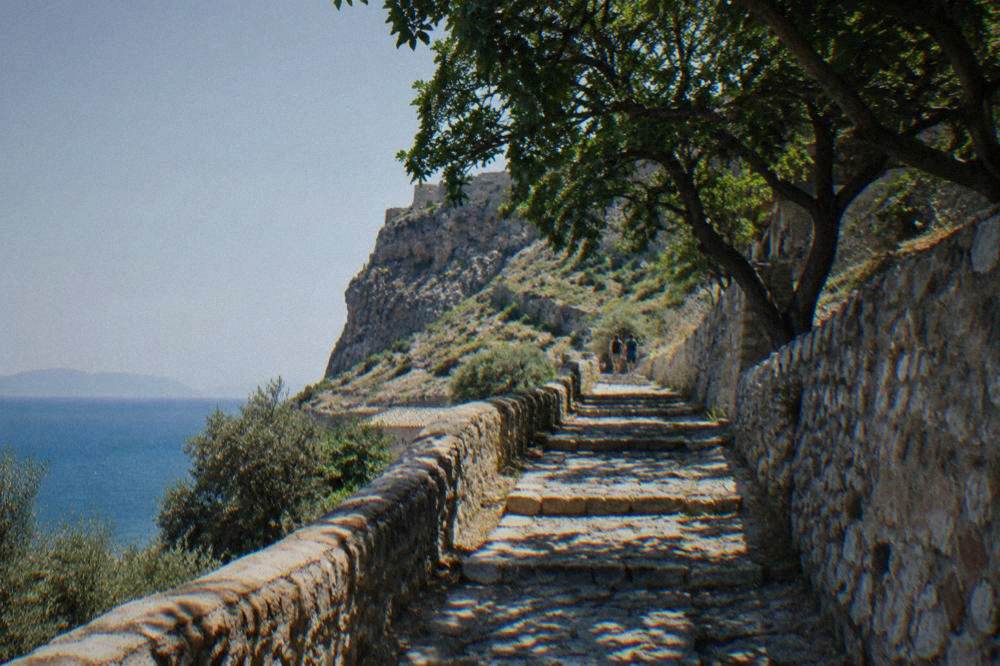
The upper town is the second act. A stepped and in places rough path climbs from the lower town toward the summit plateau, where walls, cisterns and church ruins stand among the rocks. The sources describe it as a substantial ascent, so carry water, wear real shoes, and treat midday in high summer with respect: the HNMS Argos station, 1980 to 2010, records a July mean daily high of 34.0 C, and while that station is inland near Nafplio, about 10 km north-west of Syntagma Square, the exposed rock at Monemvasia offers little shade.
For Nafplio travellers used to the Palamidi stairway, about 850 steps and not the legendary 999, the comparison is direct: the upper-town path at Monemvasia is a climb of similar character, on a bigger rock, at the far end of a much longer drive.
Monemvasia Or Mystras: Which Is The Better Day Trip From Nafplio?
Mystras wins on distance, about 124 minutes from Nafplio against about 219, and on UNESCO-listed Byzantine substance; Monemvasia wins on atmosphere and setting, a lived-in sea-girt town rather than a deserted ruined city on a hillside. Both are long days by road, and doing both properly in one day from Nafplio is not realistic on the computed figures.
The honest comparison, on the numbers this site holds:
| Factor | Mystras | Monemvasia |
|---|---|---|
| Drive from Syntagma Square | about 124 minutes | about 219 minutes |
| Distance by road | 128 km | 208 km |
| Character | Ruined Byzantine city on a hillside | Walled town on a sea rock |
| Overnight potential | Sparta area | Inside the walls or Gefyra |
Check the current price on the ticket page before booking either trip.
Editorially, the desk's judgement runs like this. If your trip is Nafplio-centred and you want one far-flung fortress day, Mystras gives you the deeper history and over three hours less driving. If you want the photograph, the sea and the feeling of a town preserved rather than excavated, Monemvasia is the stronger draw, and the overnight that the distance pushes you toward is part of the pleasure rather than a concession. The Mystras day-trip guide covers the Spartan option in full.
Where Does Monemvasia Fit Among Nafplio's Far Day Trips?
Monemvasia anchors the far end of Nafplio's day-trip spectrum at about 219 minutes, alongside Ancient Olympia at about 186 minutes and Mystras at about 124 minutes, all of them Laconian and western-Peloponnese destinations that reward either an early start or a night away. The near ring, Mycenae at about 32 minutes and Epidaurus at about 41, is a different kind of planning altogether.
The full spread from Syntagma Square, computed over free-flow routing:
| Destination | Free-flow drive | Type of day |
|---|---|---|
| Mycenae | about 32 minutes | Half-day possible |
| Epidaurus theatre | about 41 minutes | Half-day possible |
| Ancient Nemea | about 46 minutes | Easy half-day |
| Corinth Canal | about 72 minutes | Comfortable day |
| Ermioni | about 96 minutes | Full day |
| Mystras | about 124 minutes | Long day |
| Ancient Olympia | about 186 minutes | Very long day |
| Monemvasia | about 219 minutes | Overnight advised |
A sensible big-picture plan uses both rings. Base in Nafplio, work the Argolid sites in the near ring over several days, then take one or two nights for the far ring. The things to do in Nafplio page maps the near ring, and the Nemea day-trip guide covers the wine country that sits, conveniently, on the road west, though Nemea town and Ancient Nemea are different places and should be kept apart in any plan.
For wine-minded travellers who would rather not drive 208 km each way, the Argolid and its borders offer closer options:
And for Athens-based travellers weighing a different base entirely, the full-day private circuit is the strongest single-product answer:
What Should You Know Before Driving To Monemvasia?
Plan the drive itself as part of the day: about 208 km each way, about 219 free-flow minutes, no rail and no ferry alternative on any part of the route in 2026, and a car park on the mainland shore before the causeway, since the rock town itself is car-free. Leave early, check the weather, and treat the return leg at night as a real consideration.
| Planning item | What the sources say |
|---|---|
| Route type | Road only, no train on any Peloponnese line into Nafplio or Laconia |
| Free-flow drive, each way | about 219 minutes |
| Distance, each way | 208 km |
| Access to the rock | Causeway from the shore, then on foot |
| Best season margin | Long summer daylight gives the widest one-day window |
Climate shapes the day more than the averages suggest. The nearest official station to Nafplio, the HNMS Argos station 1980 to 2010 about 10 km north-west of Syntagma Square, records July and August mean daily highs of 34.0 C and 33.7 C, with rainfall of just 9.1 mm and 13.0 mm respectively; November, at 82.5 mm and 9.4 rain days, is the month the table shows as the rainiest. Laconia is not the Argolid, but the pattern of hot dry summers and a wet November-to-March half of the year holds across the Peloponnese, and the exposed rock amplifies both.
Practical notes the desk can stand behind: the emergency number in Greece is 112; the country uses the euro and is a Schengen member; and Nafplio's General Hospital switchboard, +30 2752 361100, is the Argolid's reference point, though on a Laconia trip the local services along the route are the nearer ones. Accommodation anywhere in Greece collects the climate resilience fee, and it is higher from April to October; the rates are collected by the property and are not printed on this site.
Is Monemvasia Worth The Drive From Nafplio?
On the desk's judgement, yes, with conditions: Monemvasia justifies about 208 km each way only for travellers who specifically want its walled sea-town character, and it is best bought with an overnight rather than a same-day return, while a Nafplio-only stay is better spent on the Argolid's own UNESCO sites at Mycenae, Tiryns and Epidaurus, all under 45 minutes away. The drive is the price, not the bonus.
Mycenae and Tiryns share a UNESCO inscription, Epidaurus carries its own from 1988, and each sits inside a 41-minute drive of Syntagma Square with Ministry-published tickets of 20 euro full and 10 euro reduced. Monemvasia offers a different product, a preserved town rather than an ancient site, at more than five times the driving distance. Neither choice is wrong; they serve different interests.
For the classic Argolid day, the shared half-day tour remains the entry point, and it pairs naturally with a self-driven far day later in the week:
Read more on the pieces of the near ring in the Mycenae and Epidaurus guides, or the wider question of whether Nafplio works as an Athens day trip if your base is still undecided.
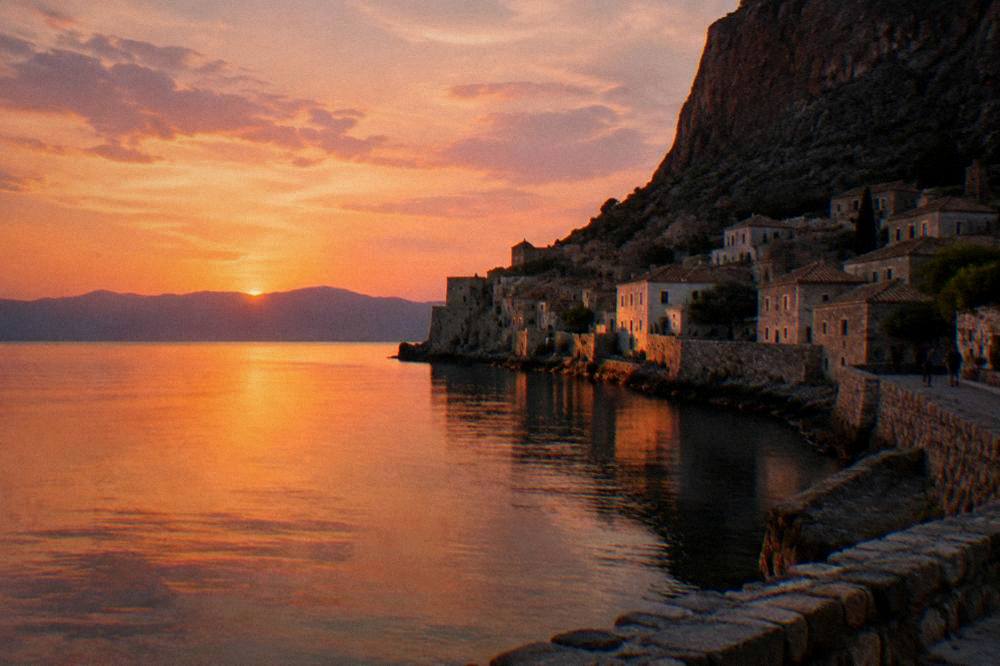
And if Monemvasia has won you over, commit to it properly: one night inside or beside the walls, an evening walk after the day visitors leave, and the drive back broken at Mystras or Nemea. The rock rewards the traveller who slows down; the arithmetic punishes the one who rushes.
Common Questions About Monemvasia From Nafplio
How far is Monemvasia from Nafplio?
Monemvasia is about 208 km by road from Syntagma Square in Nafplio, a computed free-flow drive of about 219 minutes each way. It is the longest day trip from Nafplio that this site covers.
Can you do Monemvasia as a day trip from Nafplio?
Yes, as a full day with an early start: about seven hours and twenty minutes of total driving leaves roughly four to five hours on the rock. An overnight in or near the town is the more comfortable option.
Monemvasia or Mystras from Nafplio?
Mystras is closer, about 124 minutes against about 219, and is a UNESCO-listed ruined Byzantine city; Monemvasia is a preserved walled sea town with a stronger setting. Neither site's admission price is printed on this site, so check the current price on the ticket page before booking.
Is there a bus or train from Nafplio to Monemvasia?
There is no passenger rail anywhere on this route in 2026, and this site's sources hold no direct Nafplio to Monemvasia bus service; the realistic options are a self-driven car or a private arrangement. Confirm any coach connection locally before relying on it.
What is there to see in Monemvasia?
The walled lower town with its stone lanes, houses and medieval churches, the steep stepped path to the ruined upper town on the summit, and the causeway and sea walls on the east face. The rock rises sheer above the sea.
When is the best time to visit Monemvasia from Nafplio?
Late spring to early autumn gives the longest daylight for a one-day plan; the HNMS Argos station, 1980 to 2010, records July mean daily highs of 34.0 C, so on the rock itself, spring and autumn shoulder months are the gentler choice. November shows the highest rainfall in that record, 82.5 mm.