How Do You Pronounce Nafplio?
Nafplio, Nafplion and Nauplion are the same Greek town in the Argolid: how the spellings arose, why Greek place names carry several Latin forms, and what to say when you book.
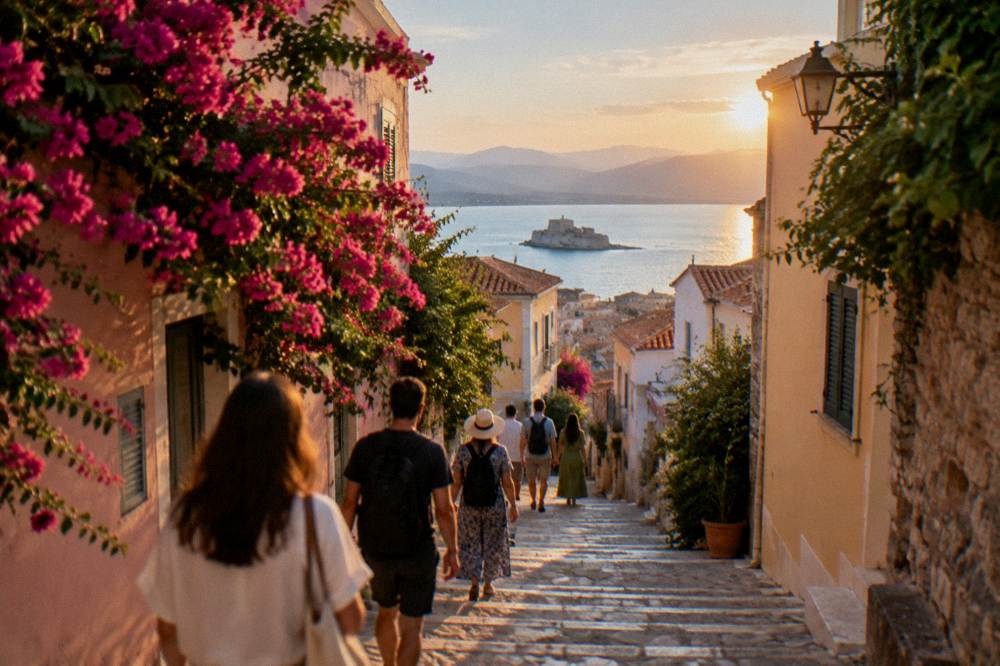
Nafplio is a small coastal town of about 14,500 residents in the Argolid, in the north-east Peloponnese of mainland Greece, sitting on the Argolic Gulf with Palamidi Fortress rising 216 m above the Old Town and Bourtzi, a small fortified islet, anchored in the harbour. It was the first capital of modern Greece, from 1827 to 1834, and it is not an island and not Athens, which lies about 141 km away by road. Its name, however, is spelled three different ways in Latin letters, and that is what confuses travellers who first meet the town on a map, a bus timetable or a festival brochure.
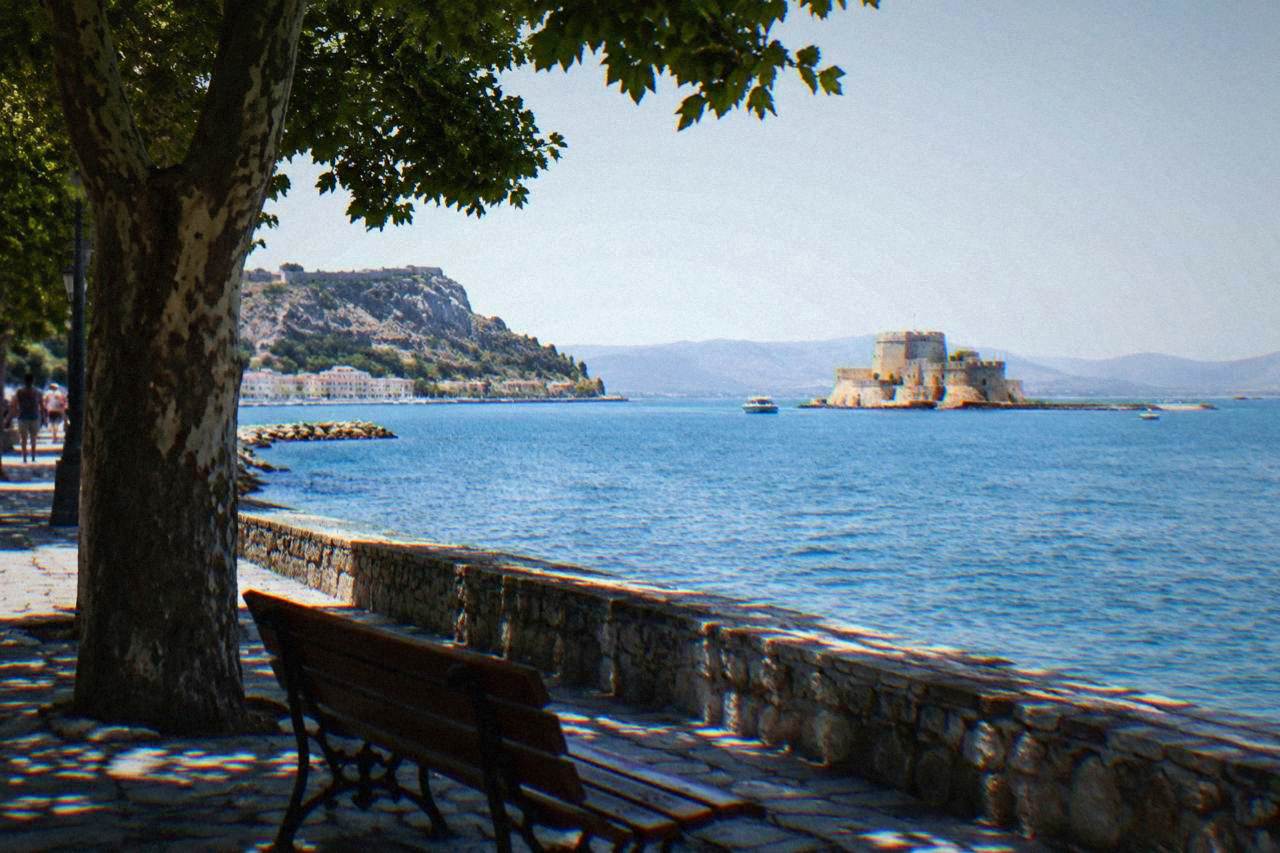
The site spells the town Nafplio throughout, and the municipality's own English pages use that form too. But the spellings Nafplion and Nauplion refer to exactly the same place, and all three appear on signs, tickets and travel listings. Rather than a phonetic lesson, what helps is understanding why Greek names carry several Latin spellings at all, and what the name of this particular town actually means. The Nafplio Travel Guide covers the town in depth; this page settles the name question.
How Do You Pronounce Nafplio?
Nafplio is the standard Latin spelling of the town's Greek name, and Nafplion and Nauplion are alternative Latin spellings of exactly the same town on the Argolic Gulf. Greek place names routinely have several Latin spellings because Greek is written in the Greek alphabet and every published transliteration into Latin letters is a convention, not a correction. The town itself uses one name, and this site follows the spelling Nafplio throughout.
That is the honest, complete answer. No phonetic respelling or stress guide appears on this page, because none is offered by the sources this site reports from, and a hand-made pronunciation key would be exactly the kind of invented fact this site refuses to print. What the sources do say is plain: three Latin spellings circulate for one town, all of them correct, all of them pronounced the same way by the people who live there.
The practical consequence is smaller than the confusion suggests. A bus ticket, a hotel confirmation and a museum guide may each spell the name differently on the same day of your trip, and every one of them will get you to Syntagma Square, the centre of town since the days when Nafplio was the capital of Greece. If you are booking anything, match the spelling used by the operator's live listing rather than worrying about which form is "right".
Why The Same Greek Town Has Three Latin Spellings
The town's name is written in the Greek alphabet, and each Latin spelling reflects a different era of transliteration: Nauplion follows the classical scholarly tradition, Nafplion a modern Greek pronunciation convention, and Nafplio the contemporary form used by the municipality. All three render one and the same name. There is no second town and no rivalry between spellings, only different conventions for moving Greek letters into Latin ones.
Transliteration is the whole story. Greek has letters and letter combinations that Latin scripts reproduce imperfectly, and different eras, different countries and different institutions settled on different solutions. The "au" of the older spelling and the "af" of the newer one are two attempts to write the same sound sequence, just as the final vowel drops away in the contemporary form. You see the same pattern across Greece, and once you recognise it, mixed spellings stop looking like errors.
The practical lesson for a traveller is simple. When you search for tours, transport or tickets, try the other spellings if the first search disappoints, because listings created in different years, or by operators in different countries, may standardise differently. The rest of the time, read all three as one name.
| Latin spelling | Where you are likely to meet it |
|---|---|
| Nafplio | The municipality's English pages and modern travel listings; the form used across this site |
| Nafplion | Older guidebooks, many tour listings and some international signage |
| Nauplion | Classical and scholarly transliteration, and older historical writing |
The trio of spellings is not the only name question travellers ask about the region, and the answers overlap: the same transliteration logic explains Epidaurus appearing inside the place name Palaia Epidavros while the ancient theatre site is written Epidaurus, and it explains why some timetables still carry forms that look antique. For a wider sense of what the town offers once the name is settled, the things to do around Nafplio page is the site's main round-up.
A cycling, sightseeing and tasting outing is a natural first booking in a town this compact, and a guided visit to Mycenae and Epidaurus covers the two headline ancient sites, both UNESCO World Heritage inscriptions, without any driving on your part. A food walk introduces the town through its table, which is also where you will hear the town's name said aloud by the people who live in it, the most reliable pronunciation guide there is.
Where The Name Nafplio Comes From
Local history accounts trace the town's name to Nauplius, a figure of Greek mythology described as a son of Poseidon, and link the name's elements to words for ship and sailing, fitting for a harbour town on the Argolic Gulf. The mythology is reported by local history sources rather than fixed in an official text, so it is best read as tradition rather than fact.
Harbour names across the Greek world often carry maritime roots, and Nafplio's is no exception. A town that served as a Venetian stronghold from 1389, changed hands between Venetian and Ottoman rule twice, and then became the first capital of the new Greek state in 1827 naturally accumulated layers of naming along with layers of fortification. Bourtzi in the harbour was begun in June 1471; Palamidi Fortress above was built by the Venetians and taken by Greek forces in 1822. The name predates all of that by a very long stretch of time.
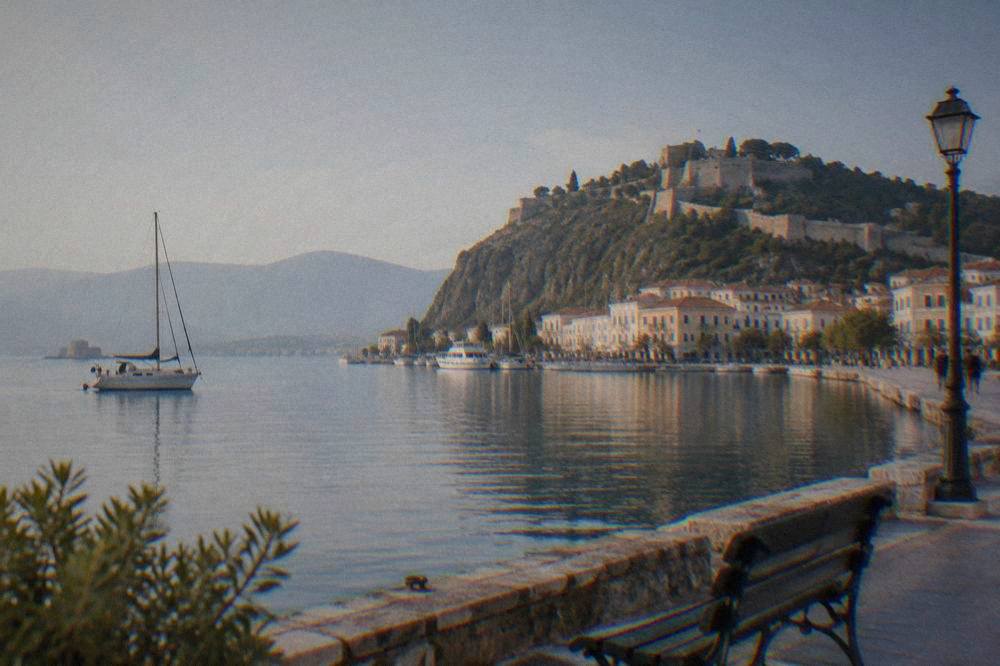
The history matters to the spelling question more than it first appears. Because the town has been written about by Venetian administrators, Ottoman clerks, German scholars, British travellers and Greek municipal officials, each generation of documents latinised the name according to its own rules. The three spellings in circulation today are the survivors of that paper trail. For the full story of the town's decades as capital, and of Governor Kapodistrias, who arrived in 1828 and was assassinated in September 1831 outside the Church of Agios Spyridon, see why Nafplio became the first capital of Greece.
| Layer of the town's past | Era |
|---|---|
| First Venetian rule | From 1389 |
| Second Venetian rule | 1686 to 1715 |
| Greek capture of Palamidi | 1822 |
| Capital of Greece | 1827 to 1834 |
None of that changes how the name is said today, but it explains why a single small town generated so much ink. When a place has been administered from Venice, Istanbul, Athens and its own Syntagma Square, its name travels in more than one suitcase.
Does The Spelling Change What You Can Book In Nafplio?
No: tours, buses and tickets reach the same town whichever spelling a listing uses, and operators' own listings sometimes mix the forms, as with tours titled both "Nafplio" and "Nafplion". What matters is matching the departure point, usually the Old Town or the harbour, and reading what the listing actually includes. The spelling on the voucher is cosmetic.
The practical detail worth attention is a different one: several of the region's headline experiences leave from the town itself, while others collect from Athens, and the title of a listing will not always flag the difference. A Mycenae and Epidaurus itinerary can start from a Nafplio hotel or from an Athens hotel, and both are listed under names that use either spelling of the town. Reading the meeting point line matters far more than decoding the name.
The same applies to food and cooking experiences, boat trips on the Argolic Gulf and walking tours of the Old Town: confirm the meeting point and what is included, and treat the spelling as decoration. If you are still weighing whether the town justifies the journey at all, the site's assessment of whether Nafplio is worth visiting and its guide to how many days you need in Nafplio cover that question directly.
Saying Other Place Names Around Nafplio
The same one-name-several-spellings pattern runs through the whole Argolid: Epidaurus appears inside Palaia Epidavros while this site writes Epidaurus for the ancient theatre, and Tolo, Tiryns and Mycenae each have variant Latin forms on older maps. The rule of thumb is to trust the spelling on the official ticket page you are booking from and expect variety everywhere else.
What helps is knowing that the variants cluster in predictable places: old maps and scholarly texts carry the classical forms, modern listings carry the contemporary ones, and road signage in Greece itself uses Greek letters, so the Latin spelling you carry in your head is the one that matters when you read a sign. The drive times from Syntagma Square tell you how close everything sits: Tiryns is about 9 minutes away by road, Argos about 18, Mycenae about 32 and the theatre at Epidaurus about 41, all computed over standard routing and best treated as free-flow approximations.
| Place near Nafplio | Drive from Syntagma Square (about) |
|---|---|
| Tiryns | 9 minutes |
| Argos | 18 minutes |
| Tolo | 17 minutes |
| Mycenae | 32 minutes |
| Epidaurus theatre | 41 minutes |
| Ancient Corinth | 61 minutes |
Those neighbours are the reason the name question comes up so often: a single day of sightseeing around the Argolid can put four different spellings of four different places in front of you, each with its own transliteration history. Settle on the forms this site uses, which follow the municipality and the Ministry of Culture's English pages, and the rest falls into place. For travellers building a trip around the region, what the Peloponnese is famous for sets the wider scene.
One Name, One Town: Getting It Right Without A Guide
The safest habit is to use the spelling Nafplio when you write and to accept any of the three when you read, because all three name the same town on the Argolic Gulf, the first capital of modern Greece. Booking platforms, bus timetables and museum pages may each prefer a different form, and every one of them will deliver you to the same harbour below Palamidi Fortress.
That habit scales to the whole region. Match the operator's spelling when you book, match the sign's language when you drive, and let the variants coexist peacefully. The town itself is unambiguous: a compact Old Town around Syntagma Square, a fortress reachable by a stairway usually counted at about 850 steps, not the legendary 999, and a harbour where Bourtzi sits within easy sight of the shore, open to visitors who reach it by boat.
A combined cycling, sightseeing and tasting outing threads the whole story together, from the waterfront to the local table, and it is a gentle way to fix the town's geography in your mind on the first day. Once the layout is familiar, the ancient sites and the beaches fall into an obvious order, and the name, however you spell it, stops being a question at all.
Common Questions About Pronouncing Nafplio
How Do You Pronounce Nafplio?
Nafplio is the standard Latin spelling of the town's Greek name, and Nafplion and Nauplion are alternative spellings of the same town. Greek names have several Latin spellings because transliteration from the Greek alphabet is a convention, and this site prints no phonetic guide, only the three forms.
Are Nafplio And Nafplion Different Towns?
No. Nafplio, Nafplion and Nauplion all name the same coastal town of about 14,500 residents in the Argolid, on the Argolic Gulf in the north-east Peloponnese. The spellings reflect different transliteration conventions, not different places.
Which Spelling Should I Use When Booking?
Use whichever spelling the operator's live listing uses, and confirm the meeting point, usually in the Old Town or at the harbour, before you go. The spelling does not change the destination.
Why Do Greek Place Names Have Several Spellings?
Greek is written in the Greek alphabet, and each era and institution has transliterated Greek letters into Latin ones by its own rules. The variants you meet across the Argolid, including Epidaurus within Palaia Epidavros and Epidaurus for the ancient theatre, all follow that pattern.
Where Does The Name Nafplio Come From?
Local history accounts trace it to Nauplius, a mythological figure described as a son of Poseidon, and link its elements to words for ship and sailing, fitting a harbour town. Read this as tradition reported by local sources rather than settled fact.